In the green hills of northern Morocco, not far from the imperial city of Meknes, stand the ruins of Volubilis, the finest Roman site in the country and one of the best-preserved ancient cities in North Africa. Its triumphal arch, colonnaded street and superb floor mosaics mark the far western edge of the Roman world.
Volubilis was a wealthy provincial city, grown rich on the olive oil and grain of its fertile surroundings. Long after Rome withdrew, it remained inhabited and even briefly became a capital, making it a bridge between the ancient and the Islamic history of Morocco.

Table of Contents
- Rome’s Outpost in Morocco
- Volubilis and the Kingdom of Mauretania
- The Triumphal Arch of Caracalla
- The Capitol and Forum
- The Basilica
- The Decumanus Maximus
- Magnificent Mosaics
- Olive Oil and the City’s Wealth
- From Rome to Idris and Islam
- Earthquake, Rediscovery, and UNESCO
- Getting There
- Nearby Places
- Closing Thoughts
Rome’s Outpost in Morocco
Volubilis lay near the southwestern frontier of the Roman Empire, in the province of Mauretania. It was one of the most remote important cities of the Roman world, yet it enjoyed the full range of Roman urban life.
Its ruins spread across a hillside above a fertile plain, preserving streets, houses, public buildings and monuments. The setting, amid rolling green country, is as beautiful as the ruins are impressive.

Volubilis and the Kingdom of Mauretania
Before it became fully Roman, Volubilis was an important town of the Berber and later the client kingdom of Mauretania, whose kings ruled under Roman influence. It already had a long history when Rome annexed the region.
Under Roman rule it flourished as a prosperous city with a mixed population of Berbers, Romans, Greeks, Jews and others. This blend of peoples gave Volubilis a rich and cosmopolitan character.
The Triumphal Arch of Caracalla
The most famous monument of Volubilis is its triumphal arch, built in honour of the emperor Caracalla in the early third century AD. Restored in modern times, it stands astride the main street as the symbol of the city.
Once topped with a bronze chariot and decorated with statues and inscriptions, the arch marked the grandeur of Volubilis at its height. It remains the first great sight to greet visitors today.
The Capitol and Forum
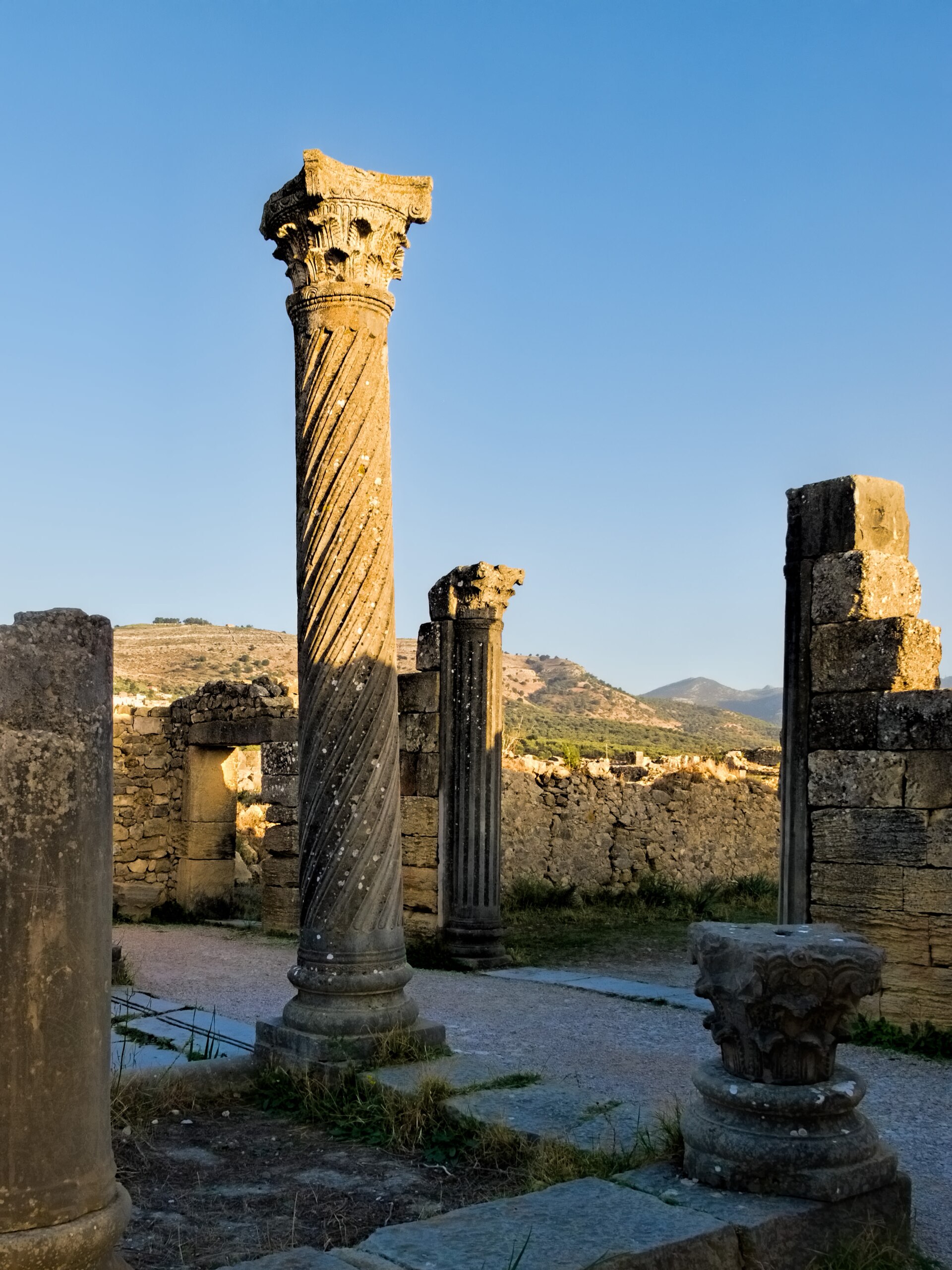
At the civic heart of Volubilis stood the Capitol, a temple dedicated to the great Roman gods Jupiter, Juno and Minerva, its columns still rising above the ruins. Beside it lay the forum, the public square of the city.
Here the citizens gathered for business, politics and religion, surrounded by temples, statues and inscriptions. The Capitol’s re-erected columns are among the most striking features of the site.

The Basilica
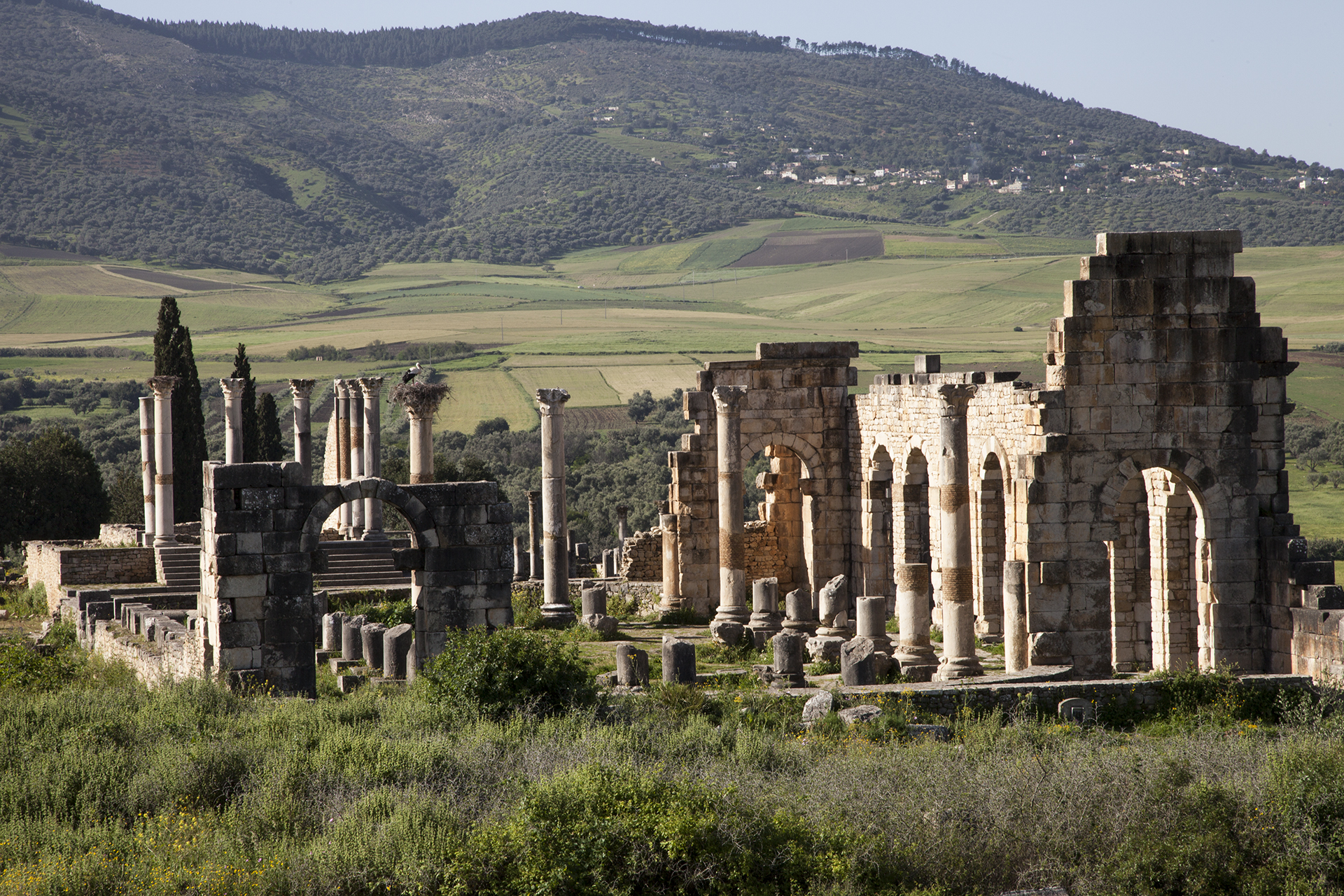
Next to the forum stands the basilica, a large roofed hall used as a law court and for public business. Its rows of arches and columns, partly restored, give a powerful impression of Roman civic architecture.
The basilica was one of the grandest buildings in the city, reflecting the importance of law and administration in Roman life. Storks often nest atop its columns today.

The Decumanus Maximus
The main street of Volubilis, the Decumanus Maximus, runs through the city lined with columns, shops and the entrances to grand houses. Walking it gives a vivid sense of the city in its prime.
Along this avenue stood the mansions of the wealthy, whose ruins still contain the treasures for which Volubilis is most famous: its mosaics.
Magnificent Mosaics
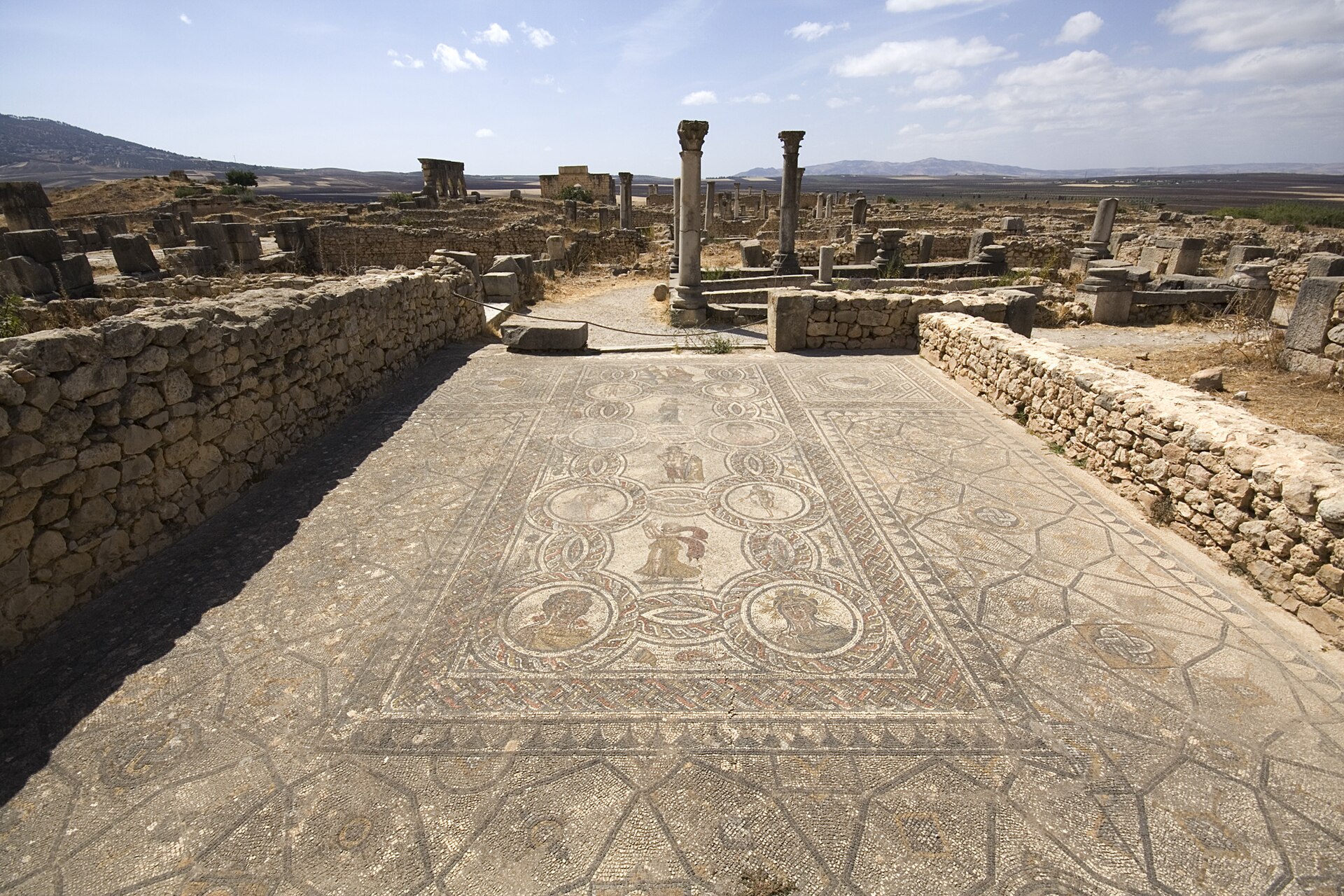
Volubilis is celebrated above all for its floor mosaics, many of which remain in place in the ruins of the houses. They depict scenes from mythology, gods, animals and daily life in rich detail and colour.
Famous examples show Orpheus charming the animals, the labours of Hercules and the goddess Diana bathing. These mosaics are among the finest surviving anywhere in the Roman world and reveal the wealth and taste of the city’s elite.

Olive Oil and the City’s Wealth
The prosperity of Volubilis was built on agriculture, above all the olive. The surrounding hills were covered in olive groves, and the city was full of presses for extracting the valuable oil.
Many of these stone olive presses survive among the ruins. The oil was traded across the Roman world, bringing the wealth that paid for the city’s grand houses and their beautiful mosaics.

From Rome to Idris and Islam
Unlike many Roman cities, Volubilis was not abandoned when Roman power faded. It remained inhabited for centuries, and in the eighth century it became associated with Idris I, the founder of the first Moroccan Muslim dynasty.
For a time it served as a base for this new Islamic kingdom, before the nearby city of Fez rose to prominence. Volubilis thus links the Roman and Islamic chapters of Moroccan history.
Earthquake, Rediscovery, and UNESCO
Volubilis was eventually abandoned, and much of its stone was later carried off to build the nearby city of Meknes. A great earthquake also damaged the ruins. Yet enough survived to preserve its remarkable character.
Excavated from the late nineteenth century, Volubilis was inscribed on the UNESCO World Heritage List in 1997. Today it is Morocco’s most impressive Roman site and a popular destination for visitors.
Getting There
Volubilis lies in northern Morocco, near the town of Moulay Idriss and about thirty kilometres from the imperial city of Meknes. Meknes and the nearby city of Fez are the usual bases for a visit.
The site is easily reached by road, and is often combined with a visit to the holy town of Moulay Idriss and the historic cities of Meknes and Fez. A small museum and marked paths guide visitors around the ruins.
Coordinates: 34.0742, -5.5556 — open Volubilis in Google Maps.
Nearby Places
- Timgad — another superbly preserved Roman city of North Africa, further east in Algeria.
- Leptis Magna — the grandest Roman city of North Africa, on the Libyan coast.
- Carthage — the great earlier power of North Africa whose lands Rome inherited and cities like Volubilis replaced.
Closing Thoughts
Volubilis is Rome at the western edge of its world: a wealthy provincial city of triumphal arch, colonnaded street and dazzling mosaics, set among the green hills of Morocco.
Inhabited long after Rome withdrew and linked to the birth of Islamic Morocco, it bridges two great chapters of history. Its mosaics and monuments make it one of the finest and most beautiful ancient sites in all of Africa.