In the driest desert on Earth, where some weather stations have never recorded a drop of rain, a people has managed not just to survive but to build oasis towns, farm terraced fields, and maintain trade networks stretching from the Pacific coast to the high Andean plateau. They call themselves the Likan Antai, though most of the world knows them by the name of the desert they call home: the Atacameno.
For more than three thousand years, Likan Antai communities have clustered around the rare rivers and underground water sources that cut through the Atacama, building a civilization uniquely adapted to scarcity. Long before Spanish colonization, and even before Inca expansion reached this far south, Atacameno farmers and traders had already turned isolated desert oases into thriving centers of agriculture and exchange.
This is the story of the Atacameno: their deep origins in the desert oases, what their names, both self-given and externally applied, actually mean, the fate of their language, the extraordinary homeland that shaped them, their old way of farming and trading life, their society and beliefs, their traditions and crafts, their food, their festivals, the history of conquest and modern mining, and where the Likan Antai stand today.
- Deep Origins in the Desert Oases
- Likan Antai and Atacameno, Two Names
- A Language Nearly Gone Silent
- The Driest Homeland on Earth
- The Old Life of Farming and Trade
- Society Built Around Water
- Belief Tied to Mountain and Lagoon
- Landscape Woven Into Culture
- Weaving and Everyday Craft
- Food of the Oasis
- Festivals of the High Desert
- Conquest, Mining, and Change
- The Likan Antai Today
Deep Origins in the Desert Oases

Archaeological evidence places human presence in the Atacama region back tens of thousands of years, with the ancestors of today’s Likan Antai developing settled oasis communities roughly three thousand years ago, drawing on the small but reliable rivers descending from the Andes to sustain agriculture in an otherwise near-lifeless desert landscape.
San Pedro de Atacama, still the cultural center of Likan Antai life today, sits atop archaeological layers documenting continuous habitation stretching back millennia, including some of the best-preserved pre-Columbian textiles, mummies, and artifacts in South America, remarkably conserved by the desert’s extreme dryness.
Distinct from the Diaguita to the south, though sharing some cultural and trade connections, the Atacameno developed their own settlement pattern centered on scattered oasis villages called ayllus, each drawing on a specific water source and connected to neighboring communities through trade rather than unified political authority.
By the time Inca administrators reached the region in the fifteenth century, Likan Antai communities were already deeply experienced desert farmers and traders, knowledge that made them valuable, semi-autonomous partners within the empire’s southern frontier rather than a population easily displaced or reorganized.
Chinchorro mummification practices, among the oldest known intentional mummification traditions in the world, predating ancient Egyptian practices by roughly two thousand years, developed along the neighboring Pacific coast and influenced burial customs in Atacameno territory, illustrating how deeply interconnected the region’s ancient cultures were despite the harsh terrain separating them.
Likan Antai and Atacameno, Two Names

“Atacameno,” the more widely used external name, derives simply from the Atacama Desert itself, a Spanish colonial-era label describing the people according to the forbidding landscape they inhabited rather than any term the community used to describe itself.
“Likan Antai,” increasingly preferred in cultural and political contexts today, translates roughly to “inhabitants of the land” in the Kunza language, reflecting a self-identification tied directly to territory and belonging rather than to the desert’s reputation for emptiness and hardship as seen by outsiders.
This dual naming reflects a broader pattern seen among Indigenous nations across the Americas, where a name assigned by colonizers or outside observers, describing landscape or perceived character, became the historically dominant term, while a community’s own self-designation carries different, often more dignified, meaning.
Today both names circulate, with “Atacameno” remaining common in general and international usage, while “Likan Antai” appears increasingly in official Chilean government documents, cultural organization names, and community-led educational material as part of a broader push toward self-determined terminology.
A Language Nearly Gone Silent

Kunza, the traditional Likan Antai language, is now considered dormant as a spoken first language, with the last fully fluent native speakers believed to have died in the mid-twentieth century, though a substantial body of vocabulary, place names, and ritual phrases survived through documentation and community memory.
Kunza is classified as a language isolate, meaning it shows no clear, confirmed relationship to any other known language family, a linguistic mystery that has drawn sustained interest from historical linguists working to understand the deep, ancient roots of Andean and South American language diversity.
Certain Kunza words and phrases survived embedded within Spanish-language religious and ceremonial contexts in Atacameno communities, preserved almost accidentally through ritual repetition even as everyday conversational use of the full language disappeared over previous generations.
In recent decades, Likan Antai cultural organizations, working with linguists, have compiled Kunza dictionaries and educational material aimed at reviving at least partial language knowledge among younger community members, treating language recovery as a central pillar of broader cultural reassertion.
Linguistic reconstruction of Kunza has relied heavily on a small number of colonial and early twentieth-century word lists compiled by missionaries and travelers, supplemented by ongoing analysis of surviving place names across the region, a painstaking process that has slowly expanded documented vocabulary even without any living fluent speakers to consult directly.
The Driest Homeland on Earth

The Atacama Desert holds the distinction of being the driest non-polar desert on the planet, with some interior areas receiving virtually no measurable rainfall for years or even decades at a time, a level of aridity that makes the oasis settlements of the Likan Antai all the more remarkable as sustained centers of agriculture and community life.
Despite this extreme dryness, the region contains a surprising range of dramatic landscape features, including the geysers of El Tatio, one of the highest-altitude geyser fields in the world, high-altitude salt flats dotted with flamingo colonies, and the eerily lunar landscape of the Valle de la Luna near San Pedro.
Rivers descending from the Andes, though small by global standards, provide the essential water that makes Likan Antai oasis agriculture possible, supporting terraced fields and orchards in narrow green corridors that stand in stark visual contrast to the vast, barren desert surrounding them.
This environment, simultaneously one of the harshest and most visually stunning on Earth, has increasingly drawn international tourism and, more consequentially, large-scale lithium and copper mining operations, both of which now shape the economic and environmental reality of Likan Antai communities in ways their ancestors could scarcely have imagined.
ok 1-4The Old Life of Farming and Trade

Likan Antai subsistence relied on carefully irrigated agriculture within the oases, growing maize, quinoa, beans, and squash on terraced plots watered through canal systems diverted from local rivers, supplemented by llama herding on the surrounding puna grassland at higher elevation.
Beyond farming, the Atacameno built an extensive trade identity, with llama caravans linking desert oases to the Pacific coast, where fish, shellfish, and guano could be exchanged, and to the high Andean altiplano, where highland goods including wool, dried meat, and later Bolivian silver moved through Atacameno-controlled routes.
This position as intermediaries between coast, desert, and highland gave Likan Antai communities an economic role disproportionate to their population size, and archaeological evidence of imported goods found in Atacameno graves and settlements confirms a trade network stretching hundreds of kilometers in multiple directions.
Following Inca incorporation, this existing trade infrastructure was absorbed into the empire’s broader logistics network, with Atacameno oases serving as way stations along Inca roads connecting the northern and southern reaches of the empire, a role that continued in modified form under later Spanish colonial trade patterns.
Society Built Around Water

Likan Antai social organization centered on the ayllu, a community structure tied to a specific water source and its associated agricultural land, with membership determining rights to irrigation water on a carefully managed rotation system essential to fair and sustainable desert farming.
Water rights, formalized through customary law passed down over generations, remain a defining feature of Likan Antai community organization today, with traditional water councils in some oasis villages still managing irrigation schedules alongside, or sometimes in tension with, modern Chilean water rights regulations.
Leadership historically combined practical water and agricultural management responsibility with ceremonial and religious duties, since maintaining proper relationships with mountain and water spirits was considered directly connected to the community’s continued agricultural survival in such an unforgiving environment.
Extended family networks spanning multiple oasis villages helped manage risk, since a drought or water shortage affecting one community could sometimes be offset through kinship ties and reciprocal support from relatives in a different, better-watered oasis elsewhere in Likan Antai territory.
Modern astronomical observatories including ALMA, one of the largest radio telescope arrays in the world, now operate on the high Atacama plateau, drawn by the same extraordinarily clear, dry air that Likan Antai skywatchers relied on centuries earlier, creating an unusual juxtaposition between cutting-edge international science and ancestral desert knowledge sharing the same land.
Belief Tied to Mountain and Lagoon
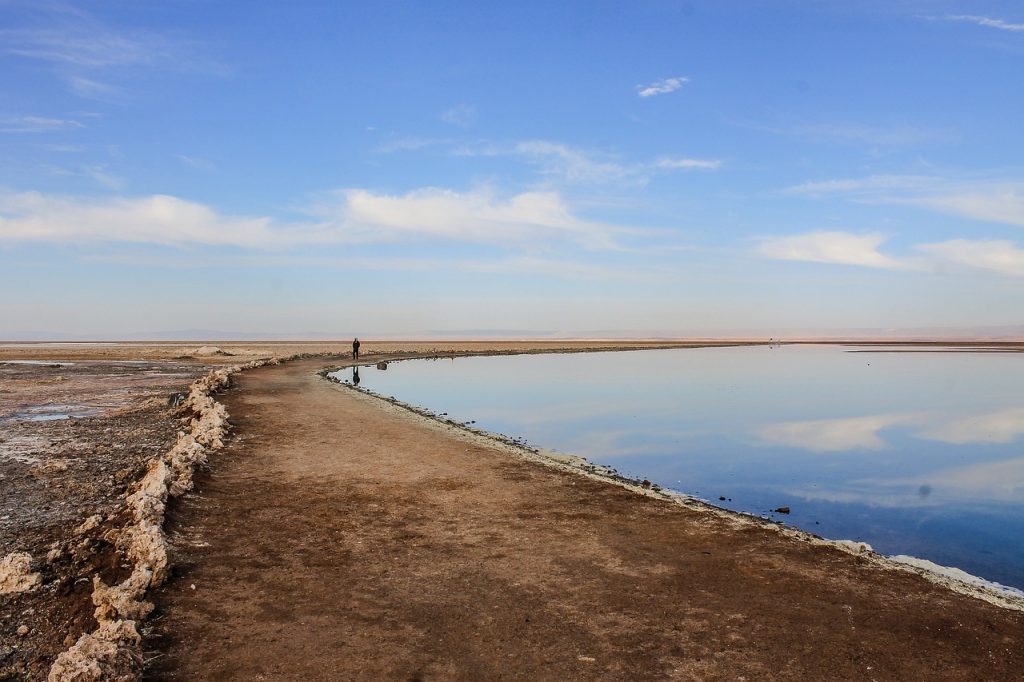
Likan Antai spirituality centers on reverence for mountains, particularly prominent peaks visible from oasis villages, believed to control weather and water availability, alongside sacred lagoons and rivers treated as living entities deserving careful ritual respect rather than simply practical resources.
Water ceremonies, timed to the agricultural calendar, involve offerings intended to ensure continued flow from mountain snowmelt and springs, reflecting a direct, practical link between religious practice and the community’s literal survival in a landscape where water scarcity remains a constant, serious concern.
Catholicism, introduced during Spanish colonization, blended with these existing beliefs to produce distinctive local religious practice, visible today in the adobe churches of oasis towns like San Pedro, where Catholic feast days often incorporate elements of older water and mountain veneration.
Talatur, a traditional cleaning and maintenance ceremony for irrigation canals performed communally each year, exemplifies this blend of practical necessity and ritual observance, treating essential agricultural infrastructure maintenance as an occasion for community bonding and spiritual renewal rather than mere labor.
ok 5-7Landscape Woven Into Culture

Distinctive natural landmarks across Likan Antai territory, from the Valle de la Luna to specific mountain peaks and lagoons, carry names, stories, and ritual associations that tie community identity directly to particular places, reinforcing a worldview in which land and culture are treated as inseparable.
Traditional clothing, including hats and garments woven from llama and alpaca wool, historically indicated village origin and social role through specific patterns and colors, a visual language of belonging that some communities have worked to document and revive alongside broader language and craft recovery efforts.
Astronomy held practical and spiritual importance for Likan Antai communities, whose extremely clear desert skies allowed detailed observation of stars and planets used to time agricultural activity, a tradition that connects meaningfully to the region’s modern reputation as one of the world’s premier locations for professional astronomical observatories.
Contemporary Likan Antai cultural organizations increasingly partner with these same observatories and research institutions, arguing that traditional astronomical knowledge deserves recognition alongside cutting-edge telescope science being conducted literally on ancestral land.
Weaving and Everyday Craft

Textile weaving using llama and alpaca wool remains an important Likan Antai craft, produced on traditional looms to create blankets, ponchos, and bags decorated with geometric patterns whose specific designs can indicate community origin or family tradition.
Pottery, though less internationally celebrated than the painted ceramics of neighboring cultures like the Diaguita, was also produced by Atacameno communities, typically simpler in decoration but well suited to the practical storage needs of oasis agricultural life.
Basketry using local plant fiber, along with leatherwork from llama hide, rounded out the practical craft tradition, producing items essential for both everyday household use and the extensive trade networks that connected Atacameno oases to distant regions.
Today, craft cooperatives in San Pedro de Atacama and surrounding villages sell traditional textiles and other goods to a growing tourism market, providing income while also serving as an active means of keeping specific weaving techniques and patterns in practical, ongoing use rather than purely museum preservation.
Some Likan Antai communities maintain specific ritual calendars tied closely to the agricultural cycle, with distinct ceremonies marking planting, the arrival of irrigation water down mountain channels, and harvest, each involving offerings and communal participation intended to maintain proper balance between human activity and the desert’s scarce natural resources.
Food of the Oasis

Maize, quinoa, beans, and squash formed the agricultural core of the traditional Likan Antai diet, grown in irrigated oasis plots and supplemented by llama meat and, historically, dried fish and shellfish obtained through trade connections with coastal communities.
Chanar and algarrobo, native trees producing edible pods, provided important supplementary food and could be processed into flour or fermented beverages, extending the food supply beyond what irrigated cropland alone could produce in such a harsh environment.
Salt, abundant in the region’s natural flats, was both a practical seasoning and an important trade good, exchanged with highland and coastal communities for goods unavailable in the desert, reflecting how even the Atacama’s most extreme features could be turned into economic opportunity.
Modern Atacameno cuisine continues to draw on these staples, with restaurants in San Pedro de Atacama increasingly showcasing quinoa, llama meat, and native desert plants as a point of cultural pride rather than simply historical curiosity, appealing to both community members and curious visitors.
ok 8-10Festivals of the High Desert

The Talatur canal-cleaning ceremony mentioned earlier doubles as a major community festival, combining practical irrigation maintenance with music, food, and celebration marking the start of the agricultural season, a fusion of labor and festivity typical of Likan Antai cultural life.
Carnival season brings costumed dance and music to oasis towns, blending Catholic calendar observance with older seasonal and agricultural themes, performed by community dance groups whose choreography and costume often reference specific local landscape features or ancestral stories.
Patron saint festivals, introduced through Spanish colonization, remain significant community events in towns like San Pedro de Atacama, incorporating processions, traditional food, and craft display, while frequently retaining older elements of water and mountain veneration within the officially Catholic celebration.
Astronomical events, including solstices, have also become occasions for community and increasingly tourist-oriented celebration, drawing on the region’s deep tradition of skywatching and its modern reputation as a global center for astronomical research and observation.
Conquest, Mining, and Change

Inca incorporation in the fifteenth century brought Atacameno oases into the empire’s administrative and trade network with relatively limited disruption compared to more centralized societies further north, given the existing sophistication of Likan Antai desert agriculture and trade infrastructure.
Spanish colonization beginning in the sixteenth century proved considerably more disruptive, imposing forced labor obligations and new land arrangements, though the extreme aridity and remoteness of much Atacameno territory meant colonization here unfolded somewhat differently than in more densely populated, resource-rich regions of the Spanish empire.
The nineteenth and twentieth centuries brought a new transformation through large-scale mining, first nitrate and later copper and lithium extraction, which reshaped the region’s economy, drew large non-Indigenous populations into the area, and created ongoing tension over water use between mining operations and traditional Likan Antai agricultural communities dependent on the same scarce water sources.
Lithium mining in particular, driven by global demand for batteries, has become an intensely debated issue in recent years, with Likan Antai communities and environmental advocates raising serious concerns about the industry’s heavy water consumption in a region where every liter has historically been treated as a precious, carefully managed resource.
Water conflicts between mining companies and Likan Antai communities have occasionally reached Chilean courts, with community organizations arguing that customary water rights, some documented in colonial-era records, deserve legal protection equal to or greater than modern industrial water permits, a legal battle with significant implications for Indigenous water rights across Chile more broadly.
The Likan Antai Today

Chile formally recognized the Atacameno as an official Indigenous people in 1993, part of a broader national Indigenous rights law that has since supported land claims, cultural programming, and bilingual education initiatives in oasis communities across the region.
Educational programs in San Pedro de Atacama and other oasis towns now include Kunza vocabulary and Likan Antai history as part of local school curricula, a relatively recent development reflecting Chile’s broader, gradual shift toward incorporating Indigenous perspectives into mainstream education rather than treating such history as a separate, optional subject.
Tourism, centered heavily on San Pedro de Atacama’s dramatic surrounding landscapes, has become both an economic opportunity and a source of tension, providing income and cultural visibility while also raising concerns about water strain, cultural commodification, and rapid, sometimes poorly regulated development in a fragile desert environment.
Likan Antai community organizations today work actively on multiple fronts simultaneously: defending water rights against mining and tourism pressure, reviving Kunza language knowledge, documenting traditional textile and craft techniques, and asserting a role in decisions about resource extraction happening on their ancestral land.
The story of the Likan Antai illustrates a particular kind of resilience, not the story of a hidden or isolated people but of a population that has spent three thousand years turning one of Earth’s most hostile environments into a home, and that now insists on shaping how that same demanding, valuable landscape is used going forward. Much further north, along the arid coastline of Colombia and Venezuela, the Wayuu carry forward their own distinct story of desert survival and cultural persistence.
Continuing the Journey
The Likan Antai add another chapter to an ongoing look at Indigenous nations across the Americas. Explore more of these stories:
- The People Who Emerged Into This World, the Story of the Navajo
- The People Who Never Left the Mountains, the Story of the Quechua
- The People Who Never Vanished, the Story of the Maya
- The People of the Seven Council Fires, the Story of the Lakota
- The People of the Land Who Were Never Conquered, the Story of the Mapuche
- The People of Ice and Sea, the Story of the Inuit
- The Islands of the People, the Story of the Haida
- The Four Directions People, the Story of the Cree
- The Principal People, the Story of the Cherokee
- The People of the Timeless Speech, the Story of the Aymara
- The People Whose Language Became a Nation, the Story of the Guarani
- The People of the Big Feet, the Story of the Tehuelche
- The People Rediscovered by Their Own Nation, the Story of the Diaguita
You May Like
The Damara, an Ancient People of Namibia


One thought on “Likan Antai: Life at the Edge of the Driest Desert on Earth”