High in the Peruvian Andes, at nearly 3,200 metres above sea level, where two rivers meet in a narrow valley hemmed in by mountains, there is a temple that was built to unsettle you. That was the whole point. Nearly three thousand years ago, long before the Inca, before Machu Picchu was even imagined, the people of Chavin de Huantar constructed a stone sanctuary designed as a kind of machine for producing awe. You would arrive as a pilgrim, tired from the mountain trails, and everything about the place, the carved monsters glaring from the walls, the dark twisting passages, the roar of hidden water, would be arranged to make you feel that you had stepped into the presence of something not quite human.
Chavin is one of those sites that quietly rearranges your sense of the past. We tend to think of the great civilisations of the Andes as the Inca and maybe, if we’ve read a little, the societies that came just before them. But Chavin flourished more than two thousand years before the Inca rose. For several centuries it was arguably the most important religious centre in the Andean world, drawing pilgrims from across a huge region and spreading its distinctive art and iconography far beyond its valley. Archaeologists talk about a “Chavin horizon,” a moment when a single style and set of beliefs spread across much of what is now Peru. And it all radiated out from this one strange temple in the mountains.
I find Chavin endlessly fascinating because it wasn’t a city in the ordinary sense, and it wasn’t an empire. It was something rarer: a place whose power was almost entirely religious. No army held its territory. No king taxed distant provinces. Instead, people came, willingly, drawn by whatever happened inside those walls, and they carried the experience home with them. Understanding how a temple could do that, without conquest, is one of the great puzzles of early Andean history.
- A temple in the mountains
- How old is Chavin, really?
- The Lanzon: meeting the god in the dark
- The labyrinth beneath the temple
- The tenon heads and the art of transformation
- Engineering fear: water, sound, and light
- A religion without an empire
- Visions, cactus, and the shamans
- Rediscovering Chavin
- Reading the stone carvings
- Why Chavin faded
- Why Chavin still matters
A temple in the mountains
Chavin de Huantar sits in the Conchucos valley, in the highlands of what is now the Ancash region of Peru, close to where the Mosna and Huachecsa rivers come together. The setting is not an accident. This was a crossroads, a natural meeting point of routes linking the coast, the highlands, and the tropical lowlands to the east. People and goods moving between these very different worlds would have passed nearby, and Chavin planted itself right at that junction, perfectly placed to gather pilgrims from many directions.
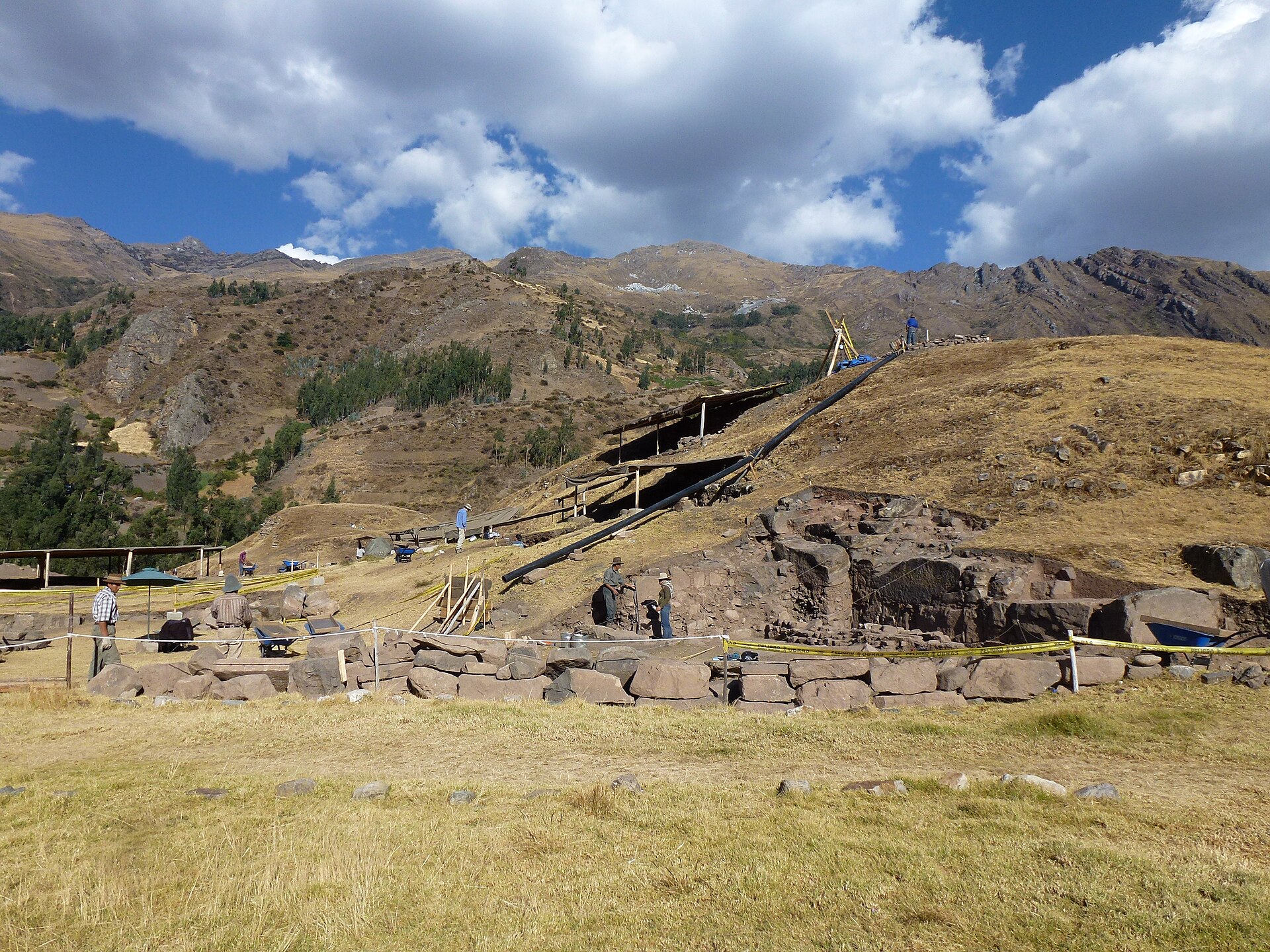
The heart of the site is a complex of flat-topped platform mounds, built up over time from cut stone and rubble, arranged around sunken plazas. The largest of these mounds is often called the Castillo, or the Old Temple and New Temple in archaeological shorthand, because the place was rebuilt and expanded across its long history. From the outside, these platforms look solid, almost like natural terraces of the mountain. The secret of Chavin is that they are not solid at all. They are riddled with passages.
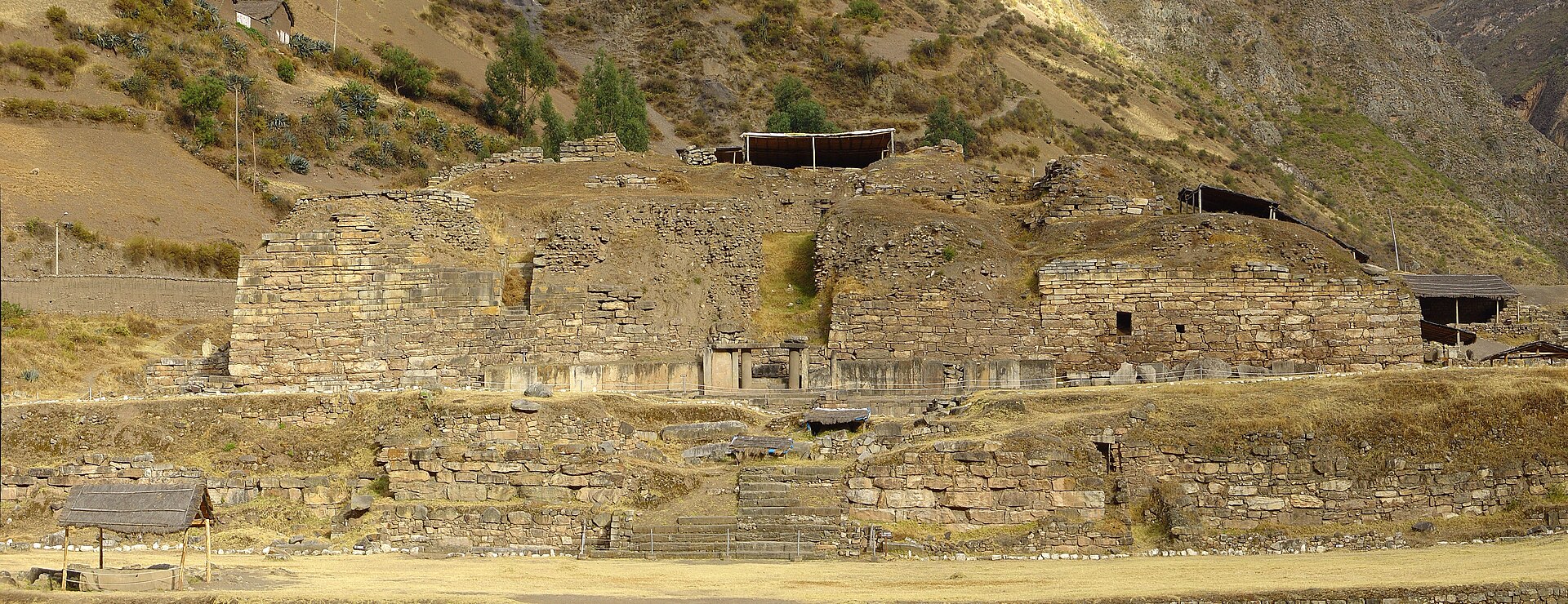
In front of the main structures lie plazas, including a striking circular sunken court, where large numbers of people could gather. You can picture the choreography: crowds assembling in the open plaza, and then, one by one or in small groups, select individuals being led away from the daylight and into the temple’s interior, into a very different and far more disorienting world. Chavin was built around that contrast, between the public and the hidden, the bright and the dark.
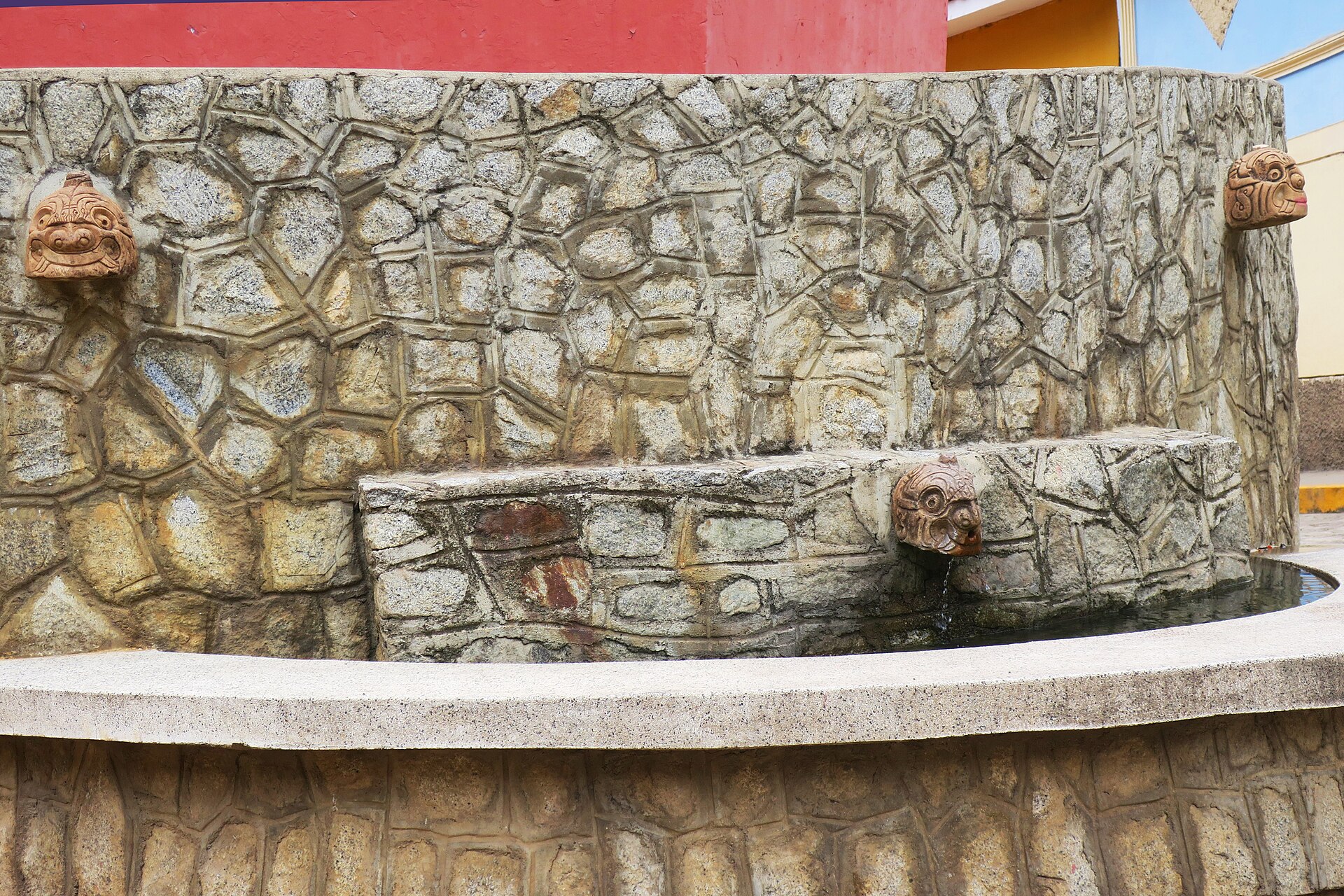
How old is Chavin, really?
Chavin de Huantar had a long life. Construction and use of the ceremonial centre span roughly 1200 to 500 BCE, with some activity earlier and later at the margins, and its period of greatest influence falling in the later part of that range. To put that in perspective, when Chavin was at its height, the Roman Republic was still centuries in the future, and the Andes would not see the Inca for well over a thousand years more.
That deep antiquity is exactly why Chavin matters so much to archaeologists. For a long time it was thought to be the “mother culture” of Andean civilisation, the fountainhead from which everything later flowed. We now know the picture is more complicated, because there were impressive societies on the Peruvian coast even earlier, building monumental centres of their own. But Chavin still holds a special place. Its art and religious ideas spread so widely, and echoed so long in later Andean cultures, that it really does function as a kind of shared ancestor for much of what came after.
The site was rebuilt in stages, and archaeologists distinguish an earlier temple from a later, expanded one. This wasn’t a place raised in a single burst and then left alone. Generations kept adding to it, reshaping it, extending its galleries and plazas. That ongoing investment tells you how central Chavin was to the people who maintained it, across a span of time longer than most nations have existed.
The Lanzon: meeting the god in the dark
At the very centre of the old temple, buried deep inside the stone platform where the narrow galleries cross, stands the single most important object at Chavin: the Lanzon. It is a carved granite monolith, more than four metres tall, wedged into a cramped gallery so tightly that it passes right through the ceiling into the space above. You cannot take it in all at once. You meet it in fragments, by the light of a torch, in a passage barely wide enough to turn around in.
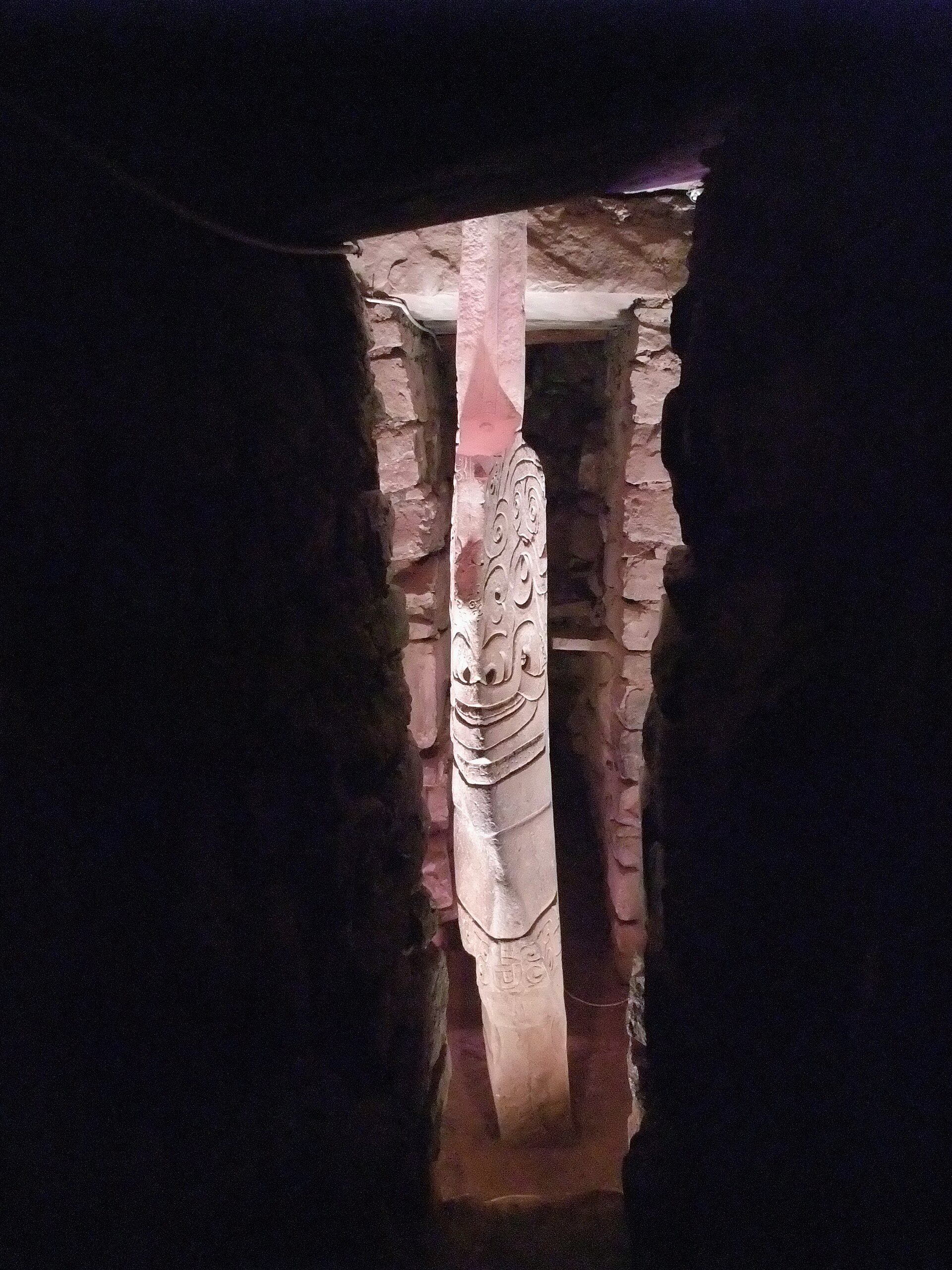
The name Lanzon means “great lance,” because the stone is shaped a bit like a blade or a spearhead driven into the earth. Carved into its surface is a figure that is deliberately hard to categorise: a being with a snarling, fanged mouth, one arm raised and one lowered, hair and eyebrows that turn into snakes, and clawed hands. It fuses human and animal features, especially those of the jaguar or great cat, the caiman, and the serpent, into a single supernatural entity. This is almost certainly the principal deity of Chavin, the god at the heart of the whole cult.
What gives the Lanzon its power is not just the carving but the staging. To reach it, you had to leave the daylight, thread through dark, twisting passages, and arrive, disoriented, in its cramped chamber. The god would loom out of the blackness, lit unevenly, impossibly tall in that tight space. Some researchers think the raised and lowered arms, and the way the figure connects the floor and the ceiling, expressed the deity’s role as a link between different worlds, the underworld, the human realm, and the heavens. Meeting it must have been overwhelming, which is exactly what it was designed to be.
The labyrinth beneath the temple
Those platform mounds at Chavin are not solid masses of stone. Running through them is a network of narrow, stone-lined galleries and passages, a genuine labyrinth threaded through the interior of the temple. These corridors are cramped and mostly dark, with sudden turns, changes of level, and small chambers opening off them. The Lanzon sits at the intersection of some of these passages, at the symbolic heart of the maze.
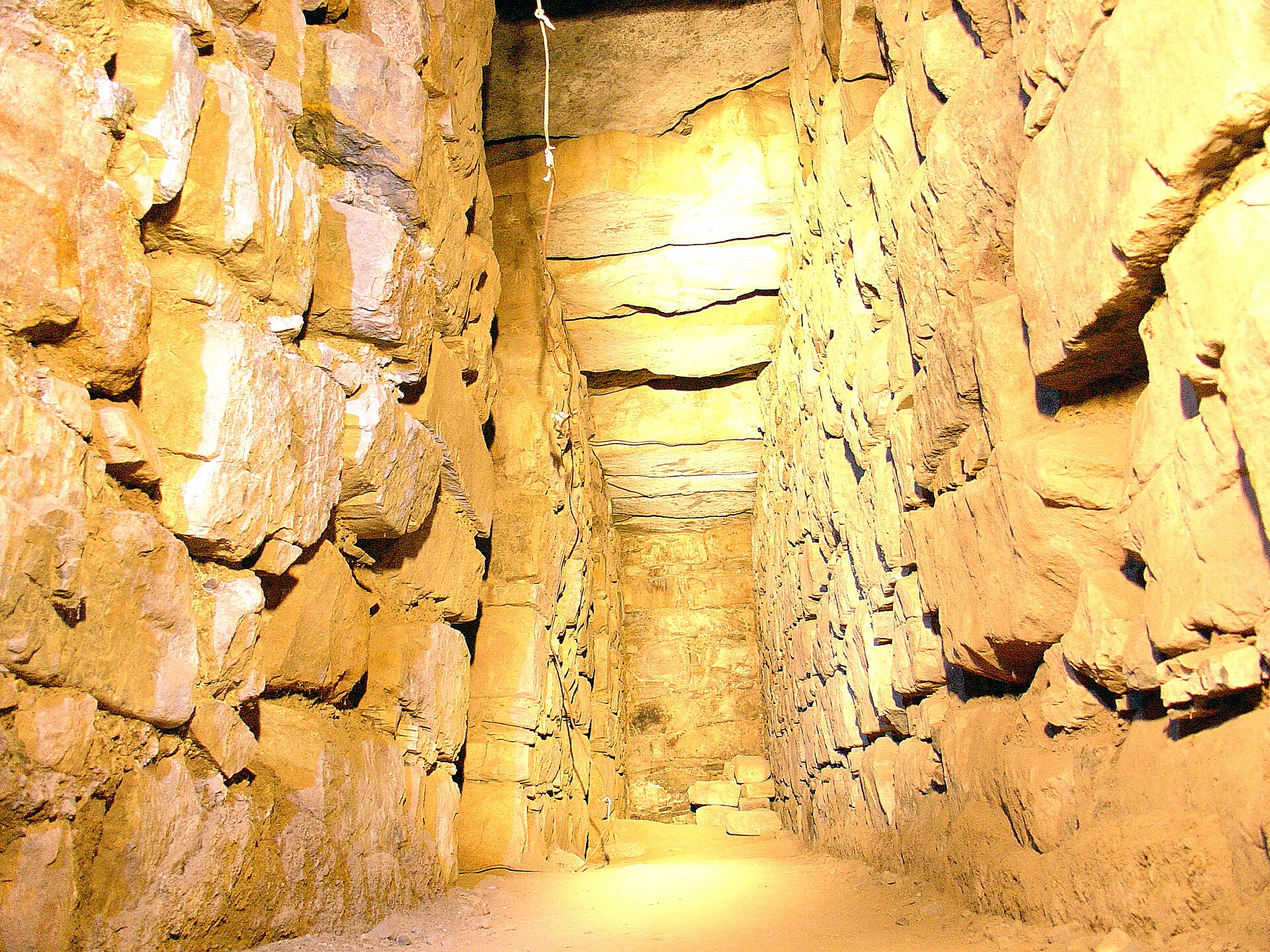
Moving through these galleries would have been a profoundly strange experience. Imagine coming in from the bright, thin mountain air of the plaza into total or near-total darkness, feeling your way along cold stone walls, unsure how far you’d come or where you were headed, with sounds echoing oddly around you. The architecture itself does psychological work. It strips away your bearings and your certainty, and prepares you, emotionally, for whatever revelation waits at the centre.
The galleries also had a practical genius. Built into the temple is a system of ducts and channels, some for ventilation, some for water, that helped the interior function and, as we’ll see, could be turned to dramatic effect. The people who designed Chavin were not just artists and priests. They were engineers who understood how to shape space, air, water, and sound to move the human mind.
The tenon heads and the art of transformation
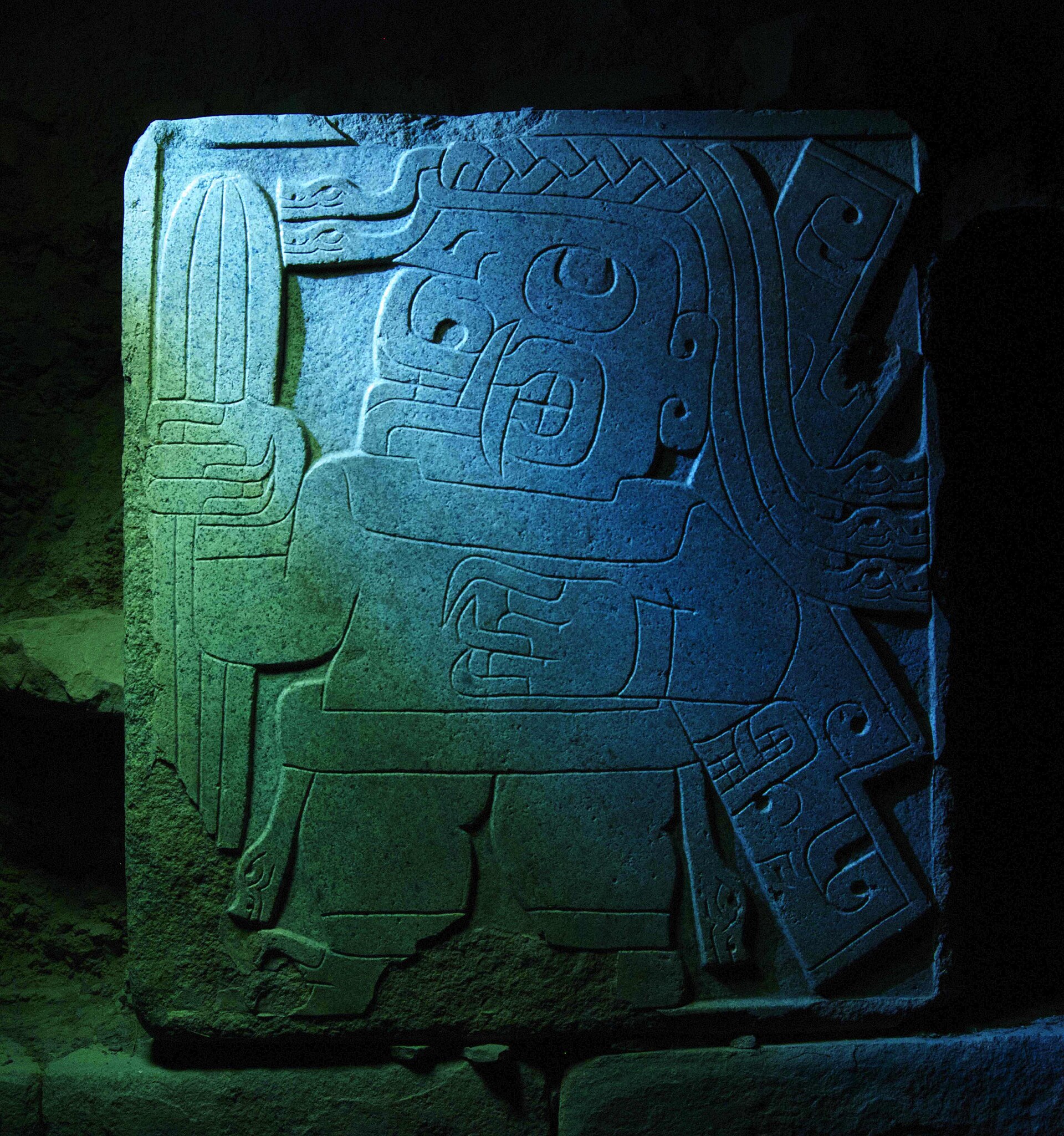
One of the most unforgettable features of Chavin is a series of carved stone heads that once projected from the upper walls of the temple, staring outward. Archaeologists call them tenon heads, or in Spanish cabezas clavas, because each was carved with a long tenon or peg behind it that was set into the masonry, so the face jutted out over anyone below. Only one remains in its original position today, but many survive, and together they are among the eeriest sculptures of the ancient Americas.
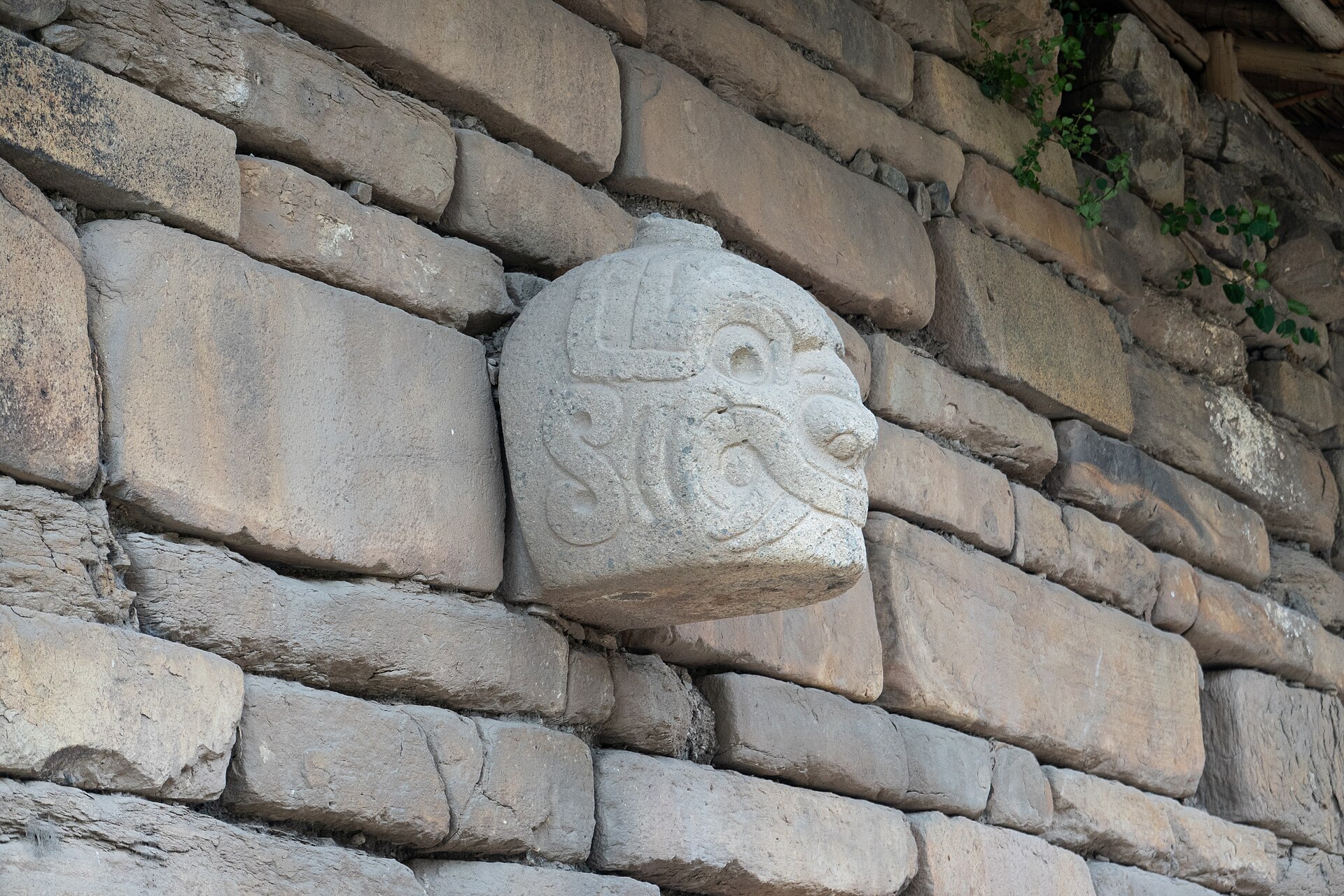
What makes the tenon heads so haunting is that they seem to show a transformation in progress. Some have relatively human faces. Others are clearly animal, snarling like cats or hawks. And a striking number appear to be caught midway between, with human features dissolving into fangs and snouts, sometimes with mucus streaming from the nose, wrinkled skin, and bulging eyes. Many scholars read these as depictions of a shaman in the act of becoming an animal, the human self giving way to a powerful animal spirit. They are, in effect, portraits of a religious experience frozen in stone.
This idea of transformation runs through all of Chavin art. The carvings love to combine creatures, to blur the line between human and beast, predator and prey, this world and another. Faces hide inside patterns; look again and an eye becomes a mouth, a strand of hair becomes a snake. The style rewards the second and third glance, and it seems designed to reflect a worldview in which nothing is fixed, in which beings can slide from one form into another. The tenon heads make that belief physical, and set it staring down at you.
Engineering fear: water, sound, and light
Here is where Chavin goes from impressive to genuinely ingenious. The temple was not just a passive backdrop for ritual. It was, in a real sense, a designed multisensory experience, engineered to overwhelm the people who entered it. And water was central to that design.
Beneath and within the temple runs a network of water channels, fed by the nearby rivers and probably by managed reservoirs. During certain conditions, water rushing through these ducts would have produced a powerful roaring sound that resonated through the stone galleries, seeming to come from everywhere and nowhere. Researchers who have studied the acoustics of the passages think the architecture could amplify and distort sound, so that the roar of water, or the blast of a conch-shell trumpet, would fill the labyrinth in disorienting, otherworldly ways.
Now put yourself back in those galleries. You are in darkness, having lost your sense of direction, and the very walls seem to growl and rumble with the sound of unseen water, perhaps mingled with the eerie moan of shell trumpets played by hidden priests. Shafts and ducts may have been used to send thin, sudden beams of light or drafts of air past the carvings, making them seem to move. Every element, the dark, the sound, the water, the light, was orchestrated to convince you that you had crossed out of the ordinary world into the realm of the gods. Few buildings anywhere, ancient or modern, have been such deliberate instruments for shaping human emotion.
A religion without an empire
One of the most remarkable things about Chavin is what it wasn’t. It wasn’t the capital of a conquering state. There’s no evidence that Chavin ruled its neighbours by force or extracted tribute from a subject population the way later Andean empires would. And yet its influence spread across an enormous area, up and down the Andes and out to the Pacific coast. How?
The answer seems to be that Chavin exported a religion, not an army. Its distinctive art style, those fanged, transforming, hybrid beings, turns up on pottery, textiles, goldwork, and carvings far from the temple itself. It looks as though people came to Chavin as pilgrims, underwent whatever transformative experience the temple offered, and went home carrying its imagery, its stories, and its prestige. Local elites in distant communities may have adopted Chavin symbols to borrow some of that spiritual authority for themselves.
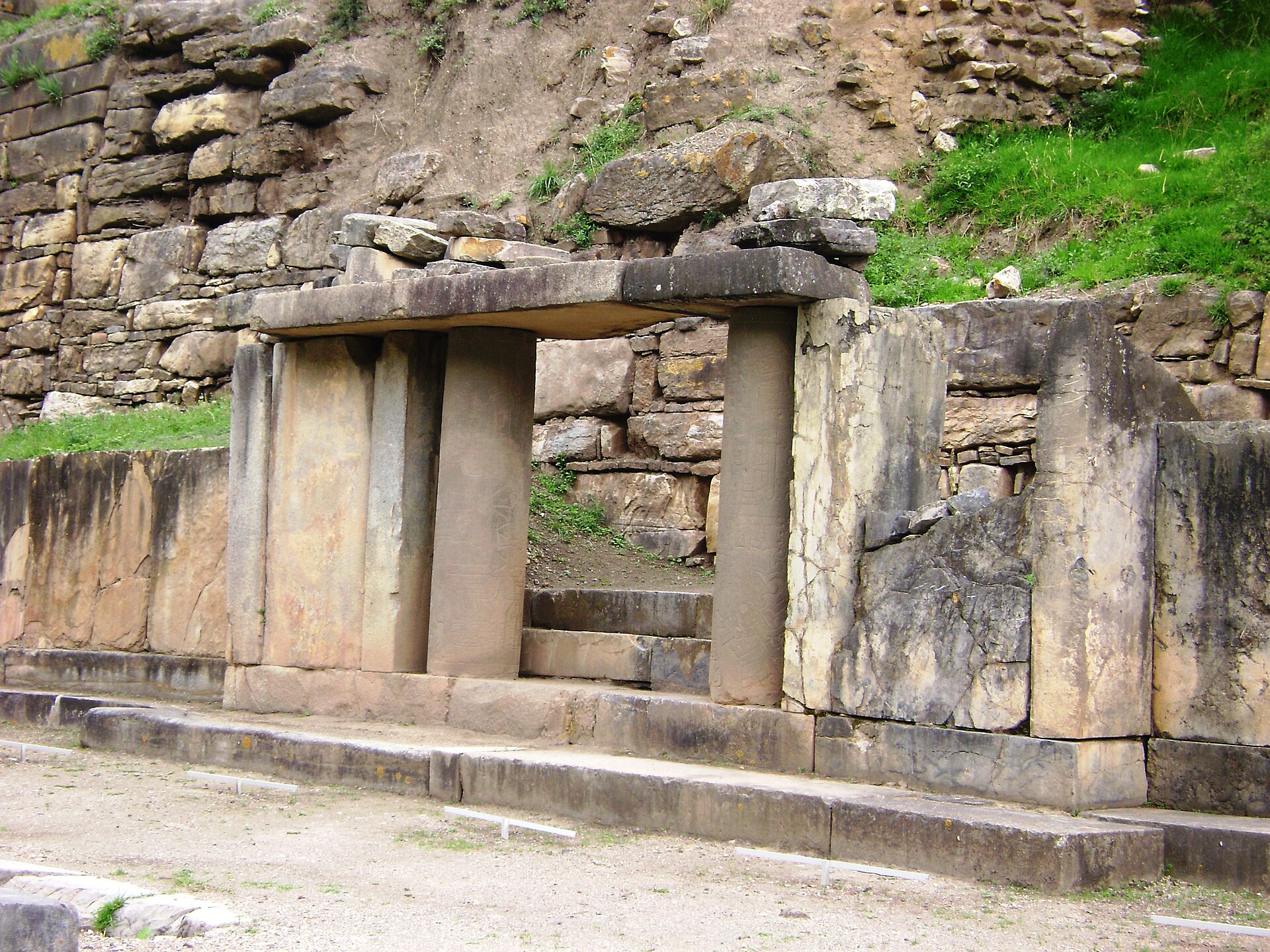
The grand entrance known as the Black-and-White Portal captures this beautifully. Built with contrasting light and dark stone and flanked by columns carved with fierce hybrid birds of prey, it marked the threshold between the everyday world and the sacred one. Passing through it was a statement in itself. The whole architecture of approach, plaza, portal, dark galleries, hidden god, was a carefully sequenced journey, and pilgrims would have understood that they were being led somewhere extraordinary.
This model, of a religious centre whose authority rested on experience and belief rather than conquest, is important. It shows that complex, far-reaching social networks can be built on shared ritual and pilgrimage, not just on armies and taxes. Chavin knit together distant communities through a common set of gods and a common awe, and for several centuries that was enough to make it the spiritual heart of a huge swathe of the Andes.
Visions, cactus, and the shamans
To understand what pilgrims may have gone through in the heart of the temple, we have to talk about altered states of consciousness. There is good reason to think that the Chavin experience involved more than darkness and sound. Carvings at the site show figures holding what appears to be the San Pedro cactus, a tall Andean cactus long used in the region for its powerful mind-altering properties. Other imagery has been linked to snuffs made from psychoactive plants, complete with depictions of the mucus-streaming faces that such substances can produce.
Put the pieces together and a vivid picture emerges. A pilgrim, perhaps after fasting and ritual preparation, is given a psychoactive substance and then led into the dark, roaring, disorienting galleries to meet the fanged god of the Lanzon. Under those conditions, the transformation depicted in the tenon heads, the human sliding into animal, would not have been an abstract idea. It might have felt like something happening to your own body and mind. The temple’s art, architecture, acoustics, and pharmacology all point in the same direction: toward an engineered visionary experience.
Seen this way, the priests of Chavin were masters of a very sophisticated technology of the sacred. They understood how to combine setting, substance, sound, and imagery to reliably produce profound, life-altering experiences in the people who came to them. That expertise, more than any weapon, was the true source of Chavin’s power. People returned home changed, and they carried the temple’s authority with them.
Rediscovering Chavin
For centuries after it was abandoned, Chavin de Huantar sat quietly in its valley, known to local people but not widely understood. Serious archaeological attention came in the twentieth century, and one name stands out: Julio C. Tello, often called the father of Peruvian archaeology. Tello, who himself came from the Andean highlands, championed the idea that the roots of Andean civilisation lay not with foreign influences but deep in the highland cultures of Peru, and Chavin was central to his argument. He saw in its art and architecture the signature of an ancient, homegrown tradition.
Work at the site has been complicated by its setting. The valley is prone to landslides and floods, and a devastating debris flow in the mid-twentieth century buried and damaged parts of the ruins, a reminder that the same rivers the builders harnessed can also be destructive. Excavation and conservation have had to contend with this fragility. Over the decades, archaeologists have gradually mapped the galleries, studied the water systems, analysed the acoustics, and pieced together the sequence of building phases, slowly reconstructing how the temple actually worked as an experience rather than just a ruin.
Some of the site’s greatest treasures now live in museums, both at Chavin and elsewhere, including carved stelae and obelisks covered in the dense, interlocking imagery that defines Chavin art. Studying these carvings, researchers have learned to read their visual language, recognising recurring beings, motifs, and the clever tricks of contour and doubling that let one image conceal another. Each fresh analysis tends to deepen our respect for how deliberate and intelligent the whole system was.
Reading the stone carvings
It’s worth lingering on the artistry, because Chavin’s carvings are not just decoration; they are a kind of theology written in stone. The style is famously complex, built around a few core supernatural beings rendered again and again in dense, symmetrical designs. The great cat, most likely a jaguar or puma, dominates, its fanged mouth and clawed limbs appearing everywhere. Alongside it come raptors like eagles and hawks, and serpents that coil out of hair, belts, and limbs. These are combined into hybrid deities that belong to no single natural species.
Chavin artists delighted in visual puzzles. They used a technique where the eyebrows, hair, and other features of a figure are themselves formed from smaller snakes or animal heads, so that the closer you look, the more creatures you find hidden inside the whole. A face examined from a distance dissolves, on closer inspection, into a swarm of eyes, fangs, and scales. This wasn’t showing off for its own sake. It expressed a genuine belief about the nature of reality, that beings contain other beings, that forms are unstable, that the boundaries between human, animal, and divine are thin and can be crossed.
Once you understand that logic, the whole site starts to feel coherent. The transforming tenon heads, the hybrid god of the Lanzon, the puzzle-like reliefs, and the visionary, animal-becoming experience at the temple’s heart are all saying the same thing in different media. Chavin art is the philosophy of the cult made visible, and it’s one of the most sophisticated and internally consistent artistic systems anywhere in the ancient Americas.
Why Chavin faded
Nothing lasts forever, and by around 500 to 200 BCE the Chavin phenomenon was in decline. The great temple gradually lost its pull, the wide-reaching Chavin art style fragmented, and the network of shared belief that had bound distant communities together began to unravel. The site was not violently destroyed in some single catastrophe so much as it slowly ceased to be the centre of the Andean world.
Why? As with most such declines, the honest answer is that we don’t fully know, and several factors probably combined. Some researchers point to environmental stresses, shifts in climate and agriculture that strained the societies that supported the cult. Others emphasise social and political change: as new centres of power and new regional styles emerged, local elites may have had less need to borrow authority from a distant mountain temple. A religion built on shared prestige can lose its grip once people find other sources of meaning and power closer to home.
There’s also something almost inevitable about it. A place like Chavin depended on continuous belief and continuous investment. The moment enough people stopped making the pilgrimage, stopped maintaining the galleries, stopped seeing the temple as the axis of their world, its decline became self-reinforcing. The stones remained, the carved god still stood in the dark, but the living current of faith that had animated it drained away. What followed in the Andes was a long, rich succession of other cultures, many of which carried fragments of Chavin’s legacy forward without ever quite reviving its unique spell.
Why Chavin still matters
Chavin de Huantar is a UNESCO World Heritage Site today, and rightly so, but its importance runs deeper than any label. It stands as one of the clearest early examples of something humans have done again and again: building an entire structure, and an entire social order, around the deliberate production of religious experience. Long before cathedrals used soaring space and coloured light to inspire awe, the priests of Chavin were using darkness, water, sound, sculpture, and vision to do something remarkably similar in the thin air of the Andes.
It also challenges some of our lazy assumptions. It reminds us that monumental achievement in the ancient Andes did not begin with the Inca, but reaches back thousands of years further. It shows that a society can project influence across vast distances through belief and pilgrimage rather than conquest. And it reveals an astonishingly sophisticated understanding of human psychology at the hands of people we too often imagine as “primitive.” The engineers and artists of Chavin knew exactly what they were doing.
When you stand in that valley now, with the mountains rising all around and the rivers still running past the old platforms, it takes an effort of imagination to hear the roar of water in the galleries and see the fanged heads glaring from the walls. But the bones of the experience are still there in the stone. Chavin was built to make people feel that they had touched another world, and nearly three thousand years later, standing before the Lanzon in the dark, some of that intention still reaches out and finds you.
It’s worth remembering, too, that Chavin was a living, working place, not the silent ruin we visit. Smoke from offerings, the murmur of pilgrims, the tramp of feet on stone, the constant sound of the rivers: the valley would have been full of life and movement. Priests maintained the galleries and the water channels, artisans carved and repaired the endless stone imagery, and a steady stream of visitors arrived from near and far, each one hoping to stand, however briefly, in the presence of the fanged god at the centre of the maze. Holding that human bustle in mind is the surest way to keep Chavin from flattening into mere archaeology.
If Chavin has whetted your appetite for places where ancient people did the seemingly impossible, there are plenty more worth wandering to. For the sheer shock of great age, few things compare with Göbekli Tepe and Karahan Tepe, the carved sanctuaries of southeastern Turkey that were raised before farming even began, or the painted caves that hold The World’s Oldest Art. If you’re drawn to the birth of cities, Uruk and Sumer in Mesopotamia and Jericho in the Jordan Valley are where it all started, while the astonishing water-planned streets of Mohenjo-daro and Dholavira in the Indus Valley show early urban engineering at its finest. For monuments raised by determined communities, there’s Stonehenge on Salisbury Plain, the tomb of Newgrange in Ireland, the The Megalithic Temples of Malta, the buried village of Çatalhöyük, and the stone houses of Skara Brae in Orkney. And for other lost worlds an ocean apart, meet the jade-carvers of Liangzhu and the deep past of Knossos on Crete, the pyramid-builders of Caral just down the Peruvian coast from Chavin itself, and Nan Madol, a whole city raised on a Pacific reef. Each one, like Chavin, is a reminder of how much the ancient world still has to astonish us with.
You might also explore Cucuteni-Trypillia, the vast planned towns that burned themselves down every few generations. You might also visit Cerro Sechin, whose ancient walls are lined with carved warriors and dismembered bodies. You might also explore Poverty Point, where hunter-gatherers built enormous ridges and mounds without farming. For a look at how far these instincts reached into the heart of Asia, take a detour to Sarazm, one of Central Asia’s oldest towns. For a glimpse of where this whole way of life began, don’t miss Mehrgarh, one of the oldest farming villages in South Asia. For a fresh twist on the birth of the city, don’t miss Tell Brak in northern Mesopotamia and its haunting eye idols. For an even earlier chapter of settled life, don’t miss Aşıklı Höyük in Cappadocia. For a different kind of ancient wonder, don’t miss Jiahu in China and its playable Neolithic flutes. For ancient sky-watching at its finest, don’t miss Chankillo in Peru and its thirteen solar towers.