Perched atop a sheer sandstone mesa in western New Mexico stands Acoma, often called Sky City, one of the oldest continuously inhabited settlements in North America. From this dramatic height the Keresan-speaking Pueblo people have looked out over the desert for many centuries, farming the valley below, shaping fine painted pottery and keeping ceremonies whose roots run back into the ancient Southwest.
The Keresan peoples include the mesa-top community of Acoma and the nearby Pueblo of Laguna, along with several villages further east along the Rio Grande. What unites them is the Keres language, a tongue unlike any other and belonging to no known wider family, a true language isolate that sets these communities apart even among their Pueblo neighbours. This article follows their origins, their language, their homeland and their living culture into the present day.
Contents
- Origins on the High Mesa
- A Name Tied to Language and Place
- Keres, a Language That Stands Alone
- Homeland of Mesa and Desert Valley
- The Old Way of Life Atop the Rock
- How Keresan Society Was Organized
- Kivas, Kachinas and the Sacred Year
- Traditions Kept Behind Guarded Walls
- Acoma Pottery and Keresan Crafts
- Corn and the Foods of a Dry Land
- Feast Days and Village Dances
- A History of Siege and Survival
- Keresan Pueblo Peoples in the World Today
Origins on the High Mesa
The Keresan peoples descend from the ancient farming cultures of the Southwest, the same broad ancestral world that raised the great cliff dwellings and canyon towns whose ruins still stand across the region. Their forebears mastered life in a dry land long before any outsider set foot in the area.
According to their own histories, the ancestors of Acoma searched for a promised place and finally settled atop a towering mesa that offered both safety and a commanding view of the surrounding country. The choice of such a defensible height shaped the whole character of the community that grew there.
Archaeological and oral evidence together point to many centuries of continuous life on and around the mesa, making Acoma a serious contender for the oldest continuously inhabited place in North America. For its people, this is not a claim to fame but simply the plain fact of an unbroken home.
This deep rootedness gives the Keresan communities an extraordinary sense of belonging, tying them to a specific and dramatic landscape that has sheltered their families for longer than almost any other people on the continent can claim.
The story of how the ancestors came to settle atop the mesa is told in the community’s own traditions with great care, and it explains not only where the people live but why they belong there. For the Keresan, the mesa is not simply a convenient stronghold but a place chosen and sanctified at the very beginning of their settled life, giving their home a meaning far beyond its physical safety.
Visitors who make the climb to the top of Acoma today often speak of a powerful sense of age and continuity, of standing in a place where people have lived and prayed for a thousand years. For the community itself, that continuity is simply the fabric of ordinary life, a home that has been handed down without interruption from one generation to the next.

A Name Tied to Language and Place
The term Keresan refers above all to the people who speak the Keres language, a grouping defined by tongue rather than by a single unified government. Each Keresan village is its own community with its own leaders and its own carefully kept traditions.
The most famous of these communities, Acoma, is widely known by the evocative nickname Sky City, a reference to its home high atop the mesa. Laguna, its close neighbour, shares the same language and much of the same culture while remaining a distinct pueblo.
As with other Pueblo peoples, villagers identify first with their particular community and its sacred places, and only secondly with the broader label that scholars use to group the Keres-speaking villages together.
So Keresan is best understood as a family of related communities bound by a shared and unusual language, each proud of its own identity and its own place upon the land.
This layering of names, an outsider’s term for the language group, an evocative nickname for the most famous village and each community’s own name for itself, reflects the long and complicated history through which the Keresan peoples have passed. To use these names with care is to respect both the shared heritage of the Keres-speaking villages and the distinct pride each community takes in its own identity.

Keres, a Language That Stands Alone
The Keres language is one of the great puzzles of North American linguistics, for despite careful study it has never been convincingly linked to any other tongue. It stands entirely alone as a language isolate, a fact that hints at a very long and independent history in the region.
Keres is spoken in several dialects across the different Keresan villages, close enough that speakers can broadly understand one another but distinct enough to mark each community. The language carries a rich body of ceremonial and everyday knowledge.
Like other Pueblo peoples, the Keresan communities have guarded their language carefully, limiting outside study of its sacred vocabulary and keeping it alive in the home and in ceremony. This protectiveness has helped it endure where many other languages faltered.
Today the survival of Keres remains a central concern, with communities running programmes to ensure that children continue to grow up speaking the isolate tongue that so strongly marks their identity.
For linguists, the very existence of a language with no known relatives is a reminder of how much of the deep human past remains hidden from us. For the Keresan people, however, the isolate status of their tongue is simply confirmation of what they have always known, that they are an ancient people with a long and independent history rooted in this particular corner of the world.
Efforts to keep Keres strong include teaching it to children in the home and, where communities judge it appropriate, in carefully controlled settings that respect the boundary around sacred speech. The survival of the language is understood not as an academic matter but as a question of whether the ceremonies, and with them the identity of the people, will continue into the future.
Homeland of Mesa and Desert Valley
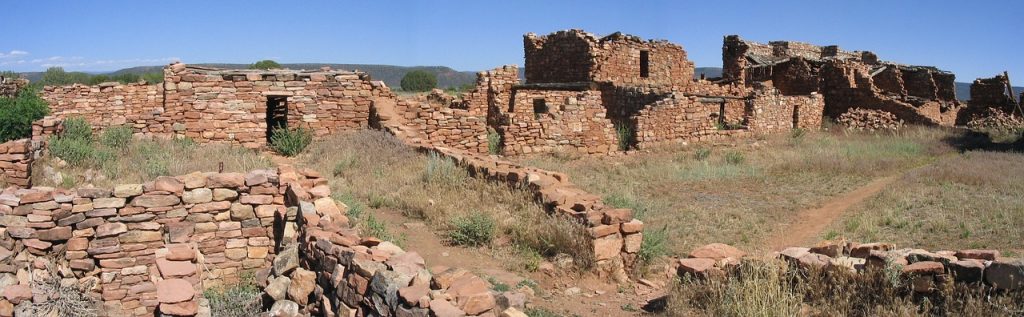
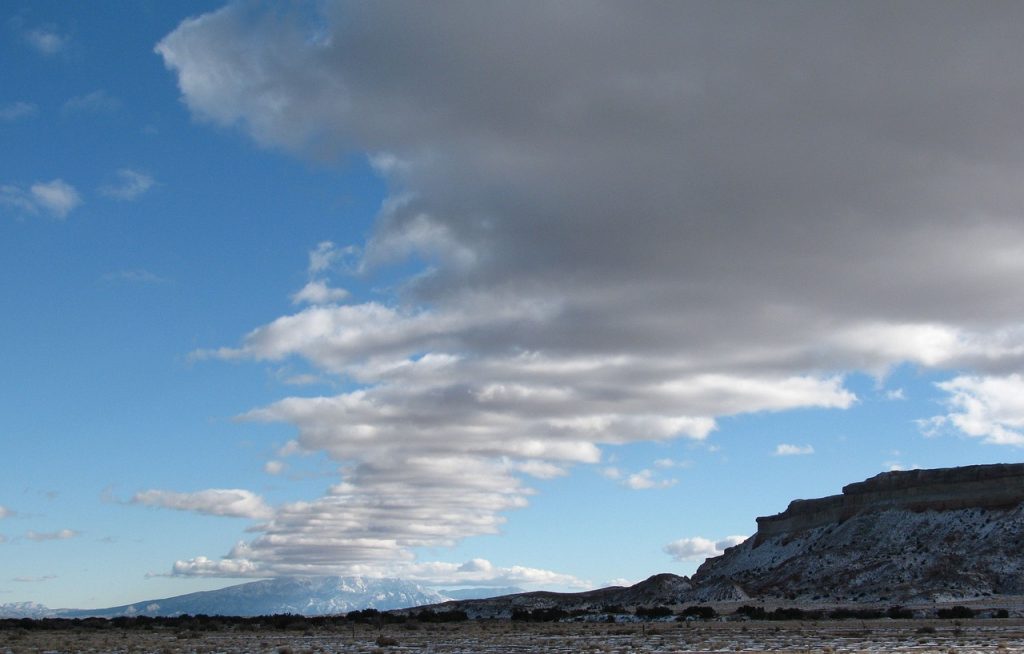
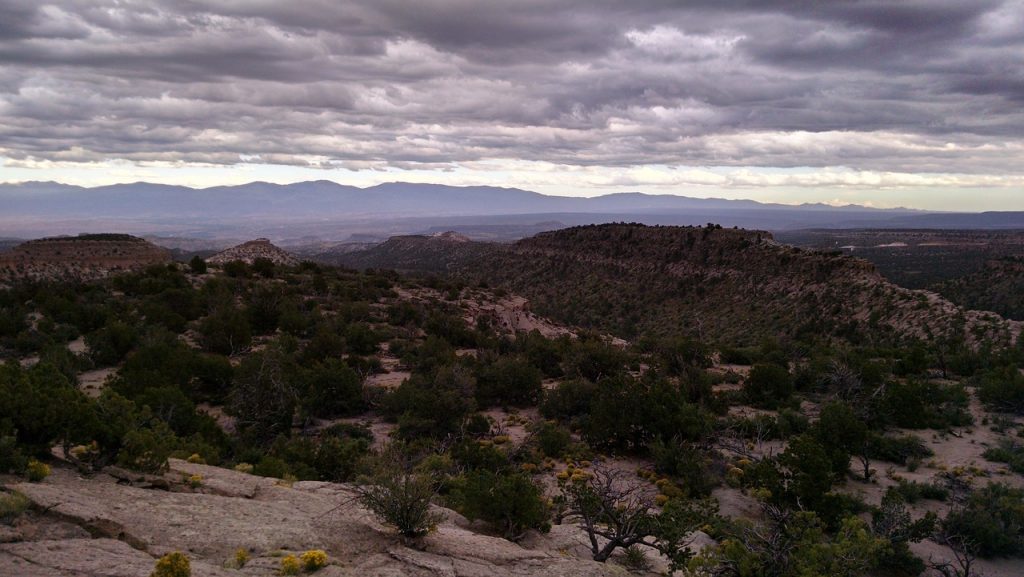
The Keresan homeland lies in the high desert of western and central New Mexico, a country of sandstone mesas, wide dry valleys and distant blue mountains. At its heart rises the great rock of Acoma, standing sheer above the plain like a natural fortress.
This is a land of little rain and dramatic skies, where the light shifts constantly across the desert and summer storms bring brief, precious water to the fields below the mesa. Farming here demanded deep knowledge and careful management of every drop.
The mesa top offered safety and a spiritual centre, while the valley floor provided the fields where corn and other crops were grown. Life moved between these two levels, the high sacred rock and the working land below.
For the Keresan people this desert country is not a harsh exile but a cherished home, marked with sacred places and tied to them through centuries of ceremony, farming and story.
The interplay of the high sacred mesa and the working valley below gave Keresan life a distinctive vertical rhythm, moving between the safety of the rock and the labour of the fields. This daily journey between two worlds, the spiritual height and the productive lowland, mirrored a whole way of understanding the balance between the sacred and the practical that ran through the culture.
Water gathered in natural basins in the rock became a lifeline for the mesa-top village, and its careful use was surrounded by both practical rules and spiritual meaning. In a land where rain was rare and precious, the arrival of the summer storms was greeted not only with relief but with ceremony, as the community gave thanks for the gift that made their life possible.

The Old Way of Life Atop the Rock
Traditional Keresan life was built around farming the valley below the mesa, above all the growing of corn, together with beans and squash. Families climbed down from the high village to tend their fields and climbed back up to the safety of the rock.
Water was the constant concern, and the people developed careful techniques to catch and use the scarce rain, including natural rock pools atop the mesa that stored precious water. Every aspect of life reflected the demands of a dry land.
Life on the mesa top was compact and communal, with adobe houses clustered together and daily existence lived in close quarters. This closeness reinforced the bonds of family and ceremony that held the community together.
Hunting and gathering supplemented the harvest, but it was the reliability of farming and the security of the high village that allowed the Keresan people to maintain their remarkable continuity across the centuries.
The knowledge needed to thrive in such a place was immense, covering the reading of weather, the storage of scarce water and the careful tending of crops in a short and uncertain growing season. This hard-won wisdom, refined over countless generations, was among the most precious inheritances that a Keresan family could pass to its children.
Around the central work of farming grew a whole way of life, with its own tools, its own seasonal tasks and its own body of songs and stories tied to the land and the mesa. To be raised in a Keresan village was to absorb this knowledge almost without noticing, learning the ways of corn, water and season simply by living within a community that had practised them for centuries.
How Keresan Society Was Organized
Keresan society was organised around clans and ceremonial societies, with roles and responsibilities often passed down through particular family lines. Each village governed itself, blending religious and civil authority in a tightly woven whole.
Ceremonial leaders held great responsibility, for the proper performance of the sacred calendar was believed essential to the wellbeing of the whole community. Authority carried duty rather than mere privilege.
Cooperation was vital in such a demanding place, and communal effort maintained the fields, the water sources and the ceremonies. The good of the village came before individual ambition.
This closely knit order, focused on clan, ceremony and village, gave the Keresan communities the strength to preserve their identity through long centuries of outside pressure.
The balance between clans, ceremonial societies and village leaders gave Keresan communities a resilience that carried them through centuries of pressure. Power was shared and hedged with responsibility, so that no single person could easily overturn the customs on which the survival and order of the whole community depended.
The sense of belonging to a particular village, with its own plaza, its own kivas and its own sacred round, lies close to the heart of what it means to be Keresan. This rootedness gives the communities a strong and settled character, in which each person understands their place within a web of family and ceremony that reaches back across the generations.
Kivas, Kachinas and the Sacred Year
At the heart of Keresan religious life stands the kiva, the ceremonial chamber where sacred societies gather to carry out their rituals. Much of the deepest religious life takes place within these guarded spaces, hidden from outside eyes.
The Keresan year follows a cycle of ceremonies tied to the seasons and to the great need for rain in a dry land. Central to this life are the kachinas, powerful spirit beings honoured in dance and ceremony and believed to bring rain and blessing.
As with other Pueblos, much of this religious life is deliberately kept private, its deepest meanings shared only with those who have earned the right to know them. This careful guarding has been essential to its survival.
For the Keresan people, religion is the framework that binds community, land and season into a single sacred order, and its faithful observance is understood as a duty owed to the whole world.
The presence of the kachinas in ceremony brought the spirit world directly into the life of the village, reminding people that the rain and the harvest depended on maintaining a right relationship with unseen powers. In this way the boundary between the human and the sacred grew thin, and the whole rhythm of the year took on a ceremonial shape.
The rhythm of the ceremonial year gives shape to time itself in the village, so that the passing months are measured less by any outside calendar than by the succession of dances and observances. In this way the sacred and the everyday are woven together so tightly that they can hardly be separated, and the whole of life takes on a ceremonial form.
Traditions Kept Behind Guarded Walls
Keresan traditions have been guarded with particular care, and Acoma in especial is known for protecting its ceremonies and sacred knowledge from outside intrusion. This determined privacy is itself one of the community’s defining customs.
Ceremonial knowledge, songs and stories are entrusted only to members of the appropriate societies, passed down carefully across the generations. Membership carries lifelong obligation to the community and its sacred round.
The ritual calendar, performed year after year in the same plazas and kivas, ties each new generation to the ancestors who filled the same roles before them. To take part is to step into a living stream of tradition.
Through this careful transmission the Keresan people have kept alive a heritage reaching back to the ancient Southwest, bending where necessary but never surrendering its sacred core.
The reputation of Acoma for guarding its sacred life so closely is not a matter of secrecy for its own sake but a strategy for survival, born of centuries of pressure from outsiders who sought to suppress the old religion. By keeping the heart of their ceremonies hidden, the Keresan people ensured that even in the darkest times their sacred core could continue undisturbed.
Acoma Pottery and Keresan Crafts
Acoma is world-renowned for its pottery, thin-walled vessels of white clay painted with intricate geometric and natural designs. Made by hand from local materials, these pots are among the most admired of all Pueblo crafts and are prized by collectors far beyond the Southwest.
The distinctive Acoma style, with its fine lines and bold patterns, has been passed down through families of potters across many generations. Each artist works within the tradition while bringing her own hand to the ancient designs.
Beyond pottery, Keresan artisans also work in other media, and jewellery of silver and turquoise is part of the wider craft heritage of the Pueblo Southwest. Craft and identity are closely bound together.
Today Acoma pottery provides both income and pride, carrying the identity and design traditions of the mesa-top community into galleries and homes around the world.
Families of renowned Acoma potters have passed their techniques and designs down through the generations, so that a distinctive hand can often be traced to a particular household. In this way the pottery itself becomes a carrier of history, linking the work of living artists to that of their grandmothers and the long line of women who shaped clay on the mesa before them.
The finest Acoma pots are so thin and finely made that they seem almost impossibly delicate, a testament to the skill and patience of the potters who create them. Yet these vessels were never mere ornaments, for they grew out of a long tradition in which beautiful and useful objects were part of the fabric of daily and ceremonial life alike.

Corn and the Foods of a Dry Land
Corn lies at the foundation of Keresan food and Keresan life, grown in the valley fields and prepared in many forms, from breads to stews and ground meal. It is sacred as well as sustaining, central to both diet and ceremony.
Alongside corn grew beans and squash, the reliable companions of Southwestern farming, supplemented by chili, wild plants and hunted game. Together these formed a balanced diet suited to a dry land.
Food and ceremony are closely linked, with special dishes prepared for feast days when families open their homes to relatives and guests. Generosity at these times is both an honour and a duty.
The careful cultivation and preparation of desert foods, above all corn, reflects a whole philosophy of drawing life from a hard land through knowledge, effort and respect.
The reverence surrounding corn is expressed in the ceremonial use of cornmeal and corn pollen in prayer and blessing, marking the crop as sacred as well as nourishing. To share food, and above all corn, is to affirm the bonds of kinship and community that hold the village together through the turning of the seasons.

Feast Days and Village Dances
The most visible expression of Keresan culture is the public dance held on feast days through the year, when dancers in careful regalia move to drum and song in the village plaza. These ceremonies call for rain, growth and the wellbeing of the community.
Each village keeps its own feast days, often blending the ancient ceremonial calendar with dates introduced during centuries of contact, so that old dances may take place around a village’s patron saint day. The result is a rhythm of celebration unique to each pueblo.
These occasions draw families home from far away and open the village to invited guests, with homes filled and tables laid for all who come. The dances are acts of worship and renewal rather than performance.
Through these gatherings the Keresan people reaffirm their identity and their bonds year after year, in the same plazas their ancestors used, keeping the ceremonial heart of the village strong.
For visitors fortunate enough to be welcomed, these feast days offer a glimpse of a living ceremonial tradition of great depth, though always with the understanding that much remains rightly hidden. For the Keresan themselves, the dances renew their covenant with the land and the powers that sustain it, repeated faithfully year after year.

A History of Siege and Survival
The arrival of Spanish colonisers brought violence to the Keresan world, and Acoma in particular endured a brutal siege and assault that left deep scars in the community’s memory. The high mesa that had long offered safety could not hold out against firearms and cannon.
In the years that followed, the Keresan peoples faced forced labour, pressure to abandon their religion and the constant threat to their land and autonomy. Yet they held to their ceremonies, often in secret, and refused to surrender their identity.
The Keresan communities joined the other Pueblos in the great revolt that drove the colonisers from the region for a time, a rare and successful act of united resistance whose memory endured through later centuries of foreign rule.
Under later Spanish, Mexican and United States rule the pressures continued, including the removal of children to distant schools, yet through all of it the Keresan people kept their villages, their language and their sacred life alive.
The memory of the siege of Acoma remains a powerful part of the community’s identity, a reminder of both the violence they suffered and the endurance that carried them through it. That the village atop the mesa is still inhabited today stands as living proof that no conquest was ever able to erase the Keresan people from their ancient home.

Keresan Pueblo Peoples in the World Today
Today the Keresan communities remain vibrant, self-governing pueblos, each a recognised nation managing its own affairs while continuing the ceremonies that define it. Acoma, still inhabited atop its ancient mesa, is honoured as living heritage of the deepest kind.
Keresan people move confidently in the modern world, working in every field and pursuing education, while returning home for the feast days and ceremonies that anchor their identity. This balance between two worlds shapes contemporary Keresan life.
Acoma pottery brings both income and international recognition, and cultural tourism to Sky City is carefully managed so that visitors may glimpse its wonders without intruding on what remains sacred and private.
For the Keresan peoples the future is rooted in the same mesa, the same valley fields and the same ceremonial calendar that have sustained them for centuries, carried forward by generations determined to keep their ancient way of life alive.
Younger generations increasingly take up the work of cultural preservation, learning the Keres language, mastering the celebrated pottery and stepping into ceremonial roles once held by their elders. In doing so they ensure that the thread linking the ancient Southwest to the modern world will pass on unbroken to the children who come after them.
At the same time the Keresan communities face the familiar pressures of the modern age, from economic hardship to the pull of the wider world on their young people. Yet the strength of their ceremonies, the fame of their pottery and the deep attachment to their ancient mesa continue to draw people home, so that Sky City remains a living community rather than a monument to the past.
Related Peoples of the Region
- Pemón, Savanna Dwellers Beneath the Sacred Tepuis of the Gran Sabana
- Waorani, Forest Hunters of Ecuador Standing Guard Over the Amazon
- Wichí, Honey Gatherers and Weavers of the Gran Chaco Thornlands
- Warao, Canoe Dwellers of the Orinoco Delta and Their Tree of Life
- Coast Salish Canoe Nations of the Salish Sea and Their Cedar Longhouse World
- Tanoan Pueblo Peoples of the Rio Grande and Their Thousand-Year Adobe Villages


