In the lowland rainforest of the northwestern Amazon, where the great river and its countless tributaries thread through some of the most biologically rich country on earth, live the Yagua, an indigenous people of northeastern Peru and neighboring Colombia. Known to the wider world for their striking traditional dress of palm fiber and their skill with the blowgun, the Yagua have inhabited this forest world for a very long time, developing a culture finely tuned to its rhythms.
This article explores who the Yagua are, from their ancient roots and distinctive language to their beliefs, crafts, food, and their endurance through the catastrophes that swept the Amazon after European contact. Their story offers a window into the depth and resilience of Amazonian indigenous culture and into the ongoing struggle to defend a homeland and a way of life.
Contents
- Origins of the Yagua in the Northwestern Amazon
- The Name Yagua and Its Meanings
- The Peba-Yaguan Language and Its Survival
- Homeland Along the Amazon and Its Tributaries
- The Old Way of Life in the Rainforest
- How Yagua Society Was Organized
- Beliefs, Shamans, and the Forest Spirits
- Traditions Passed Down the Generations
- Crafts of Palm Fiber and Bark
- Food from the River and the Forest
- Festivals, Music, and Community Gatherings
- A History of Contact and Displacement
- The Yagua People Today
Origins of the Yagua in the Northwestern Amazon
The Yagua are an indigenous people of the northwestern Amazon, living in the lowland rainforest of northeastern Peru and reaching into neighboring parts of Colombia. Their homeland lies in the great basin drained by the upper Amazon and its many tributaries, a world of dense forest, winding rivers, and abundant life. The Yagua have inhabited this region for a very long time, developing a culture finely tuned to the rhythms of the rainforest.
For centuries the Yagua lived as one of the many peoples scattered through this vast and biologically rich forest, distinct in language and custom from their neighbors. Their traditional way of life combined the cultivation of forest gardens with hunting, fishing, and the gathering of wild foods, a pattern shared in broad outline with many Amazonian peoples but expressed in ways particular to the Yagua.
The Yagua became known to the wider world in part through their striking traditional dress and their skill with the blowgun, images that have often stood in for the peoples of the Amazon in the popular imagination. Behind these images lies a real community with a deep history, a distinctive language, and a way of life rooted in an intimate understanding of one of the most complex environments on earth.
The upper Amazon around the region the Yagua call home is sometimes described as the most species-rich place on the planet, a distinction that shaped every part of their culture. Living within such abundance demanded not only skill but a deep body of knowledge about which plants healed, which animals could be hunted safely, and how the forest changed from month to month.
That the Yagua became, for many outsiders, a kind of shorthand for the Amazon itself says more about the wider world’s fascination with the rainforest than about the people, who were always far more than the images made of them.

The Name Yagua and Its Meanings
The name Yagua has been recorded in a number of spellings over the centuries, reflecting the challenges outsiders faced in writing down a language quite unlike their own. The people are also known by other names in the historical record, given to them by neighbors, missionaries, and colonial officials. As with many Amazonian peoples, the name by which they became widely known was not necessarily the one they used for themselves.
Various meanings have been suggested for the name over time, some connected to descriptions of the people or their appearance. What is clear is that the Yagua have long possessed a strong sense of their own distinct identity, separate from the Kichwa, Ticuna, and other peoples around them. That identity was rooted in shared language, custom, and a common relationship to the forest homeland.
The consistent thread through the shifting spellings and names is a people who knew who they were. Even as they interacted, traded, and sometimes clashed with their neighbors, the Yagua maintained a clear sense of themselves as a distinct nation. In the modern era, reclaiming and asserting that identity has become part of the wider effort to secure their rights and their future.
The layering of names given by outsiders over the name the people used themselves is a common story across the Amazon, where explorers and officials rarely paused to learn how a community described itself. For the Yagua, cutting through this tangle of labels has been part of reclaiming a voice long spoken about by others rather than heard directly.

The Peba-Yaguan Language and Its Survival
The Yagua language belongs to the small Peba-Yaguan family, a grouping that once included several related languages but that has been reduced over time. Yagua is the main surviving member of this family, and its distinct structure and vocabulary make it a subject of interest to linguists studying the diversity of Amazonian tongues. The language carries knowledge of the forest world accumulated over countless generations.
Like many indigenous languages of the Amazon, Yagua faces pressure from Spanish and from the dominant national culture. Yet it has shown considerable resilience, remaining in use in a number of communities where children still learn it as their first language. This survival stands in contrast to the fate of many smaller Amazonian languages, and it reflects the strength of Yagua cultural identity.
Efforts to document, teach, and support the Yagua language are part of the broader movement to defend indigenous cultures in Peru. Recordings, dictionaries, and educational programs aim to strengthen the language and pass it securely to younger generations. The future of Yagua as a living tongue depends on this work and on the continued vitality of the communities that speak it.
That children in a number of communities still grow up speaking Yagua is one of the most encouraging signs for the language’s future, for a tongue passed on in the home is far harder to lose than one taught only in a classroom. This everyday vitality gives the documentation and education efforts something living to build upon.

Homeland Along the Amazon and Its Tributaries
The Yagua homeland lies in the lowland rainforest of the northwestern Amazon, in a region drained by the upper Amazon River and tributaries such as the Napo and others. This is a world defined by water, where the great rivers and their countless smaller channels shape the landscape and the rhythm of life. The forest here is among the most biologically diverse on earth, teeming with plants and animals.
Yagua settlements have traditionally clustered along the rivers and streams that serve as highways, fishing grounds, and sources of water. The seasonal rise and fall of the waters governs much of life, dictating when travel is easy, when fish are plentiful, and when gardens can be worked. The Yagua learned to read this watery world with great skill, knowing its cycles and its resources intimately.
Much of the traditional territory now falls within regions under pressure from logging, oil exploration, and the expansion of settlement and roads. Protecting the homeland has become inseparable from protecting the Yagua way of life, and the community has had to defend its lands and rivers against a range of outside interests. For the Yagua, as for so many Amazonian peoples, land and identity are bound tightly together.
The flooded forests known as varzea, submerged for part of the year by the rising rivers, were especially important, offering rich fishing and fertile ground. Learning to live with these seasonal floods rather than against them was central to the Yagua mastery of their watery homeland.

The Old Way of Life in the Rainforest
Traditional Yagua life was built around the extended family living in a large communal house, surrounded by garden plots cut from the surrounding forest. This pattern of dispersed settlement suited an environment where resources were spread across a wide area and where moving on periodically allowed the forest to recover. The communal house was the heart of family life, sheltering several related families under one roof.
The daily rhythm followed the forest and the rivers. Men hunted with the blowgun, a weapon for which the Yagua became especially known, and fished the waters, while women tended the gardens, prepared food, and cared for children. Knowledge and work were shared according to age and skill, and children learned the ways of the forest by watching and helping their elders in the tasks of daily life.
This way of life gave the Yagua a remarkable self-sufficiency, for a household could provide nearly everything it needed from the forest and rivers around it. Tools, shelter, food, and medicine all came from an intimate knowledge of the environment. That independence was both a strength and, when the forest came under threat, a source of vulnerability, since the whole way of life depended on a healthy and accessible homeland.
The blowgun itself was a marvel of craftsmanship, a long tube bored with great care and paired with darts tipped in plant-based poison that could bring down prey high in the canopy. Mastering it took years of practice, and skill with the weapon was a source of real prestige among Yagua men.

How Yagua Society Was Organized
Yagua society was organized around the extended family and the local group rather than around powerful chiefs or centralized authority. Leadership tended to be informal, resting on the respect earned through experience, generosity, and skill. Elders and capable individuals guided the group through persuasion and example, and decisions were often reached through discussion within the community.
Kinship ties bound the scattered communal houses into a wider web of relationships, and marriage and trade linked families across the territory. These connections were essential in a landscape where each household lived at some distance from its neighbors. Alliances could shift, and rivalries sometimes arose, but the shared language and culture provided a common thread that held the Yagua world together.
This decentralized structure gave Yagua society flexibility, allowing groups to disperse or gather as conditions required. It also meant there was no single authority for outsiders to deal with, which shaped their relations with colonial powers and later the Peruvian state. In modern times the Yagua have built new forms of community organization to represent themselves and defend their collective interests.
When disagreements could not be settled through talk, the freedom of a family to move to a new stretch of forest served as a kind of release valve, letting tensions ease without hardening into lasting feuds. This mobility was one of the quiet strengths of a society that never leaned on rigid hierarchy.
Respect for the elderly ran deep, and the counsel of those who had lived longest carried real weight in a society that kept much of its most valuable knowledge in living memory rather than in writing.

Beliefs, Shamans, and the Forest Spirits
The spiritual world of the Yagua was inseparable from the forest around them, understood as a living place filled with spirits and powers. Animals, plants, rivers, and certain places held their own kind of presence, and to live well meant to maintain right relationships with these beings. The rules governing hunting, fishing, and the use of the land were bound up with this spiritual understanding.
Shamans held a central place in Yagua society, serving as healers and as intermediaries between the human community and the powers of the forest. Working with knowledge of medicinal plants and, in some cases, sacred plants, they sought to cure illness, to restore balance, and to protect the community from harm. Their role required years of learning and a deep familiarity with both the visible and invisible worlds.
This spiritual knowledge was closely tied to the language and the land, and it was passed down through careful instruction and long apprenticeship. The pressures of contact with the outside world, including the influence of missionaries and the disruption of communities, placed this knowledge at risk. Yet elements of Yagua belief and practice have endured, part of the deep cultural inheritance the people have worked to keep alive.
Dreams and visions held meaning in Yagua spiritual life, treated as ways of touching a world that lay just beyond the everyday. Elders and shamans attended to them closely, drawing guidance from the images that came in sleep or in ceremony, in keeping with a wider Amazonian understanding that the visible and invisible worlds constantly meet.

Traditions Passed Down the Generations
Yagua traditions were carried forward through the spoken word, through daily practice, and through the guidance of elders rather than through writing. Stories, songs, and detailed knowledge of the forest passed from one generation to the next around the household fire and during shared work. This oral inheritance held the accumulated wisdom of the people, from practical survival skills to the myths that explained their world.
Among the most visible Yagua traditions was their distinctive dress, including garments and adornments made from palm fiber, which became widely associated with the people. Such traditional dress was worn on important occasions and carried meaning within the community, marking identity and belonging. The making and wearing of these items was itself part of the cultural inheritance passed down through the generations.
The disruptions brought by contact placed strain on the transmission of Yagua traditions, as communities were affected by disease, missionary activity, and economic change. Yet the Yagua have shown determination in maintaining their customs, and many traditions have survived or been revived. Passing this heritage to the young remains central to the community’s sense of who they are.
The famous palm-fiber costume, often photographed and shown to outsiders, was only the most visible part of a much deeper web of tradition that governed how people spoke, married, hunted, and honored their dead. Reducing Yagua culture to its most striking image risks missing the quieter customs that truly held the community together.

Crafts of Palm Fiber and Bark
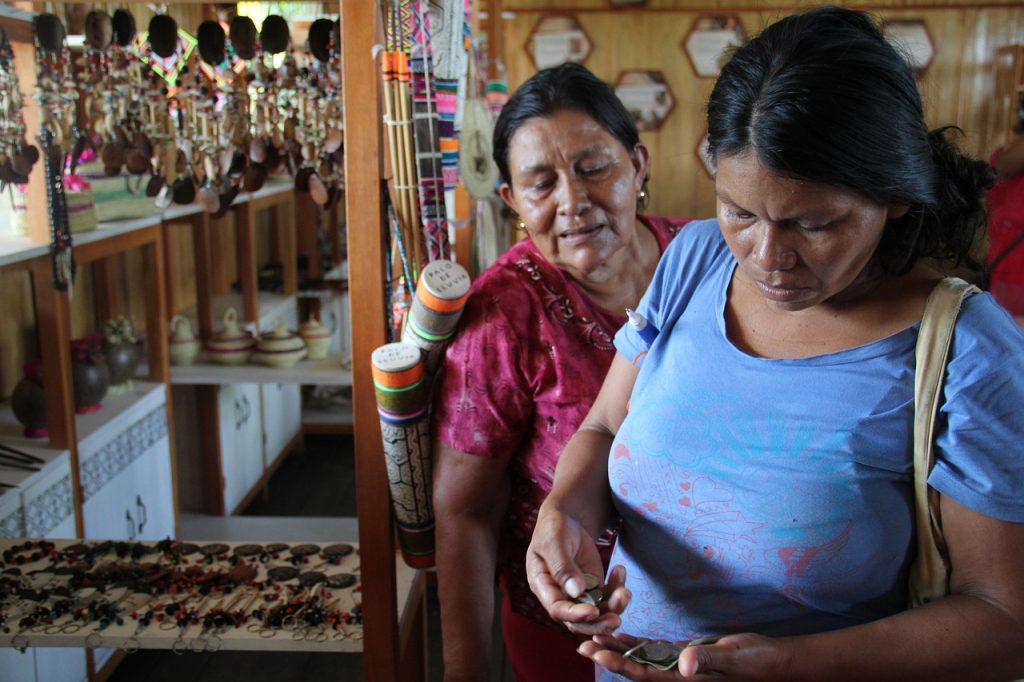
Yagua crafts drew directly on the materials the forest provided, above all the fibers of various palms, which were transformed into clothing, adornments, and useful objects. The making of garments and skirts from palm fiber was a hallmark of Yagua material culture, requiring skill and detailed knowledge of the plants involved. These items were both practical and rich in cultural meaning.
Weaving with plant fibers produced baskets, bags, and other containers essential to daily life, while other natural materials were worked into tools and ornaments. Feathers, seeds, and similar materials became decorations that marked identity and occasion. Each craft reflected an intimate understanding of the forest and the many uses to which its plants and materials could be put.
The knowledge required to produce these crafts was a form of inheritance, learned by watching skilled hands and practicing over years. As with language and story, this knowledge faced disruption during the difficult decades of contact. Encouraging the continued practice of traditional crafts has become part of the effort to keep Yagua culture alive and to give younger people a tangible link to their heritage.
Making a single traditional garment could require gathering and processing large quantities of palm fiber, a patient labor that bound the maker to the forest that supplied the raw material. In this way even an article of dress carried within it the knowledge and effort of a whole way of life.
Food from the River and the Forest
The Yagua drew their food from a combination of forest gardens, hunting, fishing, and gathering, a mixed strategy well suited to the abundance and variability of the rainforest. Garden plots provided staple crops such as manioc and plantains, which formed the base of the diet. These gardens were cut from the forest, used for a few seasons, and then allowed to return to wild growth as families moved on.
Hunting and fishing supplied vital protein. The Yagua were renowned for their skill with the blowgun, used to take monkeys, birds, and other game from the canopy, and they fished the rivers and streams with a range of techniques. The forest also offered wild fruits, nuts, palm hearts, and other foods gathered according to the season, reflecting a deep knowledge of what the forest provided.
Manioc was central not only as food but also in the form of a fermented drink prepared by the women, a staple of daily life and of every gathering. Sharing food and drink was an important social act, binding households together and expressing hospitality. As with so much of Yagua culture, the way food was produced and shared reflected values of self-reliance, generosity, and connection to the land.
The gathering of palm fruits and hearts was a seasonal highlight, and certain palms provided not only food but also the fibers and materials on which so much of Yagua life depended. Few plants illustrate the Yagua relationship with the forest as clearly as the palms that fed, clothed, and sheltered them.

Festivals, Music, and Community Gatherings
Gatherings and celebrations brought the scattered Yagua communities together for feasting, music, dance, and the renewal of social ties. These occasions were essential in a society where households lived far apart, offering a chance to arrange marriages, settle disputes, exchange goods, and enjoy one another’s company. They were moments when the wider Yagua community became visible to itself.
Music and dance lay at the heart of these events, with songs and rhythms tied to particular ceremonies and seasons. The fermented manioc drink flowed freely, and celebrations could last well into the night. Such gatherings reinforced shared identity and passed on the songs and stories that carried the culture forward, making them as much about memory and belonging as about pleasure.
In the modern era, festivals and communal gatherings have taken on added importance as expressions of Yagua identity and pride. Events that celebrate the language, dress, and traditions of the people help younger generations connect with their heritage and show the wider world that the Yagua endure. These occasions blend old forms with new purposes, keeping ancient traditions alive in a changing time.
For young people raised partly in the orbit of towns and schools, these gatherings offer a rare immersion in the language and customs of their elders, a chance to feel the culture as a lived experience rather than a set of facts. That role has made the festivals quietly vital to cultural survival.

A History of Contact and Displacement
The history of the Yagua since the arrival of Europeans is marked by disruption, displacement, and endurance. Contact brought devastating epidemics of introduced diseases against which the Yagua had no immunity, reducing their numbers and shattering communities. As with peoples across the Amazon, the demographic impact of these illnesses was severe and long-lasting.
The rubber boom of the late nineteenth and early twentieth centuries brought further catastrophe to the peoples of the northwestern Amazon, with indigenous communities forced into labor, displaced, and subjected to brutal treatment. The Yagua were caught up in these upheavals, and many were pushed from their lands or drawn into the exploitative economy of the era. The period left deep scars on the community.
Despite these hardships, the Yagua endured, holding on to their language, their customs, and their connection to the forest. In later decades the recognition of indigenous rights in Peru, including the titling of community lands, gave the Yagua a firmer foundation. Their survival through centuries of disruption stands as a testament to the resilience of a people deeply rooted in their homeland.
Some Yagua families, pushed from their lands during these upheavals, later returned or established new communities, carrying their language and customs with them. The persistence of identity through such dislocation speaks to how deeply the culture was rooted in more than any single place.

The Yagua People Today
Today the Yagua live in numerous communities across their traditional territory in the northwestern Amazon of Peru, with related people in Colombia. Community organizations represent them in dealings with the government and in the defense of their land and rights. From the disruptions of the past, the Yagua have worked to rebuild and to assert their place in contemporary Peru while holding on to their heritage.
The challenges they face remain significant. The rainforest homeland is under pressure from logging, oil development, and other forces that threaten indigenous lands across the Amazon. Balancing engagement with the wider society against the preservation of language and tradition is an ongoing task. Yet the Yagua language remains alive in many communities, a hopeful sign amid the pressures of the modern world.
The story of the Yagua is one of deep rootedness and remarkable endurance. Having thrived for centuries in one of the richest and most demanding environments on earth, they survived the catastrophes of contact and refused to disappear. As they look to the future, the Yagua carry forward a heritage grounded in the forests and rivers of the Amazon, insisting on their right to remain who they are.
Ecotourism has brought both opportunities and complications to some Yagua communities, offering income while risking the reduction of a living culture to a spectacle. Navigating this carefully, so that engagement with outsiders strengthens rather than hollows out their traditions, is one of the delicate challenges the Yagua face today.
Related Peoples of the Region
- Embera River Weavers of the Darien Rainforest and Their Jagua-Painted World
- Qom People of the Gran Chaco and Their Fierce Independence on the Argentine Plains
- Tucano Peoples of the Vaupes Rivers and Their World of Many Languages
- Shawi People of the Peruvian Foothill Forests and Their World of Masato and Rivers
- Zaparo People of the Upper Amazon and Their Language on the Edge of Silence
- Nambikwara People of the Mato Grosso Savanna and Their Seasonal Wandering World
You May Like
The Damara, an Ancient People of Namibia


One thought on “Yagua People of the Northwestern Amazon and Their World of Palm and Blowgun”