In the gold-rich forests of central Ghana rose one of Africa’s great empires: a kingdom welded from rival chiefdoms by a sacred stool said to have descended from the sky, enriched by the greatest goldfields of West Africa, and organized into a state powerful enough to resist the British Empire for the better part of a century. The Asante, or Ashanti, greatest of the Akan peoples, built a civilization of gold, kente, and kingship whose Golden Stool still holds the soul of the nation.
This portrait follows the Asante of the forest kingdom: the union of Osei Tutu and the descent of the Golden Stool, Twi and the proverbs of the Akan, the matrilineal clans and the rule of chiefs and queen mothers, Nyame and the ancestors and the talking drums, kente and adinkra and the casters of gold, fufu and palm soup, the Adae festivals of the ancestors, the empire’s long wars with Britain, and a kingdom that still reigns within the republic of Ghana.
Contents
- An Empire Born of Gold and the Forest
- Asante, Ashanti, and the People of the War
- Twi and the Speech of the Akan
- The Forest Kingdom Around Kumasi
- The Golden Stool and the Union of the Clans
- Matrilineal Clans and the Rule of the Chiefs
- Nyame, the Ancestors, and the Talking Drums
- Kente, Adinkra, and the Festivals of the King
- Goldweights, Weavers, and the Casters of Brass
- Fufu, Palm Soup, and the Yam of the Forest
- Akwasidae and the Adae Cycle of the Ancestors
- The Asante Empire and the Wars With Britain
- A Kingdom Within a Republic
An Empire Born of Gold and the Forest
The Ashanti, or Asante, are the greatest of the Akan peoples, and their kingdom was one of the most powerful in the history of West Africa. It rose in the forests of what is now central Ghana at the end of the seventeenth century, when a cluster of small Akan states, chafing under the domination of a neighbor, united under one leader and one sacred symbol to build an empire on gold and conquest.
The land itself made them rich. The Asante heartland sat on some of the greatest goldfields in Africa, and the forest yielded kola nuts prized across the Sahara, so that from early times the Akan traded gold and kola north to the savanna empires and, later, south to the Europeans on the coast, wealth that funded armies, courts, and the machinery of a state.
The founding was an act of political genius. Around 1700 the ruler Osei Tutu, with his priest and adviser Okomfo Anokye, welded the rival Akan chiefdoms into a single confederacy, and to bind them he gave them a common soul: the Golden Stool, said to have descended from the sky, in which the spirit of the whole Asante nation was held.
With union came power. The Asante conquered their old overlords, expanded in every direction, and within a century ruled an empire that covered most of modern Ghana and reached into neighboring lands, a forest kingdom of gold that would meet, and for a long time resist, the might of the British Empire.
The story of Okomfo Anokye calling the Golden Stool down from the sky, in a cloud of dust and darkness, onto the knees of Osei Tutu is the founding miracle of the nation, and whether history or sacred legend, it did the work of nation-building perfectly: it gave a league of proud, rival chiefdoms a single soul to share, and no army could have bound them so tightly as that gleaming symbol did.

Asante, Ashanti, and the People of the War
The people call themselves Asante, and the older English spelling Ashanti, from the coastal traders’ rendering, remains the familiar international form; the two name the same nation. A popular tradition derives the name from osa nti, because of war, recalling the military union that founded the state, though scholars debate the etymology.
The Asante are the largest branch of the Akan, the great family of peoples who share a language, a matrilineal social order, and a common culture across southern Ghana and into Ivory Coast, Fante, Akyem, Akuapem, Bono, Nzema, and the rest, of whom the Asante became the most powerful.
The nation is defined by its kingship: the Asante are the people of the Golden Stool and the Asantehene, the king who sits upon its authority, and to be Asante is to belong, through one’s clan and one’s chief, to the confederacy that the stool binds together.
Today the name carries both a cultural and a political weight: the Asante are one of Ghana’s major peoples, proud of an imperial history unmatched in the region, and the Asantehene remains among the most revered traditional rulers in all of Africa.

Twi and the Speech of the Akan
The Asante speak Twi, a dialect of the Akan language, itself a member of the Kwa branch of the Niger-Congo family, and Twi in its Asante form is spoken by millions and understood across much of southern Ghana, one of the country’s principal languages and a lingua franca of its forest and coast.
Like its neighbors, Akan is tonal, meaning riding on the pitch of the voice, and it is a language dense with proverb, for the Akan prize the proverb, ebe, as the highest form of speech, and a chief’s linguist, the okyeame, is a master of the allusive, indirect eloquence that wraps meaning in metaphor.
The language carries a philosophy in its symbols: the adinkra designs, each a proverb or concept rendered as a sign, gye nyame for the supremacy of God, sankofa for learning from the past, are a visual vocabulary that has spread from Asante cloth to the world’s design and jewelry.
Twi is vigorously alive, the language of home, market, radio, and the popular Ghanaian music and film that carry it across West Africa and the diaspora, and its speakers, unlike some of the continent’s peoples, face no danger of losing a tongue that remains the daily voice of one of Ghana’s great cultures.
The okyeame’s art repays study: because a chief must not speak directly, his linguist restates the chief’s words and the petitioners’ words in polished, proverb-laden form, a role of diplomat, orator, and living memory, and the linguist’s gold-topped staff, carved with a proverb-figure, is one of the most characteristic emblems of Akan chieftaincy.

The Forest Kingdom Around Kumasi
The Asante homeland is the forest country of central Ghana, the Ashanti Region and the lands around its capital Kumasi, a green, hilly, well-watered country of dense forest and farmland, rich in gold, cocoa, and timber, the wealthy heart of modern Ghana.
Kumasi is the nation’s soul: the seat of the Asantehene, site of the royal palace and the Manhyia where the king holds court, one of West Africa’s great cities and the second city of Ghana, a commercial hub whose Kejetia market is among the largest in Africa.
The forest shaped the kingdom: it hid and protected the Asante heartland, its gold funded the state, its kola fed the northern trade, and its very density made the Asante a people of the interior, masters of the forest between the savanna empires to the north and the European forts on the coast to the south.
Beyond the heartland the old empire spread across most of modern Ghana, and Asante communities and the wider Akan people fill the forest zone into Ivory Coast, but it is the country around Kumasi, the golden forest, that remains the homeland of the nation and the seat of its king.

The Golden Stool and the Union of the Clans
The old Asante order rested on the stool. Every office, from the head of a family to the king himself, was embodied in a carved wooden stool that held the spirit of its holders past and present, and to be enstooled was to take office, to be destooled to lose it; the stool, not the crown, was the seat of Akan authority.
Above them all stood the Golden Stool, the Sika Dwa Kofi, the soul of the whole nation, so sacred that no one, not even the king, ever sat upon it, and on which the survival of the Asante people was believed to depend. Osei Tutu’s genius was to make loyalty to the stool the bond of union, transforming a league of rivals into a single people.
The empire ran on a sophisticated state machine: a hierarchy of chiefs owing allegiance upward to the Asantehene, a bureaucracy of officeholders, a standing framework for raising armies, a network of great roads radiating from Kumasi, and a treasury filled by gold, tribute, and the tolls of trade, an African state of remarkable organization.
Gold measured everything: dust weighed on brass scales with the famous figurative goldweights was the currency, gold ornaments marked rank, and the king’s regalia blazed with it, so that the wealth of the forest was made visible in the shining courts of a kingdom the Europeans called, with reason, the empire of gold.
The goldweights are a civilization in miniature: thousands of tiny brass figures, cast to weigh gold dust, depict proverbs, animals, tools, and scenes of daily life, so that a merchant’s weighing kit was also a gallery of Akan wisdom, and museums now prize the goldweights as one of the richest bodies of small sculpture Africa produced.

Matrilineal Clans and the Rule of the Chiefs
Asante society is matrilineal, and descent, inheritance, and succession pass through the mother’s line: a man’s heir is not his son but his sister’s son, and the eight great abusua clans, into which every Asante is born through the mother, are the framework of the whole social order, spanning the nation and binding strangers as kin.
Authority is held by chiefs and queen mothers together: each stool has its chief and its ohemaa, the queen mother, a senior woman of the royal clan who nominates the chief, advises him, and holds real power, for in a matrilineal state the women who transmit the royal blood are the guardians of legitimacy.
The chiefs form a pyramid rising to the Asantehene: village and division chiefs owe allegiance upward, sit in councils, and are bound by the oaths and obligations of the confederacy, a structure of checks and consultations in which even the king rules with and through his councils and can, in the last resort, be destooled.
The okyeame, the chief’s linguist and spokesman, mediates all formal speech, for a chief does not address his people directly, and the elaborate protocols of the court, the drums, the horns, the gold-hung regalia, and the poured libations, surround Akan chieftaincy with a majesty that has survived every political change.
The queen mother’s power is real and constitutional: she nominates the candidate for a vacant stool, can rebuke a chief in council, and holds her own court and following, and the Yaa Asantewaa war, when a queen mother rallied the nation to fight the British over the Golden Stool after the men had hesitated, is the enduring proof of what an ohemaa could be.

Nyame, the Ancestors, and the Talking Drums
Akan religion rises to a supreme creator, Nyame or Onyankopon, whose greatness the adinkra sign gye nyame proclaims, and beneath him the abosom, the lesser gods of rivers, forests, and shrines, and above all the ancestors, the honored dead of the clan, who remain present and must be served, the living and the dead one community.
The ancestors are served at the stools: the blackened stools of departed chiefs, kept in the stool house and fed with offerings, are the shrines of the lineage, and the Adae festivals of the ritual calendar are the appointed times to honor them, the king and chiefs pouring libation and offering food to the forebears on whom the nation’s welfare depends.
The talking drums carry the sacred and the historical: the great fontomfrom and atumpan drums speak the tonal language of Twi, reciting the praises, proverbs, and genealogies of the chiefs, so that the drum is a voice of the ancestors and the memory of the state, an oral archive beaten in bronze-dark rhythm.
Christianity, spread from the coast and the mission schools, is now the faith of most Asante, and Islam has its communities, but the old religion endures woven through the new, in the reverence for ancestors, the sanctity of the stools, the pouring of libation at every gathering, and the festivals that still order the year of the king.
The blackened stools are the true altars of the nation: each departed chief’s stool is ritually blackened and kept in the stool house, fed at the Adae with sheep and drink, and consulted as the seat of an ancestor, so that the whole political order is also a religious one, the chiefs both governing and priesting for the dead who legitimize them.

Kente, Adinkra, and the Festivals of the King
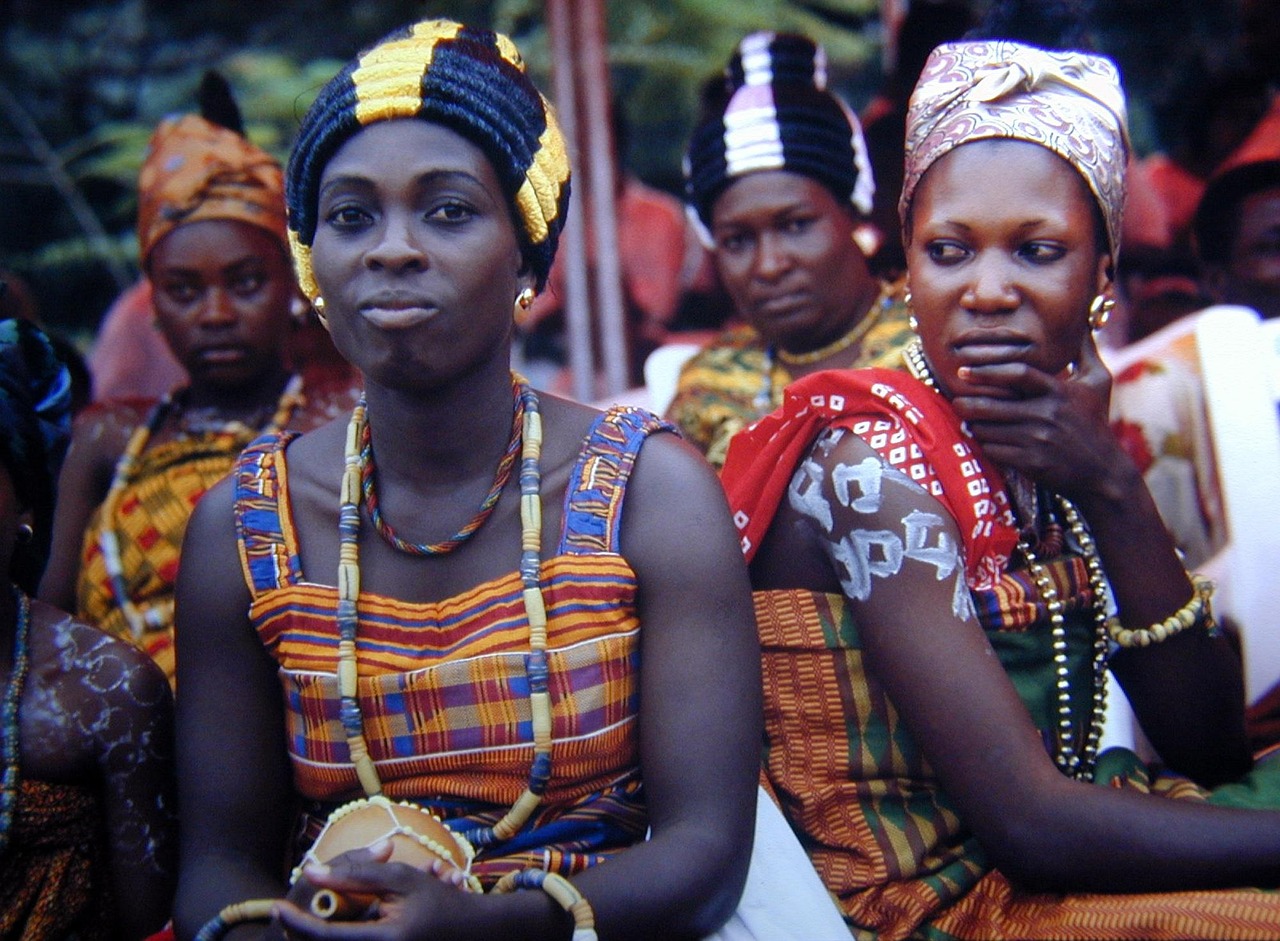
Kente is the Asante gift to the world’s eye: the brilliant silk and cotton cloth woven in narrow strips on the men’s loom and sewn into robes of dazzling color and pattern, each design named and meaningful, once reserved for royalty and now the cloth of celebration and of African identity across the globe.
Adinkra is its intellectual twin: the stamped cloth whose symbols, printed with carved calabash stamps in dark dye, each carry a proverb or idea, worn traditionally at funerals and now a visual language of Akan philosophy recognized worldwide, from the sankofa bird to the gye nyame of God’s supremacy.
The court is a theater of gold: at the durbars and festivals the Asantehene and his chiefs appear beneath state umbrellas, hung with gold ornaments, borne in palanquins, preceded by sword-bearers, drummers, and horn-blowers, the wealth and majesty of the old empire displayed in a pageantry that has changed little in centuries.
Life and death keep their ceremony: the outdooring and naming of children, the elaborate marriage customs of a matrilineal people, and above all the funerals, the great social events of Asante life, where the whole community gathers in the red and black of mourning to honor the dead and send them to the ancestors.

Goldweights, Weavers, and the Casters of Brass
The Asante are master craftsmen, and gold was their genius: goldsmiths worked the metal into the regalia of chiefs, the pectoral discs, rings, and sword ornaments of the court, and cast the famous goldweights, tiny brass figures and geometric forms used to weigh gold dust, each a miniature sculpture and often a proverb rendered in metal, one of Africa’s great small-scale arts.
Weaving is the other summit: the kente weavers of Bonwire, the royal weaving town, work the narrow-strip loom to produce the shimmering named patterns of the royal cloth, a craft of guild and inheritance whose masters are celebrated and whose finest cloths are treasures.
Woodcarving serves the stools and the court: the carved stools that hold each office, the akuaba fertility dolls with their flat discoid heads, the linguist staffs topped with proverb-figures, and the state swords and drums, all worked by carvers whose art is bound to the symbolism of chieftaincy.
Brass-casting, pottery, and the stamping of adinkra cloth complete the register, and the Asante craft tradition, gold, kente, adinkra, goldweights, has carried the visual identity of the Akan across the world, its symbols now global emblems of African heritage.

Fufu, Palm Soup, and the Yam of the Forest
The Asante table is built on the forest’s roots and the pounded staple. Fufu is the heart of the meal: cassava and plantain, or yam, pounded in the tall mortar to a smooth, elastic dough, swallowed in pieces with a soup, the sound of the fufu pounding the evening rhythm of an Asante household.
The soups carry the flavor: light soup of tomato and pepper, groundnut soup rich with peanut, and palm nut soup, abenkwan, thick and red from the boiled palm fruit, cooked with meat, fish, snails, and the bushmeat of the forest, ladled over the fufu in the communal bowl.
Other staples fill the week: banku and kenkey of fermented maize, boiled yam, and rice, with the fiery pepper, the smoked fish, and the palm oil that run through Ghanaian cooking, and the plantain in all its forms, boiled, fried into kelewele, or roasted.
Cocoa transformed the modern forest: introduced in the colonial era, it made Ghana the world’s great cocoa producer and the Asante forest its heartland, so that the crop the world eats as chocolate became the modern wealth of the kingdom that was once measured in gold.

Akwasidae and the Adae Cycle of the Ancestors
The Asante ritual year turns on the Adae cycle, the calendar of the ancestors: every forty-two days come the Adae days, Akwasidae falling on a Sunday and Awukudae on a Wednesday, when the Asantehene and the chiefs enter the stool houses to honor the blackened stools of their forebears with offerings and libation, the pivots of the sacred year.
Akwasidae is the great public festival: at Manhyia in Kumasi the Asantehene holds durbar, seated in gold beneath his umbrellas, receiving the homage of his chiefs and people amid the thunder of the fontomfrom drums and the cry of the horns, a spectacle of the living empire that draws crowds and visitors from around the world.
The larger festivals gather the nation: the Odwira, the yam festival of purification once celebrated across the empire, cleansed the state and the shrines and renewed the bond of the chiefdoms to the king, and its revival and the enthronement anniversaries and jubilees of the Asantehene fill the calendar with pageantry.
Around them run the funerals and the local festivals of each town and shrine, so that the Asante year is a near-continuous round of ceremony, ancestral, royal, and communal, the drums and the gold and the poured libation binding the living, the dead, and the unborn into one enduring nation.

The Asante Empire and the Wars With Britain
The Asante Empire, founded around 1700, grew within a century into the dominant power of the region, conquering its neighbors, controlling the gold and kola trades, and extending its rule over most of modern Ghana, a centralized state whose armies, wealth, and organization made it a great power of West Africa.
Its wealth drew it into the Atlantic world: the Asante sold gold and, in the era of the slave trade, captives to the Europeans on the coast, and the forts and castles of the shore, Elmina, Cape Coast, are monuments to that grim commerce, even as the empire itself lay inland, beyond European reach.
The nineteenth century brought the long collision with Britain: a sequence of Anglo-Asante wars fought across decades, in which the Asante repeatedly resisted and repeatedly clashed with British power, until in 1874 the British sacked Kumasi, and in 1900 the Yaa Asantewaa war, led by the queen mother of Ejisu in defense of the Golden Stool, ended in the empire’s defeat and annexation.
Yet the nation endured: the British exiled the Asantehene but could not take the Golden Stool, which the Asante hid and never surrendered, and in 1935 the confederacy was restored; the kingdom passed into independent Ghana in 1957 as a traditional state within the republic, its king and stool intact.
Yaa Asantewaa’s defiance has become a symbol far beyond Asante: her reported words, that if the men would not fight the British for the Golden Stool then the women would, made her a heroine of African resistance, and though the war was lost and she died in exile, the stool she fought for was never captured, and the Asante count that as the victory that mattered.
A Kingdom Within a Republic
The Asante today number in the millions, the largest of Ghana’s peoples, concentrated in the Ashanti Region and its capital Kumasi but spread across Ghana and into a global diaspora, and the wider Akan, of whom they are the greatest, form the largest population group in the country.
The kingdom lives within the republic: Ghana is a modern democracy, but the Asantehene remains a figure of immense authority and respect, the custodian of the Golden Stool, a mediator in national affairs, a promoter of education and development, and the head of a chieftaincy institution that Ghana’s constitution recognizes and honors.
The Asante forest is one of Ghana’s economic engines, its gold still mined, its cocoa still feeding the world’s chocolate, its timber and commerce centered on the great markets of Kumasi, and the region’s wealth and confidence reflect the old imperial energy in a new key.
The culture radiates outward: kente has become a global symbol of African identity, worn at graduations and celebrations across the diaspora, adinkra symbols fill the world’s design, and the Asante festivals, drums, and the majesty of the Golden Stool carry the memory of one of Africa’s great empires into a century in which its king still reigns and its cloth still shines.
The current Asantehene, enthroned in 1999, has used the office’s moral authority for education funds, peacemaking in Ghana’s north, and development in the region, showing how a traditional kingship can find new purpose within a modern democracy, and his jubilees and durbars draw dignitaries and diaspora Asante home to Kumasi in their tens of thousands.

Related Peoples of the Region
- Fulani Herders of the Sahel and Their Nation Scattered Across a Continent
- Hausa City-Builders of the Northern Savanna and Their Thousand-Year Market Civilization
- Yoruba of the Forest Cities and Their Gods That Crossed the Atlantic
- Igbo of the Republican Villages and Their Nation That Crowned No King
More Peoples of the World
You May Like
The Zaza, a Mountain People of Eastern Anatolia


2 thoughts on “Ashanti of the Golden Stool and Their Forest Empire of Gold”