In the rainforests of the northwest Amazon, along the border region between Peru and Colombia, live the Witoto and Bora, indigenous peoples whose cultures revolve around the great communal longhouse, the maloca, and a rich ceremonial life of dance, chant, and the sacred word. Closely associated through geography and a partly shared history, they developed traditions of remarkable depth in one of the most biologically rich regions on earth.
This article explores who the Witoto and Bora are, from their roots and languages to their beliefs, crafts, food, and the great signal drum that carries their ceremonies across the forest. It also confronts the terrible history of the rubber era, when their homeland became the scene of one of the worst atrocities in the story of the Amazon, and tells of the survival and endurance of these peoples through it.
Contents
- Origins of the Witoto and Bora Peoples
- The Names Witoto and Bora and Their Groups
- The Witotoan Languages of the Northwest Amazon
- Homeland Between the Putumayo and Caqueta Rivers
- The Old Way of Life Around the Maloca
- How Witoto and Bora Society Was Organized
- Beliefs, Tobacco, and the Sacred Word
- Traditions of Dance, Song, and the Longhouse
- Crafts of Fiber, Wood, and Bark
- Food from Bitter Manioc and the Forest
- Festivals, the Manguare Drum, and Ceremony
- A History Marked by the Rubber Terror
- The Witoto and Bora Peoples Today
Origins of the Witoto and Bora Peoples
The Witoto and Bora are indigenous peoples of the northwest Amazon, living in the rainforests along the border region between Peru and Colombia, in the basins of the Putumayo, Caqueta, and neighboring rivers. Closely associated through geography and a partly shared history, these peoples developed cultures deeply rooted in the great communal longhouse and in a rich ceremonial life. They have inhabited this forest world for a very long time.
For centuries the Witoto and Bora were among the many peoples of this densely forested region, distinct in language and custom yet linked by trade, intermarriage, and shared ways of life. Their traditional existence combined the cultivation of forest gardens, centered on bitter manioc, with hunting, fishing, and gathering. Above all, their societies revolved around the maloca, the great communal longhouse that was the center of daily and spiritual life.
The history of the Witoto and Bora is marked by both remarkable cultural richness and profound tragedy, for their homeland became the scene of one of the most brutal episodes of the rubber era. Understanding these peoples means appreciating both the depth of their ceremonial traditions and the catastrophe they endured, from which the survivors rebuilt their communities and carried their heritage forward.
The dense forests along the Putumayo, far from the centers of colonial power, long gave these peoples a measure of isolation, but the same remoteness would later leave them terribly exposed when the rubber trade reached their rivers with no witnesses to restrain its cruelty.
Neighboring peoples of the region, including groups such as the Ocaina and Muinane, shared parts of this cultural world, forming a wider mosaic of communities linked by trade, ceremony, and a common reliance on the maloca.

The Names Witoto and Bora and Their Groups
The Witoto, also spelled Huitoto or Uitoto, are not a single unified group but a cluster of related peoples sharing language and culture, divided into several groups spread across the region. The name Witoto was applied broadly by outsiders, and the peoples themselves have their own names in their own languages. The Bora, closely associated with the Witoto in geography and history, are a distinct people with their own language and identity.
As with many peoples of the Amazon, the names by which the Witoto and Bora became widely known were often given by outsiders and recorded in various spellings. The reality on the ground was one of distinct but interconnected groups, each with its own name, territory, and sense of identity, linked by trade, ceremony, and shared patterns of life across the forested borderlands.
For the Witoto and Bora themselves, identity was rooted in language, in membership of particular groups, and in the ceremonial life centered on the maloca. That sense of identity survived the catastrophe of the rubber era and the disruptions that followed. In the modern period, asserting and reclaiming these identities has been part of the wider effort to defend the rights and heritage of the survivors and their descendants.
The pairing of the Witoto and Bora in accounts of the region reflects their shared history more than any identity of culture, for each people guarded its own language and traditions even as they lived as neighbors and, at times, endured the same suffering together.
Reclaiming their own names, in place of the labels once imposed by outsiders, has been a quiet but meaningful part of that assertion of identity.

The Witotoan Languages of the Northwest Amazon
The Witoto languages belong to the Witotoan family, a grouping of related languages spoken in the northwest Amazon. The Bora language belongs to a separate family, though the two peoples have long been closely associated. These languages carry the accumulated knowledge of the forest world and are central to the ceremonial and spiritual traditions of the peoples who speak them.
The languages of the region are notable for their complexity and for the central place of the spoken and sung word in ceremonial life. Among these peoples, language was not merely a means of communication but a vehicle for sacred knowledge, transmitted through chants, myths, and ritual speech. The mastery of this ceremonial language was a mark of knowledge and authority.
Like many indigenous languages of the Amazon, the Witotoan and Bora tongues face pressure from Spanish and from the changes brought by contact with the wider society, and some are endangered. Efforts to document and support these languages are part of the broader movement to defend indigenous cultures. Their survival is bound up with the vitality of the communities and the continuation of their ceremonial traditions.
That sacred knowledge was carried in a special register of speech, distinct from everyday talk, meant that losing the language would sever not only ordinary communication but the very channel through which the deepest traditions of these peoples flowed.
Linguists who have studied these tongues note their intricate sound systems and grammar, features that make them both a challenge to learn and a rich subject for the study of Amazonian linguistic diversity.

Homeland Between the Putumayo and Caqueta Rivers
The homeland of the Witoto and Bora lies in the northwest Amazon, in the region drained by the Putumayo, Caqueta, and neighboring rivers along the border between Peru and Colombia. This is a world of dense rainforest, winding rivers, and abundant life, one of the most biologically rich regions on earth. The rivers provided food, water, and routes of travel through the forest.
For these peoples, the forest and rivers were both home and provider, supplying nearly everything they needed. Settlements were traditionally centered on the maloca, the great longhouse, around which lay the gardens cut from the forest. The rhythm of life followed the cycles of rain and dry season and the availability of the forest’s and rivers’ resources, read with a precision born of long experience.
The homeland of the Witoto and Bora was profoundly disrupted during the rubber era, when the region became the scene of terrible violence and forced displacement. Some communities were moved far from their original lands. In the modern period, defending and, where possible, reclaiming the homeland has been part of the struggle of these peoples to maintain their way of life and their connection to the land of their ancestors.
Rivers such as the Putumayo and Caqueta were highways through an otherwise trackless forest, and control of a stretch of river or a good garden site shaped where the great longhouses rose and how communities related to one another.
The flooded forests along the rivers teemed with fish in the wet season, while the drier months favored hunting, giving the year a rhythm that the people read closely in planning their work and their gatherings.

The Old Way of Life Around the Maloca
Traditional Witoto and Bora life revolved around the maloca, the great communal longhouse that sheltered an extended family group and served as the center of social, economic, and spiritual life. This large structure, built with skill from forest materials, was far more than a dwelling; it was a symbol of the ordered world and the setting for the ceremonies that lay at the heart of the culture.
Around the maloca lay the gardens where bitter manioc and other crops were grown, and from the surrounding forest and rivers the people drew game, fish, and wild foods. The daily rhythm followed the forest, with work shared according to age and skill. Men hunted, fished, and cleared gardens, while women tended crops and undertook the demanding labor of processing bitter manioc into food.
The maloca was the stage for the ceremonial life that gave the culture its distinctive character. Dances, chants, and rituals held within it bound the community together and connected the people to the spiritual forces of their world. This way of life gave the Witoto and Bora both self-sufficiency and a rich communal existence centered on the great longhouse and the ceremonies it sheltered.
The building of a maloca was itself a communal undertaking of great significance, drawing on knowledge of which timbers and thatch to use and unfolding according to patterns that carried meaning beyond mere shelter. A well-built longhouse could stand for many years as the heart of its community.

How Witoto and Bora Society Was Organized
Witoto and Bora society was organized around the maloca and the extended family group, with leadership closely tied to the mastery of ceremonial knowledge. The headman of a maloca held authority based on his knowledge of ritual, chant, and the sacred traditions, as well as on his ability to provide for and guide the group. Authority rested on knowledge and moral standing as much as on any formal power.
The ceremonial life centered on the longhouse structured much of social existence, and knowledge of the chants, dances, and rituals was a source of great prestige. Kinship and marriage linked the maloca groups into a wider network, and trade and ceremony connected different peoples across the region. These ties were essential in a landscape where communities lived at some distance from one another.
This structure, centered on the longhouse and on ceremonial knowledge, gave Witoto and Bora society its distinctive character. The catastrophe of the rubber era shattered many communities and disrupted this social order, but the survivors worked to rebuild it. In the modern period, these peoples have developed new forms of organization to represent themselves while drawing on their deep traditions.
The prestige attached to ceremonial knowledge meant that the most respected figures were those who had devoted years to mastering chant and ritual, so that in these societies learning and authority were bound tightly together in a single ideal of the knowledgeable elder.
When a maloca group grew too large or when tensions arose, families might establish a new longhouse elsewhere, so that the pattern of settlement shifted slowly over time while the ideal of life centered on the maloca endured.

Beliefs, Tobacco, and the Sacred Word
The spiritual life of the Witoto and Bora was rich and complex, centered on the ceremonial traditions of the maloca and on a body of sacred knowledge transmitted through chant and myth. Central to this spiritual world were sacred plants, above all tobacco and coca, which held deep ritual importance and were used in ceremony and in the transmission of knowledge among the men of the community.
The concept of the sacred word lay at the heart of Witoto and Bora belief, with knowledge understood as something transmitted through ritual speech and chant. The elders and ritual specialists who mastered this knowledge held great authority, serving as the keepers of the traditions and as intermediaries with the spiritual forces of the world. Their knowledge was essential to the wellbeing of the community.
This spiritual knowledge was closely tied to the language, the maloca, and the ceremonies that structured life. The catastrophe of the rubber era placed this knowledge at grave risk, as communities were destroyed and elders killed. Yet the survivors preserved what they could, and the ceremonial traditions, though diminished, endured as a vital part of the heritage the peoples have worked to maintain.
The ritual use of tobacco and coca among the men was not casual but hedged about with rules and meaning, part of the disciplined pursuit of knowledge that lay at the center of the spiritual life of these peoples.
Traditions of Dance, Song, and the Longhouse
The traditions of the Witoto and Bora were carried forward through the spoken and sung word, through ceremony, and through the guidance of elders within the maloca. The great dances and ceremonies held in the longhouse were among the most important expressions of the culture, uniting song, dance, and sacred knowledge in powerful communal events. These traditions held the accumulated wisdom and identity of the peoples.
Song and chant lay at the heart of these traditions, with specific songs belonging to particular ceremonies and occasions. The transmission of this knowledge was a serious matter, requiring long learning and the guidance of those who had mastered it. Through these forms the Witoto and Bora maintained their identity and their connection to the spiritual world across the generations.
The rubber-era catastrophe and the disruptions that followed placed enormous strain on the transmission of these traditions, as communities were shattered and knowledgeable elders lost. Yet the survivors held on to what they could, and the ceremonial traditions endured. Passing this heritage to the young remains central to the sense of identity of these peoples today.
The great communal dances could last through the night, drawing participants into a shared rhythm of song and movement that renewed the bonds of the community and affirmed its connection to the ancestors and the spirit world.

Crafts of Fiber, Wood, and Bark
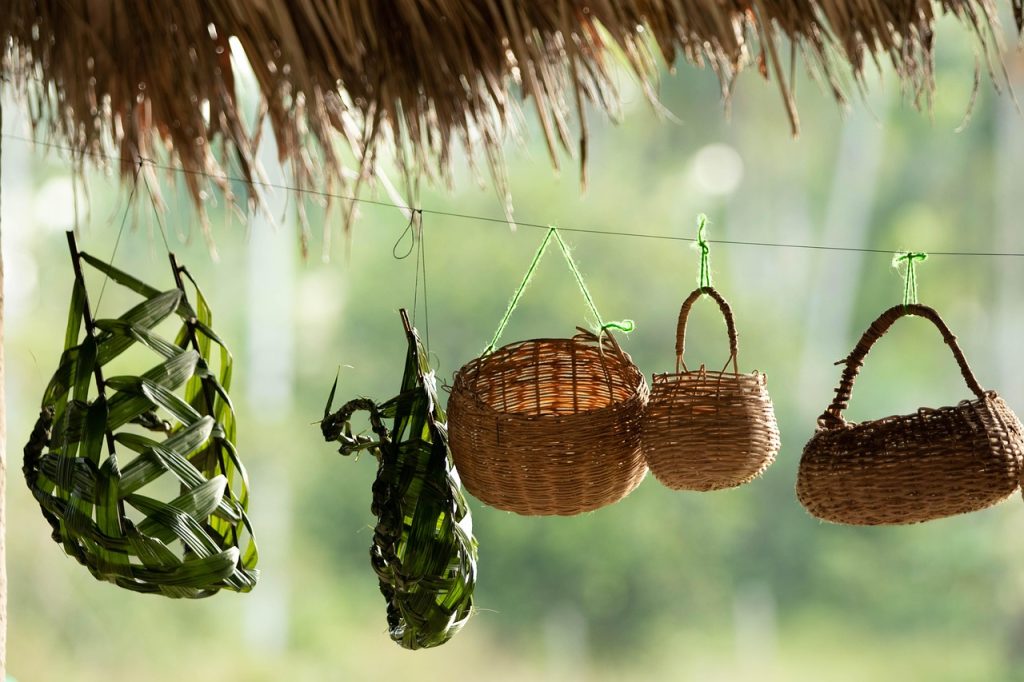
The crafts of the Witoto and Bora drew on the materials of the forest, transformed by skill into tools, containers, and objects of daily and ceremonial use. Fibers from palms and other plants were woven into baskets, hammocks, and other useful items. Wood and bark were worked into a range of objects, and bark cloth was made for various purposes, reflecting a deep knowledge of the forest’s materials.
Objects used in ceremony held special importance, connecting the material world to the spiritual concerns at the heart of the culture. Among the most significant was the great signal drum, a large hollowed instrument used to send messages across the forest and to summon people to ceremony. The making of such objects was bound up with knowledge and, in some cases, with ritual meaning.
The knowledge required to produce these crafts was a form of inheritance, learned by watching skilled hands and practicing over years. As with language and ceremony, this knowledge faced disruption during the catastrophe of the rubber era and the changes that followed. Encouraging the continued practice of traditional crafts is part of the effort to keep the culture alive for future generations.
The signal drum, hollowed with care from a great log, was among the most prized possessions of a maloca, its voice able to carry for long distances through the forest and to speak, in effect, a language of rhythm understood across the community.
Food from Bitter Manioc and the Forest
The Witoto and Bora drew their food from a combination of forest gardens, hunting, fishing, and gathering, with bitter manioc as the central staple. The processing of bitter manioc, which requires careful preparation to remove its natural toxins, was a demanding and essential part of daily life, undertaken by the women, and the resulting products formed the foundation of the diet.
Hunting and fishing supplied vital protein, with the peoples drawing on detailed knowledge of the forest and rivers. The forest also offered wild fruits, nuts, insects, and other foods gathered according to the season. Coca, prepared in a particular way, and tobacco held both social and ritual importance among the men, distinct from the everyday foods that sustained the community.
The processing and sharing of food, above all the labor-intensive preparation of bitter manioc, structured much of daily life around the maloca. Sharing food within the longhouse and beyond was an important social act, binding people together and expressing the values of the community. The food economy, centered on manioc and the resources of the forest, was inseparable from the whole way of life.
The daily grating, pressing, and cooking of bitter manioc filled much of the women’s day and stood as one of the quiet foundations of the whole way of life, without which the staple of the diet could not safely be eaten.

Festivals, the Manguare Drum, and Ceremony
Ceremony and celebration held great importance in Witoto and Bora life, and the great dances held in the maloca were among the most significant expressions of the culture. These ceremonies, involving song, dance, and the sharing of ritual substances, brought communities together and connected the people to the spiritual forces of their world. They were occasions of great cultural and spiritual intensity.
The manguare, a great signal drum made from hollowed logs, held a special place in the ceremonial life, its deep sound carrying across the forest to summon people to gatherings and to send messages between communities. The drum’s rhythms were part of the ceremonial language of these peoples, linking the practical need for communication with the sacred concerns of ritual life.
In the modern era, ceremonies and gatherings have taken on added importance as expressions of Witoto and Bora identity and pride. Efforts to maintain the great dances, the songs, and the use of the manguare help younger generations connect with their heritage and assert the continued vitality of the culture. These occasions link the present to a deep and often painful past, keeping ancient traditions alive.
Different dances marked different occasions through the year and the life of the community, each with its own songs, its own meaning, and its own place in the ceremonial calendar centered on the great longhouse.

A History Marked by the Rubber Terror
The history of the Witoto and Bora is marked above all by the catastrophe of the rubber era, one of the most brutal episodes in the history of the Amazon. In the late nineteenth and early twentieth centuries, the demand for rubber drew ruthless operators into the Putumayo region, where they subjected the indigenous peoples to forced labor, torture, and mass killing on a horrifying scale.
The violence of this period, sometimes called the rubber terror, devastated the Witoto and Bora, killing a vast portion of the population and shattering communities. The atrocities eventually drew international condemnation, but not before enormous and irreparable harm had been done. Survivors were displaced, some moved far from their homelands, and the social and ceremonial fabric of the peoples was gravely damaged.
That the Witoto and Bora survived at all is a testament to the resilience of the people who endured this catastrophe. The survivors rebuilt their communities, some in new locations, and held on to their languages and ceremonial traditions. The memory of the rubber terror remains a profound part of the history of these peoples, a reminder of the cost of the forces that reached into their forest world.
The published accounts of the atrocities on the Putumayo, once they reached the outside world, provoked outrage in distant capitals, yet the reckoning came far too late for the tens of thousands who had already perished in the forests.

The Witoto and Bora Peoples Today
Today the Witoto and Bora live in communities across their homeland in the northwest Amazon of Peru and Colombia, as well as in some areas to which their ancestors were displaced. Community organizations represent them in dealings with governments and in the defense of their land, rights, and culture. From the depths of the rubber-era catastrophe, these peoples have rebuilt and asserted their place in the modern world.
The challenges they face remain significant. Their homeland is under pressure from various outside forces, and some of their languages are endangered. Preserving the ceremonial traditions, the languages, and the knowledge centered on the maloca is an ongoing task. Yet the determination of these peoples to maintain their heritage, in the face of a history of profound suffering, remains a powerful force.
The story of the Witoto and Bora is one of extraordinary cultural richness and terrible tragedy, and of survival against overwhelming odds. Having endured one of the worst atrocities of the rubber era, they carried their ceremonial traditions and their identity forward. As they look to the future, these peoples honor a heritage rooted in the maloca and the forests of the northwest Amazon, insisting that both their culture and their history be remembered.
For the descendants of those who survived, the recovery of ceremony and language is inseparable from the memory of what was lost, so that cultural revival and the honoring of the dead are woven together in the life of these communities.
Anniversaries and commemorations of the rubber-era victims have become moments of both mourning and affirmation, occasions on which these peoples declare that they endure.
Related Peoples of the Region
- Shawi People of the Peruvian Foothill Forests and Their World of Masato and Rivers
- Zaparo People of the Upper Amazon and Their Language on the Edge of Silence
- Nambikwara People of the Mato Grosso Savanna and Their Seasonal Wandering World
- Yagua People of the Northwestern Amazon and Their World of Palm and Blowgun
- Kawesqar People of the Patagonian Channels and Their Vanishing Canoe World
- Piaroa People of the Orinoco Forests and Their Philosophy of Peace
You May Like
The Damara, an Ancient People of Namibia


One thought on “Witoto and Bora Peoples of the Northwest Amazon and Their World of the Maloca”