Along the great bend of the Niger River, in the borderland where the Sahel savanna gives way to the sands of the Sahara, there once rose one of the largest and richest empires in the history of the world. Its builders were the Songhay, a river people of fishermen, farmers, scholars, and traders whose cities of Gao and Timbuktu shone as centres of gold, salt, and learning. For a brilliant century they ruled a domain larger than western Europe, commanding the desert trade routes that linked the forests of the south to the Mediterranean world.
This is the story of that river civilisation and the people who carry its memory still. It is a story of a small kingdom that grew into a colossus under warrior kings and pilgrim emperors, of desert-edge cities famous for their libraries, of a sudden and shattering conquest, and of a people who endured along their river long after the empire fell. From the spirit dances of the Holey cult to the boats that still ply the Niger, the Songhay preserve a world that reaches back to the age when their name meant power across half a continent.
Contents
- The Empire Born on the Bend of the Niger
- Songhay and the Many Names of a River People
- The Songhay Tongue of the Great River
- The Niger Bend and the Edge of the Sahara
- Emperors, Provinces, and the Masters of the River
- Nobles, Fishermen, and the Bonds of the Water
- Islam of the Scholars and the Spirits of the River
- The Holey Cult, the Drum, and the Dance
- Boat-Builders, Weavers, and the Smiths of the Sahel
- Rice, Millet, and the Fish of the Niger
- Weddings, the Muslim Feasts, and the Spirit Dances
- From Sonni Ali to the Fall of Gao
- The Songhay of Mali and Niger in the Modern World
The Empire Born on the Bend of the Niger
Along the great bend of the Niger River, where the water swings north toward the desert before turning back south again, there grew one of the largest empires the African continent has ever known. Its people were the Songhay, a nation of the middle Niger whose fishermen, farmers, and traders built a state that at its height stretched across a domain larger than western Europe. From the trading cities of Gao and Timbuktu they commanded the routes where the gold of the forests met the salt of the Sahara, and for a brilliant century they were among the richest and most powerful people in the world.
The Songhay are in truth not one tightly bounded tribe but a river civilisation, a cluster of related groups strung along a thousand kilometres of the Niger from Mali into Niger and beyond. They are the heirs of ancient fishing and farming communities who learned to master the floods of the great river, and around that mastery they wove kingdoms, trade, and a shared identity. To speak of the Songhay is to speak of the river itself, for the Niger has been their road, their larder, and the spine of their history from the beginning.
Their story is one of the classic dramas of West Africa, the rise of a small kingdom into a vast empire, the flowering of scholarship and trade in desert-edge cities, and the sudden catastrophe of invasion that broke the state apart. Yet the Songhay did not vanish with their empire. They remained along the river, keeping their language, their music, and their memory of greatness, and today they are a large and living people whose past still colours the identity of two modern nations.

Songhay and the Many Names of a River People
The name Songhay, also written Songhai or Sonrai, has been carried by this people for many centuries, though its exact origin is lost in the deep past. It came to stand for the ruling stock of the empire and then for the whole community of the middle Niger who spoke their language and shared their way of life. Like many great names it has spread outward from a core, gathering in groups of different origins who over generations came to see themselves as Songhay through language, faith, and the shared world of the river.
Within the wider Songhay family there are many local names for its branches. The Zarma or Djerma of western Niger, the Dendi of the southern river, the Kado, and other groups all speak forms of the Songhay tongue and trace their belonging to the same ancient trunk, even as each keeps its own particular identity. This layering of a broad name over many local ones is typical of the great peoples of the Sahel, where empire, migration, and trade mixed populations for a thousand years.
To outsiders the Songhay were long known chiefly through their cities, and the names of Gao and Timbuktu travelled far beyond the river as bywords for wealth and learning. The people behind those names were the boatmen, scholars, soldiers, and merchants who made the cities work, and it is their descendants who still answer to the name Songhay today, proud of a word that once signified one of the mightiest powers in the world.

The Songhay Tongue of the Great River
The Songhay language is one of the great puzzles and treasures of West Africa. It is spoken by millions of people along the Niger, yet linguists still argue over its deeper family, some tying it to the vast Nilo-Saharan grouping and others treating it as a family almost to itself. What is not in doubt is its reach, for in its various forms it stretches from Timbuktu in Mali down through the bend of the river into Niger and Benin, serving as a mother tongue and a trade language across a huge swathe of the Sahel.
The tongue exists as a chain of closely related varieties rather than a single uniform speech. The Koyra Chiini of Timbuktu, the Zarma of the Niger capital region, the Dendi of the south, and other dialects shade into one another along the river, so that neighbours understand each other easily while distant speakers must work harder. Centuries of contact have layered the language with Arabic words from Islam and trade, and later with French from the colonial age, yet its grammar has kept its own distinctive shape.
As the speech of a former imperial power and a long-standing language of commerce, Songhay carries prestige far beyond the number of its native speakers. Along the river it is often the language in which people of different origins meet and bargain, and in the cities of Niger the Zarma-Songhay tongue stands as one of the country great vehicular languages. In its proverbs, its praise-songs, and the chants of its healers, the language preserves a memory of the river world that no dictionary could fully capture.

The Niger Bend and the Edge of the Sahara
The Songhay homeland is the middle course of the Niger River, the long stretch where the third-largest river in Africa performs its strange and generous journey. Rising in the highlands near the Atlantic, the Niger flows inland to the northeast, deep toward the Sahara, before bending in a great arc near Timbuktu and running southeast again through Niger toward the sea. Along this bend the Songhay made their world, on the narrow ribbon of green and water that cuts through an otherwise dry and dusty land.
This is a country of stark contrasts, where the life-giving river runs through the very edge of the greatest desert on earth. To the north the sand and stone of the Sahara press close, and cities like Timbuktu sit almost on the frontier between the sown and the barren. To the south the land opens into the grassy Sahel and savanna where millet and sorghum can grow. The Songhay learned to read this boundary country, to fish and farm the flood plain, to trade across the desert, and to move their herds between the wet and dry zones.
The rhythm of Songhay life has always followed the rhythm of the river. Each year the Niger rises with distant rains and spreads across its inner delta and flood plains, leaving behind rich mud and filling channels with fish, and then falls again to expose fields for planting. On this pulse the whole economy turned, the fishermen following the water, the farmers planting in the retreating flood, and the boats carrying goods up and down the stream. To live as a Songhay was to live by the great river calendar of flood and ebb.

Emperors, Provinces, and the Masters of the River
At the height of its power the Songhay Empire was a sophisticated state, far more than a loose collection of villages. From the capital at Gao the emperor, the Askia, ruled through a structure of provinces and appointed governors, a standing army with cavalry and a river fleet of war canoes, and officials charged with taxes, markets, and justice. This was one of the most organised governments of its age anywhere in the world, capable of moving armies across enormous distances and of administering cities, trade routes, and farmland under a single crown.
Songhay society was layered into distinct orders, each with its own place and calling. At the summit stood the royal lineage and the nobles who filled the offices of state, below them the free commoners who farmed and traded, and among them the specialised groups of the river, above all the Sorko fishermen and boatmen who were masters of the water. Bound beneath were large numbers of enslaved people, many of them settled on royal estates to grow grain for the court and the army, so that servile labour underpinned much of the empire wealth.
The great cities gave the empire its fame. Gao was the seat of power, but Timbuktu became the jewel, a city of scholars, libraries, and mosques where the learning of the Islamic world was studied and copied and where students came from across the Sahel. Djenne to the south was a twin centre of trade and learning, its great mud mosque a wonder of the region. Around these cities the ordinary life of farming villages and fishing camps went on as it had for centuries, feeding the splendour of the towns.
Nobles, Fishermen, and the Bonds of the Water
Even after the fall of the empire, Songhay society kept much of its old texture of ranks and callings. Families traced themselves to noble, free, or servile origins, and to particular occupational groups whose trades passed from parent to child. The most distinctive of these were the river specialists, the Sorko fishermen and hippopotamus hunters who knew the moods of the Niger, and the Do farmers of the flood plain, each guarding a body of knowledge that outsiders could not easily enter.
Alongside the ordinary hierarchy ran a class of praise-singers and genealogists akin to the griots of neighbouring peoples, keepers of history who could recite the deeds of emperors and the descent of families. Blacksmiths and other artisans formed their own endogamous groups, respected and slightly feared for their command of fire and iron and their association with the spirit world. This division of society into hereditary callings gave the Songhay world a stable order in which everyone knew their place and their duties.
Binding it all together were the ties of family, marriage, and the shared life of the riverside village. Households were large and extended, elders commanded deep respect, and the obligations between kin and neighbours structured daily existence. The great ceremonies of birth, marriage, and death drew the whole community together and set gifts and labour flowing between families, reaffirming the bonds that made the village a single body rather than a scatter of individuals.

Islam of the Scholars and the Spirits of the River
Islam has been at the centre of Songhay identity for a very long time, and under the empire it became the faith of the state and the mark of its rulers. The Askia Muhammad, greatest of the Songhay emperors, made a famous pilgrimage to Mecca and returned bearing the title of caliph for the lands of the Sudan, binding his throne to the wider Muslim world. Timbuktu became one of the great centres of Islamic learning in Africa, its scholars famous for their libraries and their teaching, and the mosque and the school stood at the heart of city life.
Yet alongside the Quran and the mosque there survived an older and very different world of belief, the cult of the spirits known as the Holey. In this tradition unseen powers inhabit the river, the bush, and the sky, and they can seize hold of men and women and speak through them. The Songhay never fully abandoned these spirits when they embraced Islam, and for many people the two worlds run side by side, the mosque for prayer and the spirit cult for healing, protection, and the troubles that ordinary religion does not reach.
The keepers of the spirit world are the zima, the priests and healers who lead the possession ceremonies and who know the songs, the offerings, and the rites that call the Holey down. Their drumming and their violin-like music can drive a dancer into a trance in which a spirit is said to ride the body and give voice to its demands. This living tradition of spirit possession, studied and filmed by scholars for decades, remains one of the most striking features of Songhay culture, a bridge to a world far older than Islam.

The Holey Cult, the Drum, and the Dance
The most famous of Songhay traditions is the spirit-possession ceremony, a dramatic ritual in which music, dance, and the sacred converge. Drawn by the insistent drumming and the scraping of the one-stringed godji fiddle, the dancers move until a Holey spirit descends and takes possession, changing their voice and bearing entirely. Each spirit has its own songs, its own gestures, and its own demands, and the crowd watches as beings of the unseen world walk for a time among them. These ceremonies serve to heal the sick, to settle troubles, and to renew the bond between the community and the powers of the river.
Music and dance run through all of Songhay life, not only the sacred rites. Drums of many kinds mark weddings, namings, and festivals, and praise-singers raise their voices to honour the living and recall the dead. The rhythms and songs of the river people have deep roots, and scholars have long seen in them and in the wider music of the Sahel one of the distant wellsprings of the blues carried across the Atlantic. To gather for a celebration is to gather around the drum.
Dress and bearing carry their own meaning among the Songhay. Men wear the flowing robes and turbans of the Sahel, and for great occasions people put on their finest embroidered cloth and their gold. Codes of courtesy, of greeting, and of respect for elders shape every encounter, and the arts of hospitality are prized as they are across the region. In these everyday traditions, as much as in the spectacular spirit dances, the Songhay keep alive a way of being that reaches back to the age of the empire.

Boat-Builders, Weavers, and the Smiths of the Sahel
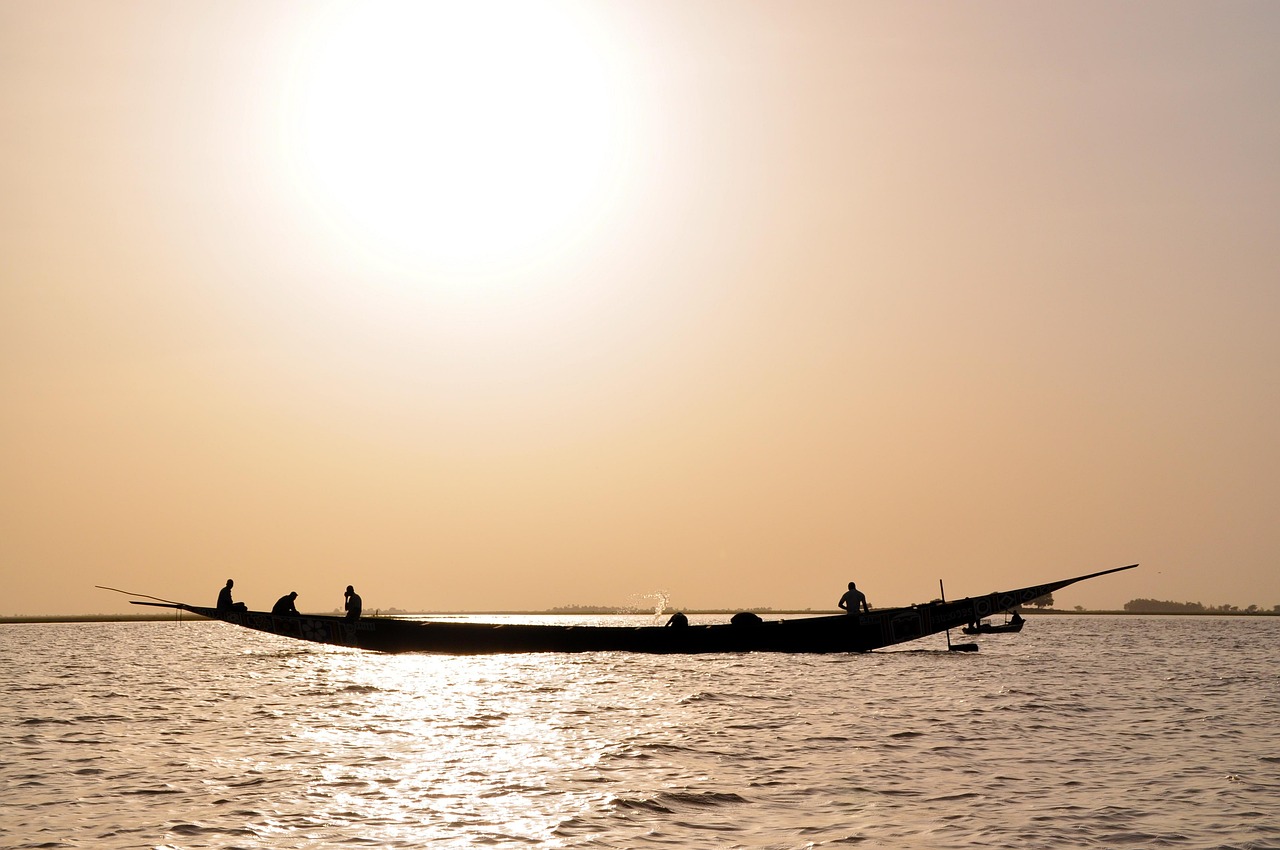
The defining craft of the Songhay is the building of boats, for on the river the canoe is everything. From long planks sewn and pegged together the boatwrights fashion the pirogues that carry people, grain, fish, and cattle up and down the Niger, some of them large enough to bear whole families and their goods. The knowledge of shaping a hull that will ride the flood and slip through the shallows is a specialised inheritance, and the boat-builders hold an honoured place among the river trades.
Weaving and dyeing clothe the Songhay world, as they do across the Sahel. On narrow looms weavers produce long strips of cotton that are stitched into blankets and robes, and dyers turn plain cloth into the deep indigo and patterned fabrics of festival dress. The blacksmiths, working iron in their forges, make the hoes, knives, spears, and tools on which farming and fishing depend, and their command of fire ties them in local belief to the world of spirits and secret knowledge.
Leatherworkers, potters, and the makers of musical instruments complete the circle of Songhay crafts. Skins are tanned and tooled into sheaths, sandals, and amulet cases, clay is shaped into the pots that store water and grain, and the carvers fashion the drums and the godji fiddle whose voices summon the spirits. Each of these trades tends to run within particular families, so that skill, status, and identity are bound together in the old pattern of the river society.

Rice, Millet, and the Fish of the Niger
Songhay food is the food of the river and the flood plain, built above all on grain and fish. Millet and sorghum, grown in the fields left moist by the retreating flood, are pounded into flour and cooked into the thick porridge that is the daily bread of the Sahel, eaten with sauces of vegetables, herbs, and dried fish. Rice too has long been grown in the wet lands of the inner Niger, and along the river it joins millet as a staple that fills the bowl at the centre of the family meal.
From the Niger itself comes the great gift of fish, and the Songhay are famous as fishermen and fish-eaters. Captain fish, catfish, and many other species are caught in nets and traps, then eaten fresh, or dried and smoked to preserve them and to trade far inland. Dried and pounded fish flavours the sauces that dress the porridge and rice, so that even a meal far from the water carries the taste of the river. Milk and meat from cattle, sheep, and goats round out the diet, especially at feasts.
Cooking is a communal art, and the sharing of a single great bowl expresses the same values of hospitality and family that shape all of Songhay life. Tea, brewed strong and sweet and poured in the ritual rounds common across the Sahel, punctuates the day and the visit, an excuse to sit and talk in the heat of the afternoon. In its reliance on millet, rice, and the fish of the Niger, the Songhay table is a direct expression of the river world that has fed this people for a thousand years.

Weddings, the Muslim Feasts, and the Spirit Dances
The Songhay year is marked by the great feasts of Islam, shared with Muslims across the world but coloured everywhere by local custom. Tabaski, the feast of the sacrifice, is the grandest, when families that can afford it slaughter a ram, dress in new and splendid clothes, and move between households sharing meat and greetings. The end of the fasting month is likewise a time of prayer, feasting, and visiting, and the birth of the Prophet is honoured with recitation and song. Around these fixed points the religious year turns.
Woven among the Muslim feasts are the ceremonies of family life that function as festivals in their own right. The naming of a newborn a week after birth, the great weddings that can last for days, and the rituals of mourning all draw the community together with drumming, praise-singing, and the flow of gifts and food. These are the moments when a family displays its standing and its generosity, and when the bonds of kinship and neighbourhood are publicly renewed before the eyes of all.
Most distinctive of all are the spirit ceremonies of the Holey cult, which gather crowds for the drama of possession and healing. On these occasions the drummers and the fiddler play through the night, dancers fall into trance, and the spirits are entertained, questioned, and appeased. Blending the sacred and the spectacular, these gatherings are festivals of a very old kind, and they sit alongside the mosque and the Muslim calendar in the layered ritual life that the Songhay have carried down the centuries.

From Sonni Ali to the Fall of Gao
The Songhay rose from a small kingdom based at Gao, which for centuries had been a trading town on the Niger and at times a tributary of the older empire of Mali. In the fifteenth century a warrior king named Sonni Ali threw off that overlordship and forged an empire, seizing Timbuktu and Djenne and building a mighty river fleet that carried his armies along the Niger. Fierce, feared, and remembered in tradition as a great magician as much as a general, he laid the foundations of Songhay greatness in a single reign of conquest.
After his death power passed to one of his generals, who took the throne as Askia Muhammad and founded a new dynasty. Under the Askias the empire reached its height, its administration refined, its trade in gold and salt flourishing, and its cities famous for learning across the Muslim world. For most of the sixteenth century the Songhay Empire was the dominant power of the western Sudan, larger and richer than the states of Mali and Ghana that had gone before it, a colossus astride the desert trade.
The end came with terrible suddenness in 1591, when an army sent by the Sultan of Morocco crossed the Sahara carrying firearms the Songhay had never faced. At the battle of Tondibi the imperial forces were shattered, and the great cities fell one by one. The empire dissolved into smaller successor states and a long twilight of decline, and the trans-Saharan trade that had made it rich began to wither. Yet the Songhay people endured along their river, carrying the memory of empire into the centuries that followed.

The Songhay of Mali and Niger in the Modern World
Today the Songhay are a large people divided among several modern nations, their heartland split between Mali and Niger with communities reaching into Benin, Burkina Faso, and beyond. In Niger the closely related Zarma-Songhay form one of the largest groups in the country and are strongly represented in its capital and its government, while in Mali the Songhay of the Timbuktu and Gao regions remain the great people of the north. Across these borders they keep a shared sense of belonging to the old river civilisation.
Modern times have not been gentle to the Songhay homeland. The northern regions of Mali have suffered repeated rebellions, conflict, and the disruption of the very cities, Timbuktu and Gao, that were once the glory of the empire, and the ancient manuscripts of Timbuktu had to be rescued and hidden to save them from destruction. Drought and the slow spread of the desert press on the farming and herding that sustain river life, and many young Songhay migrate to the cities or abroad in search of work.
Yet the culture endures with remarkable strength. The language is spoken by millions and carried by radio, music, and a lively diaspora, the spirit ceremonies still gather the faithful, and the memory of Sonni Ali and the Askias remains a living source of pride. Songhay musicians have carried the sound of the river to the wider world, and scholars continue to study a people whose empire once rivalled any on earth. From the flood plains of the Niger, the Songhay carry their long history forward into an uncertain but resilient future.
Related Peoples of the Region
- Igbo of the Republican Villages and Their Nation That Crowned No King
- Ashanti of the Golden Stool and Their Forest Empire of Gold
- Dogon of the Bandiagara Cliffs and Their World Carved Into the Rock
- Bambara of the Upper Niger and Their Antelope Dance of the Farming Cults
- Wolof of the Senegal Coast and Their Nation of Teranga
- Mossi Horsemen of the Volta Plateau and Their Kingdoms That Defied Every Empire
- Ewe of the Lagoon Coast and Their Drums That Conquered the World
- Kanuri of Lake Chad and Their Empire That Lasted a Thousand Years
More Peoples of the World
You May Like
The Zaza, a Mountain People of Eastern Anatolia