In the high mountains of southern China and Southeast Asia, and now in cities far across the world, live the Hmong, a people of the heights without a state of their own. Bound together by their language, their clans, and their dazzling embroidered dress, they have kept their identity through centuries of migration and war.
Theirs is a heritage of terraced mountain fields and shaman’s drums, of the reedy qeej and the ball-tossing courtship of the New Year, carried from the ridges of Asia to the American diaspora. To know the Hmong is to meet one of the world’s most resilient and widely scattered peoples.
The Hmong on Film
Contents
- Origins
- The Name
- The Language
- The Homeland
- The Old Way of Life
- Society and Community
- Religion and Belief
- Traditions
- Crafts
- Food
- Festivals
- History
- Today
Origins

The Hmong are a mountain people of Southeast Asia and southern China, one of the subgroups of the wider Miao nationality of China. Speaking a language of the Hmong-Mien family and living scattered across the highlands of several countries, they are a people without a state of their own, bound together by language, dress, and custom.
The Hmong trace their origins to southern China, where their ancestors lived for thousands of years before pressure and conflict drove many of them southward over the past few centuries into the highlands of Vietnam, Laos, Thailand, and Myanmar. There they settled the high ridges above the valley-dwelling lowland peoples.
The Name
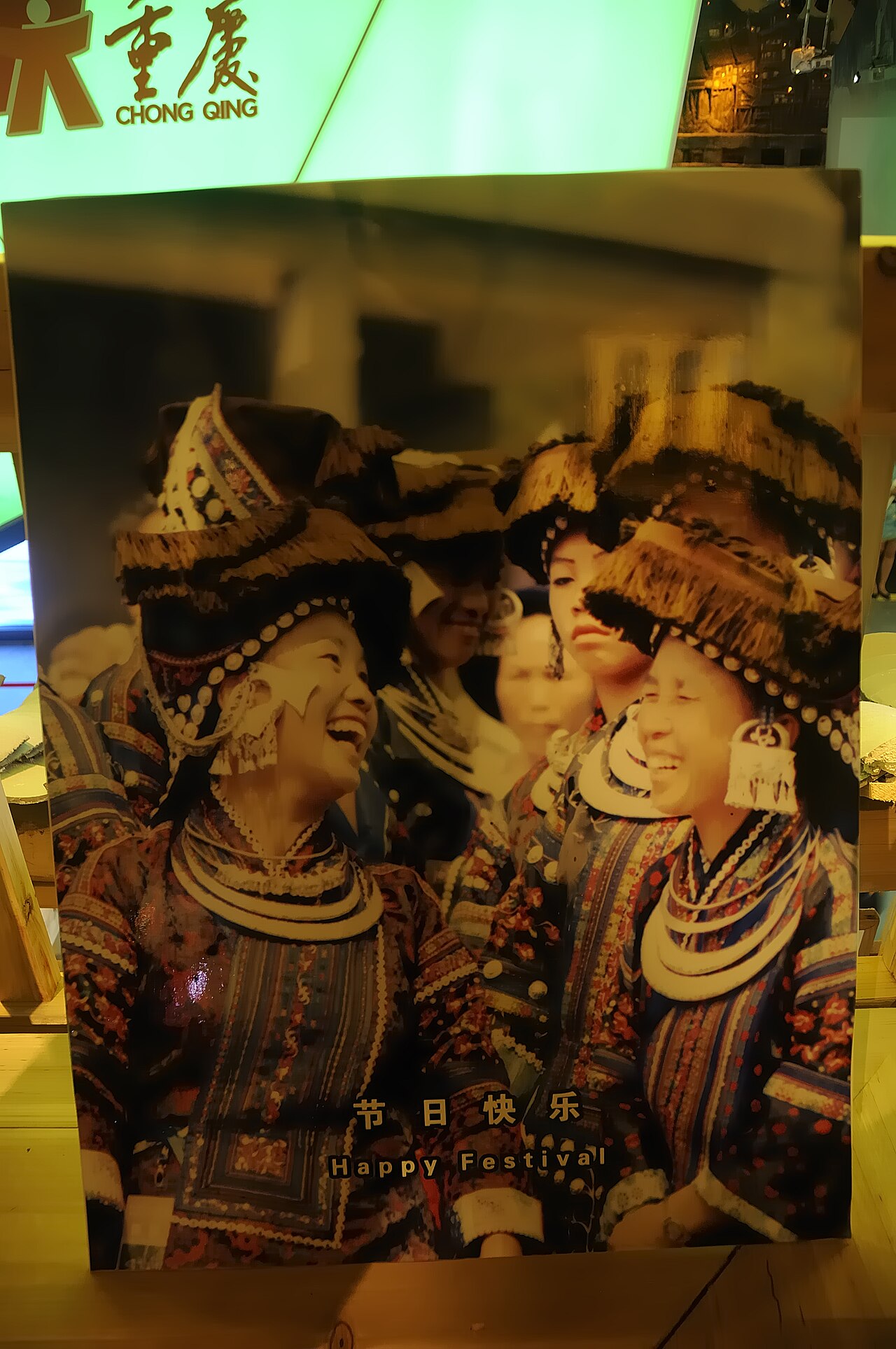
The people call themselves Hmong, a name they prefer to the older term Miao once used, sometimes disparagingly, in China. They are divided into subgroups often named for the colours and styles of their dress, such as the White Hmong, the Green Hmong, and the vividly costumed Flower Hmong.
These subgroups share a common language, in dialects that are mostly mutually intelligible, and a strong sense of being one people. To be Hmong is to belong to this highland nation spread across the mountains of several countries and, in recent times, the wider world.
The Language

The Hmong language belongs to the Hmong-Mien family, a distinct group of tonal languages of southern China and Southeast Asia. Its main dialects, White and Green Hmong, are spoken across the highlands, and the language is rich in oral poetry, sung courtship, and the coded music of the qeej.
For most of their history the Hmong had no writing, and their history and lore were carried in memory, song, and the patterns of their embroidery. In the twentieth century a romanised script was devised, and the Hmong today write their language in the Latin alphabet.
The Homeland

The Hmong homeland is not a single country but the high mountains of a broad region, from the hills of Guizhou and Yunnan in southern China through the highlands of northern Vietnam, Laos, and Thailand. They are people of the heights, traditionally settling the upper slopes above the valleys held by other peoples.
In these misty mountains they cleared the forest for their fields and built their villages on the ridges, carving terraces into the steep slopes near Sapa and elsewhere. The highland forest and the mountain field shaped the Hmong way of life.
The Old Way of Life

Traditionally the Hmong were highland farmers, practising shifting cultivation of rice, maize, and other crops on the steep mountain slopes, and in some areas building spectacular terraces. They raised pigs, chickens, and buffalo, and hunted and gathered in the forest.
Village life was organised around the clan and the household, and the growing of the opium poppy, long a cash crop of the highlands, brought both income and, in time, great trouble. Self-sufficient and independent, the Hmong lived apart from the lowland states in their mountain world.
Society and Community

Hmong society is organised around patrilineal clans, some eighteen in number, which cross all the subgroups and countries and bind the people together. Clan membership governs identity, marriage, and mutual obligation, and a man’s clan is his family wherever he travels in the Hmong world.
The household, headed by the eldest male, and the clan, led by respected elders, are the pillars of Hmong life. Loyalty to kin, the duties of hospitality and mutual aid, and the customs of the clan remain central even among the Hmong of the diaspora.
Religion and Belief
Most Hmong traditionally follow their own animist and shamanist religion, honouring ancestors and a world of spirits, and calling on shamans to heal the sick by negotiating with the spirit world. Elaborate rituals, especially at funerals, guide the soul and bind the living to the dead.
The music of the qeej, the bamboo mouth-organ, is played to speak to the spirits and to lead the soul at funerals. Many Hmong, especially in the diaspora, have become Christians, but shamanism and ancestor worship remain central to Hmong identity for many of the people.
Traditions

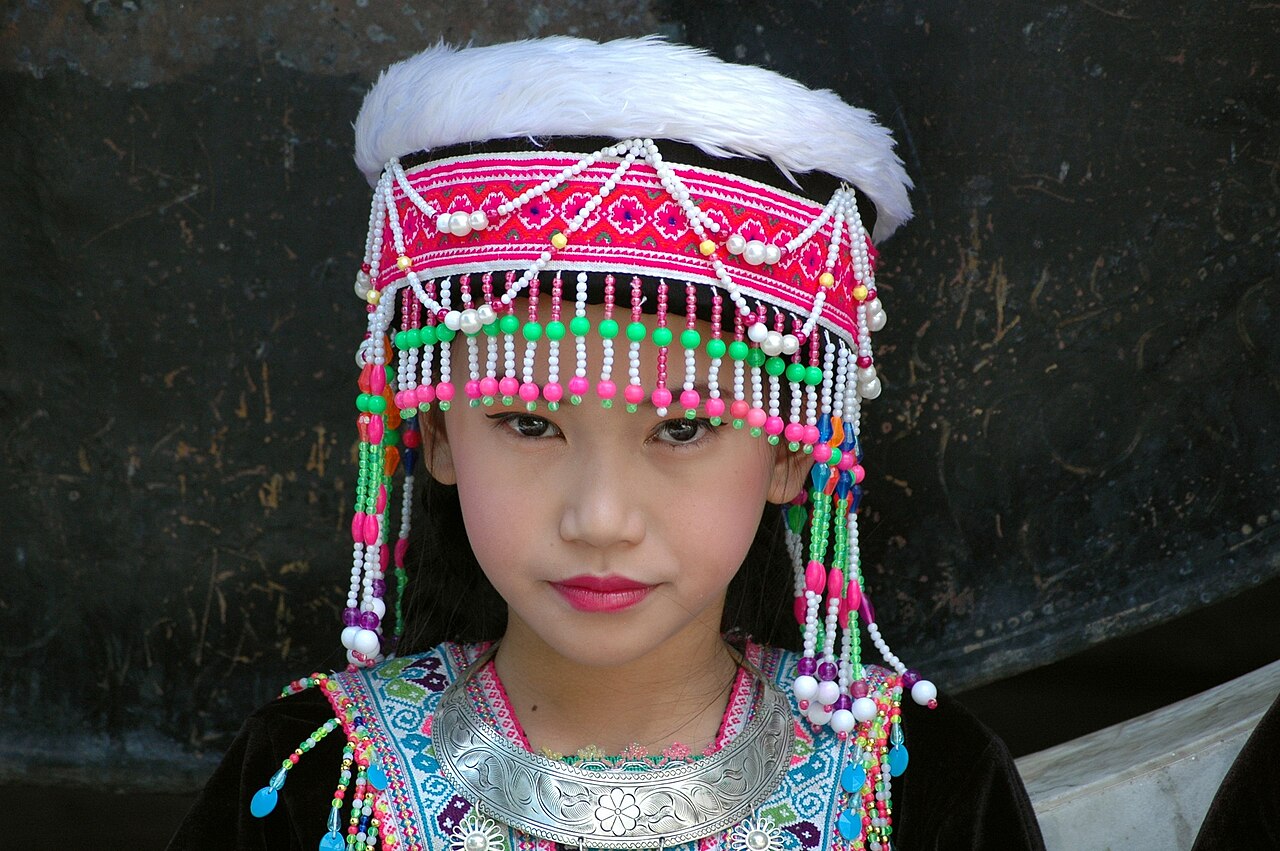
The great Hmong tradition is the New Year, celebrated after the harvest, when families honour their ancestors, young people court in the ball-tossing game of pov pob, and the community gathers in its finest embroidered dress. Sung poetry, the music of the qeej, and bullfighting and other contests mark the festival.
Courtship customs, the elaborate rituals of the life-cycle, and above all the wearing of magnificent handmade costume express Hmong identity. These traditions, carried across borders and oceans, bind the scattered Hmong nation together.
Crafts

The most celebrated Hmong craft is textile art, above all paj ntaub, or flower cloth, the intricate embroidery and appliqué worked by women onto costumes, baby carriers, and hangings. Batik, in which patterns are drawn on cloth with hot beeswax before dyeing, is another distinctive Hmong art.
Hmong women also work fine silver jewellery, worn in abundance at the New Year, and the making of the qeej and other crafts belongs to the men. These arts, especially the storied embroidery, carry the history and identity of a people who long had no written word.
Food

Hmong cuisine is the hearty fare of a highland farming people, built on rice, maize, vegetables, and the meat of pigs and chickens raised in the village. Meals are simple and fresh, with boiled and stir-fried greens, rice, and dishes flavoured with herbs and chilli.
Hmong sausage, stuffed with herbs and rice, and larb, a spicy minced-meat salad shared with their lowland neighbours, are favourites, and special dishes mark the New Year and family celebrations. Food and its sharing are central to Hmong hospitality and ritual.
Festivals

The Hmong New Year is the great festival of the people, held at the end of the harvest, when work is set aside for feasting, courtship, music, and the honouring of ancestors. Young men and women toss cloth balls back and forth in the courtship game of pov pob, and communities gather in dazzling embroidered finery.
The festival, celebrated wherever the Hmong live, from the mountains of Asia to the cities of America, is the great reaffirmation of Hmong identity. Its music, dress, and games keep the traditions of the highland nation alive across the world.
History
For centuries the Hmong resisted domination and assimilation in China, rising repeatedly against imperial rule before many migrated south into the highlands of Southeast Asia. There too they clung to their independence in the mountains above the lowland kingdoms.
The twentieth century drew the Hmong into wider wars. During the conflict in Indochina, many Hmong in Laos, recruited and armed by the United States, fought against the communist forces; when the war was lost in 1975, they faced persecution, and tens of thousands fled to refugee camps in Thailand and then to resettlement in the United States and other Western countries.
Today

Today the Hmong number several million in China and Southeast Asia, with a large and vibrant diaspora, above all in the United States, formed by the refugees of the Indochina wars and their descendants. In the mountains of Asia many still farm the highlands, while others have moved to the towns.
Modern Hmong life stretches from remote mountain villages to American cities, and the community works everywhere to preserve its language, its clans, its embroidery, and its New Year. Their strong clan bonds and rich traditions continue to unite one of the world’s most widely scattered peoples.
Related Peoples of the Region
More Peoples of the World
You May Like
The Damara, an Ancient People of Namibia