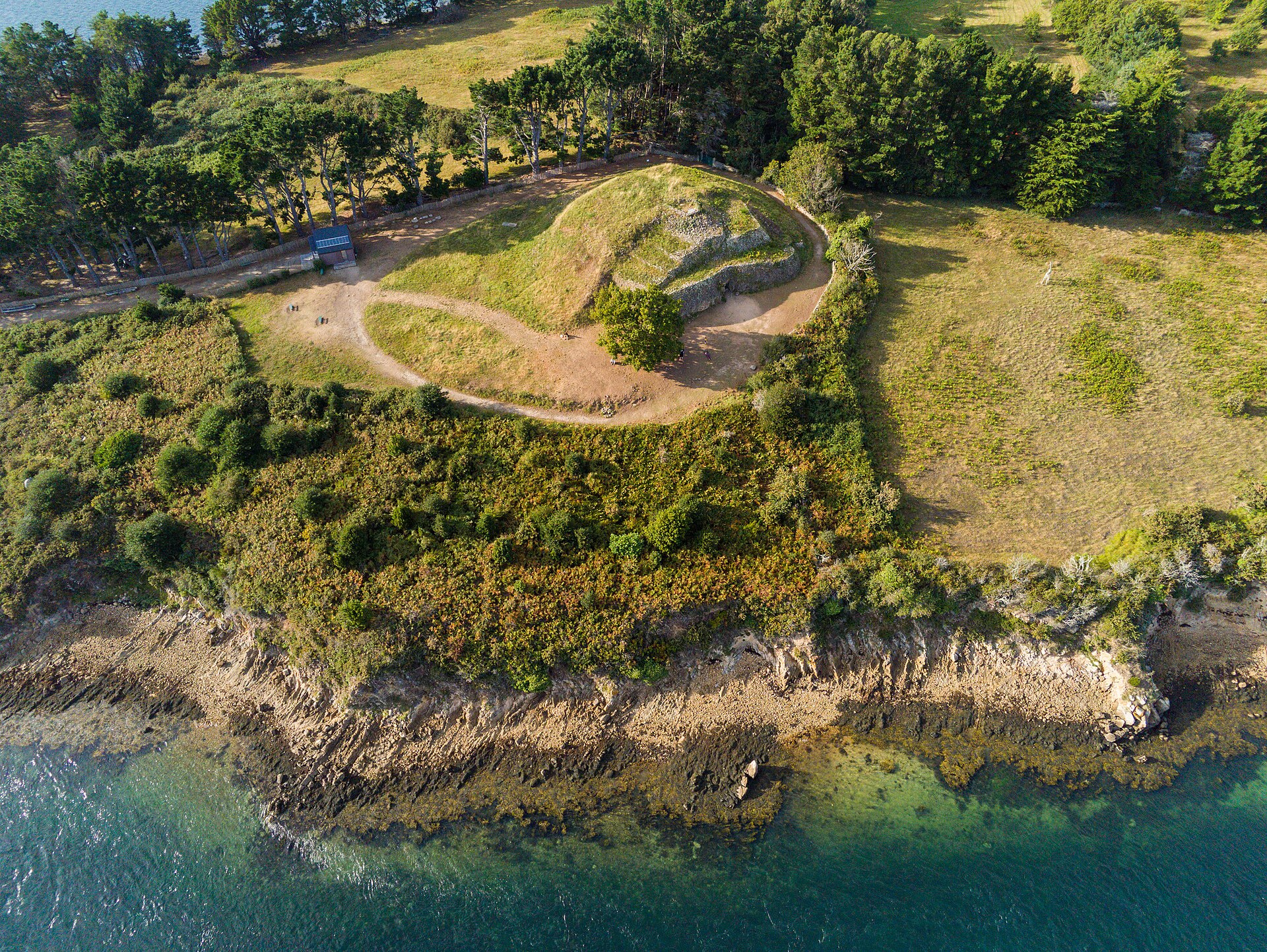
There is a small island in the Gulf of Morbihan, off the south coast of Brittany, that you can only reach by boat. It is quiet, green, and unremarkable at first glance. But under the grassy mound at its centre lies one of the most extraordinary works of art in all of prehistory: a stone passage whose walls are almost completely covered in swirling, hypnotic engravings, carved by hand around six thousand years ago. This is Gavrinis, and once you have seen its interior, you never quite forget it.
I have wanted to write about Gavrinis for a long time, because it upends everything we assume about what “Stone Age” art could be. We picture rough scratches and simple lines. Gavrinis gives us instead a dense, flowing, almost overwhelming decorative scheme, slab after slab of interlocking arcs, spirals, and shapes, executed with a confidence and intensity that has led people to call it the Sistine Chapel of the megalithic world. That comparison is grand, but standing in that passage, it does not feel like an exaggeration.
- An island that was once a hill
- The cairn and its hidden passage
- Walls of swirling stone
- What do the carvings mean?
- The broken stone that links three monuments
- Building and sealing the tomb
- Lost, robbed, and found again
- Why go to all this trouble?
- Why Gavrinis matters
- Crossing to the island today
- A crowded ritual landscape
- How old is it, and how do we know?
- The power of the passage
- Older than almost everything
- The people who carved the stone
- Standing at the edge of understanding
An island that was once a hill
The first thing to understand about Gavrinis is that its island setting is an accident of time. When the monument was built, around 4000 BCE, the sea level was significantly lower than it is now, and Gavrinis was not an island at all but a hill overlooking a coastal plain. The rising seas of the following millennia gradually drowned that landscape, turning the surrounding lowland into the maze of water and islets we now call the Gulf of Morbihan.
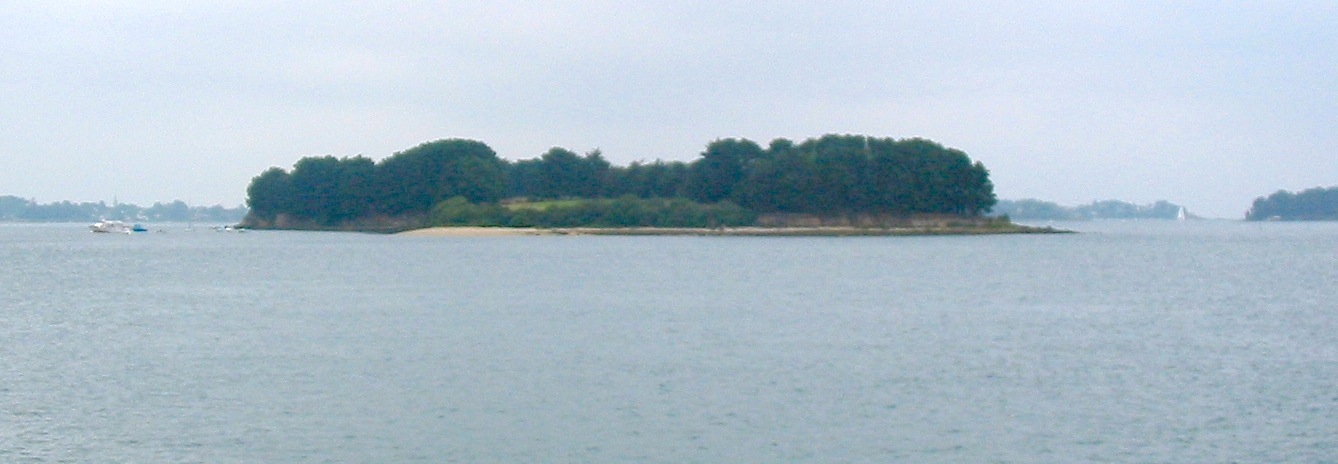
This matters because it changes how we should picture the monument in its own time. The builders did not paddle out to a remote islet to raise their tomb. They chose a prominent hill in a living landscape, a place that would have been visible and accessible, part of a dense concentration of megalithic monuments across this corner of Brittany. Only later did the sea come and set Gavrinis apart, wrapping it in the romantic isolation we see today.
I find that transformation strangely moving. The very thing that makes Gavrinis feel so special now, its lonely island setting, is not what the builders intended at all. Nature edited their monument, drowning the world around it and leaving it stranded on the water. The Gavrinis we visit is a collaboration between Neolithic ambition and the slow, indifferent rise of the sea.
The cairn and its hidden passage
From the outside, Gavrinis is a cairn: a great mound of drystone, carefully built up over the burial structure at its heart. The reconstructed exterior gives a sense of its scale, a broad, stepped mass of stone crowning the hill, the kind of monument that announced itself across the landscape.
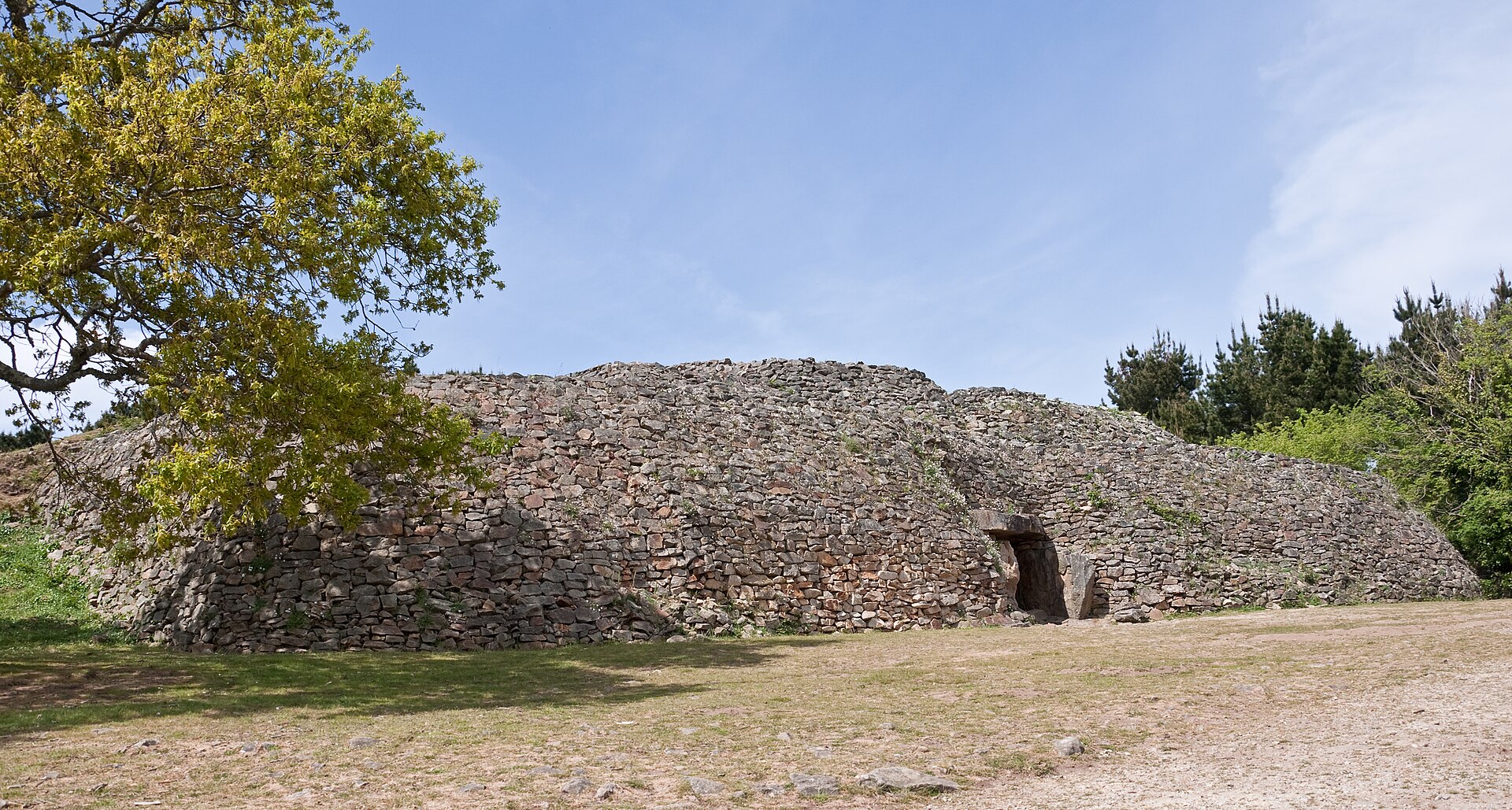
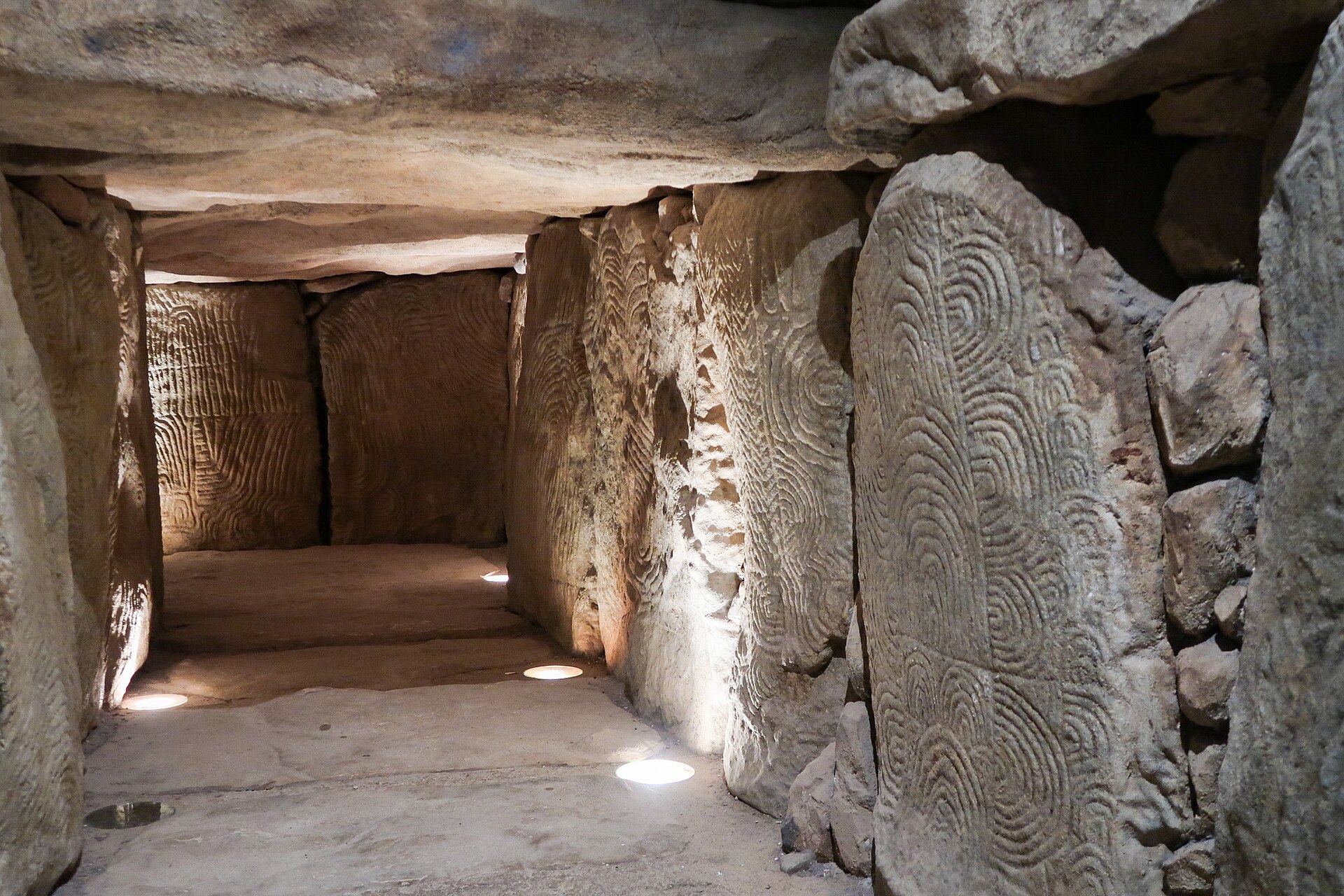
But the real wonder is inside. A single passage runs in from the edge of the cairn, roughly thirteen or fourteen metres long, leading to a chamber deep within the mound. You enter through a low doorway and walk, or stoop, down this stone corridor into the dark heart of the monument, exactly as the Neolithic builders and mourners once did.
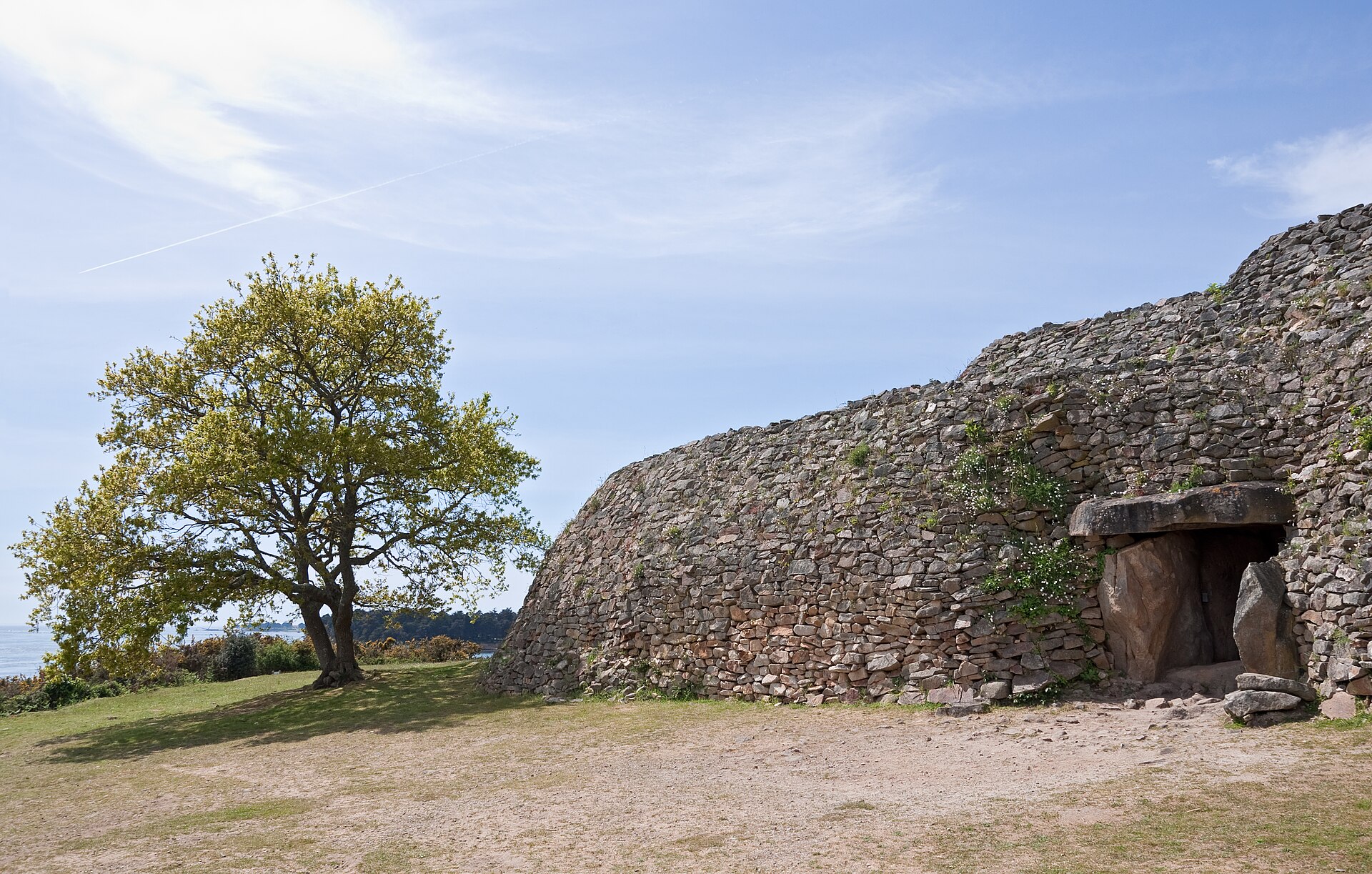
It is a classic passage tomb in its architecture, part of the great family of such monuments that spread across Atlantic Europe. What sets it utterly apart from its cousins is not the shape of the passage but what covers its walls. Because at Gavrinis, almost every upright slab lining that corridor is carved, and the effect of walking between them is like nothing else in the prehistoric world.
Walls of swirling stone
The engravings at Gavrinis are the reason people travel across the world to a tiny Breton island. Of the slabs lining the passage and chamber, the great majority are decorated, and not sparingly. They are covered, edge to edge, with a dense repertoire of motifs: nested arcs and semicircles, wavy lines, spirals, zigzags, and shapes that have been interpreted as axes, shields, and other objects.
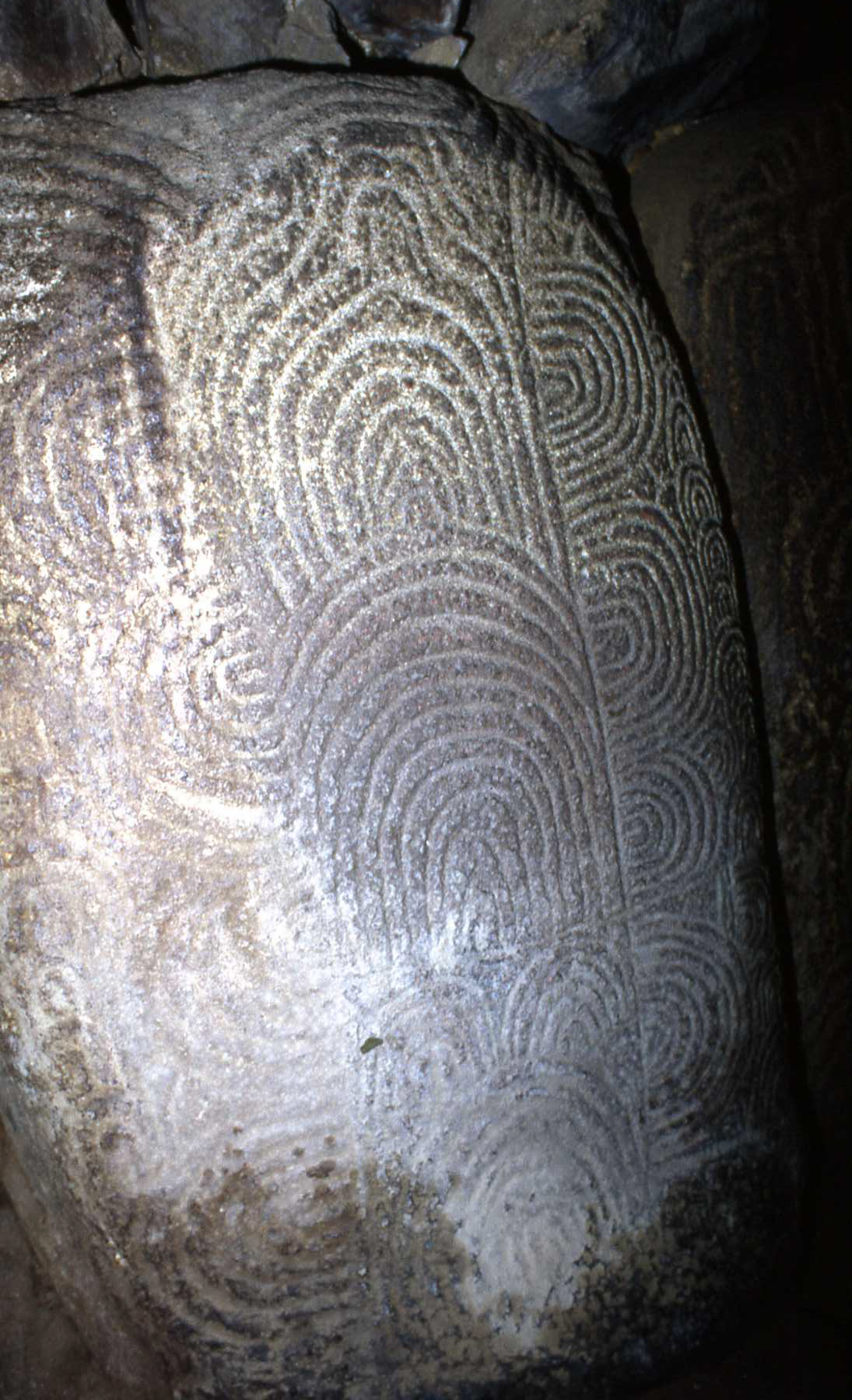
The overall impression is of movement and rhythm. The nested curves ripple across the stones like fingerprints or contour lines or the surface of water, and because slab follows slab down the passage, the eye is carried along in a kind of visual current. It is deeply patterned, almost obsessive, and the more you look, the more you see. This is not decoration added as an afterthought; it is an integral, overwhelming part of the monument’s design.
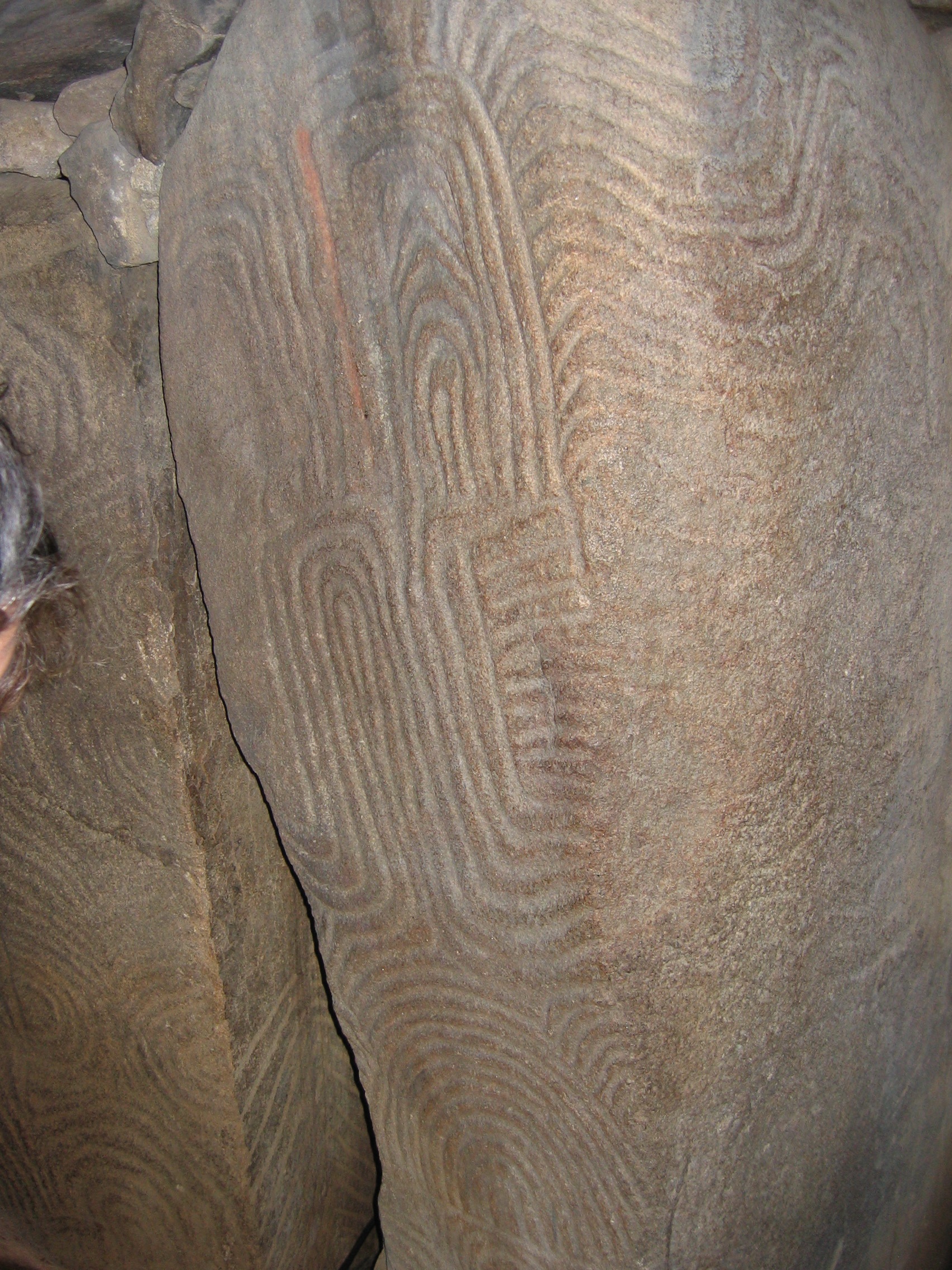
What astonishes me most is the sheer labour and skill involved. Every one of these lines was pecked and ground into hard stone with stone tools, by people with endless patience and a clear artistic vision. To carve a single slab this densely would take enormous time; to carve almost the entire passage is a staggering commitment. Whatever drove them, it mattered to them profoundly.
What do the carvings mean?
And of course we want to know: what do they mean? This is the great, tantalizing question of Gavrinis, and the honest answer is that we do not know for certain. The motifs are abstract or semi-abstract, and without any written key, their meaning is lost to us. But that has not stopped people from thinking hard about them, and some ideas are more persuasive than others.
Some of the shapes do seem to depict real things: forms widely read as stone axes, which were powerful symbolic objects in this culture, and possibly bows or shields. Others, the great fields of nested arcs and spirals, resist any literal reading. They may be symbolic, representing water, or the sun, or some cosmological idea; they may be connected to ritual states of mind; or they may carry meanings we cannot even imagine from our vantage point.
I try to hold that uncertainty lightly rather than forcing an answer. What seems undeniable is that this was sacred, meaningful decoration, not idle ornament. Somebody covered a tomb passage in these signs deliberately, at enormous cost, because the images did something, whether protecting the dead, honouring them, marking the passage between worlds, or invoking powers we can no longer name. The carvings are a message we can see perfectly and read not at all.
The broken stone that links three monuments
One of the most remarkable discoveries about Gavrinis is almost a detective story. The great capstone that roofs the chamber turns out to be a broken piece of a much larger, older carved standing stone, an orthostat that had once stood upright elsewhere and was later broken up and reused. That in itself is fascinating, but the twist is better still.
Other fragments of that same original stone have been found reused as capstones in two other, separate megalithic monuments in the region, some distance away. In other words, a single enormous decorated stone was broken into pieces, and those pieces were carried off and built into three different tombs, including Gavrinis. The carvings on the fragments can be matched across the sites, fitting together like the pieces of a shattered whole.
Think about what that implies. It means these monuments were not isolated; they were connected, part of a shared world in which a sacred stone could be broken up and its power, perhaps, distributed among several tombs. It hints at histories we can barely glimpse: an older monument dismantled, its great stone deliberately fragmented and shared out, its pieces given new life deep inside younger tombs. Prehistory here is layered, recycled, and interconnected in ways that still surprise us.
Building and sealing the tomb
The construction of Gavrinis was a huge undertaking. The great slabs that line the passage and form the chamber had to be quarried, moved, and set upright, then carved; the drystone cairn had to be piled up over and around them; and the whole thing had to be engineered to stand and to keep its interior intact. All of this by people without metal tools, wheels, or draft animals, relying on muscle, timber, rope, and deep collective effort.
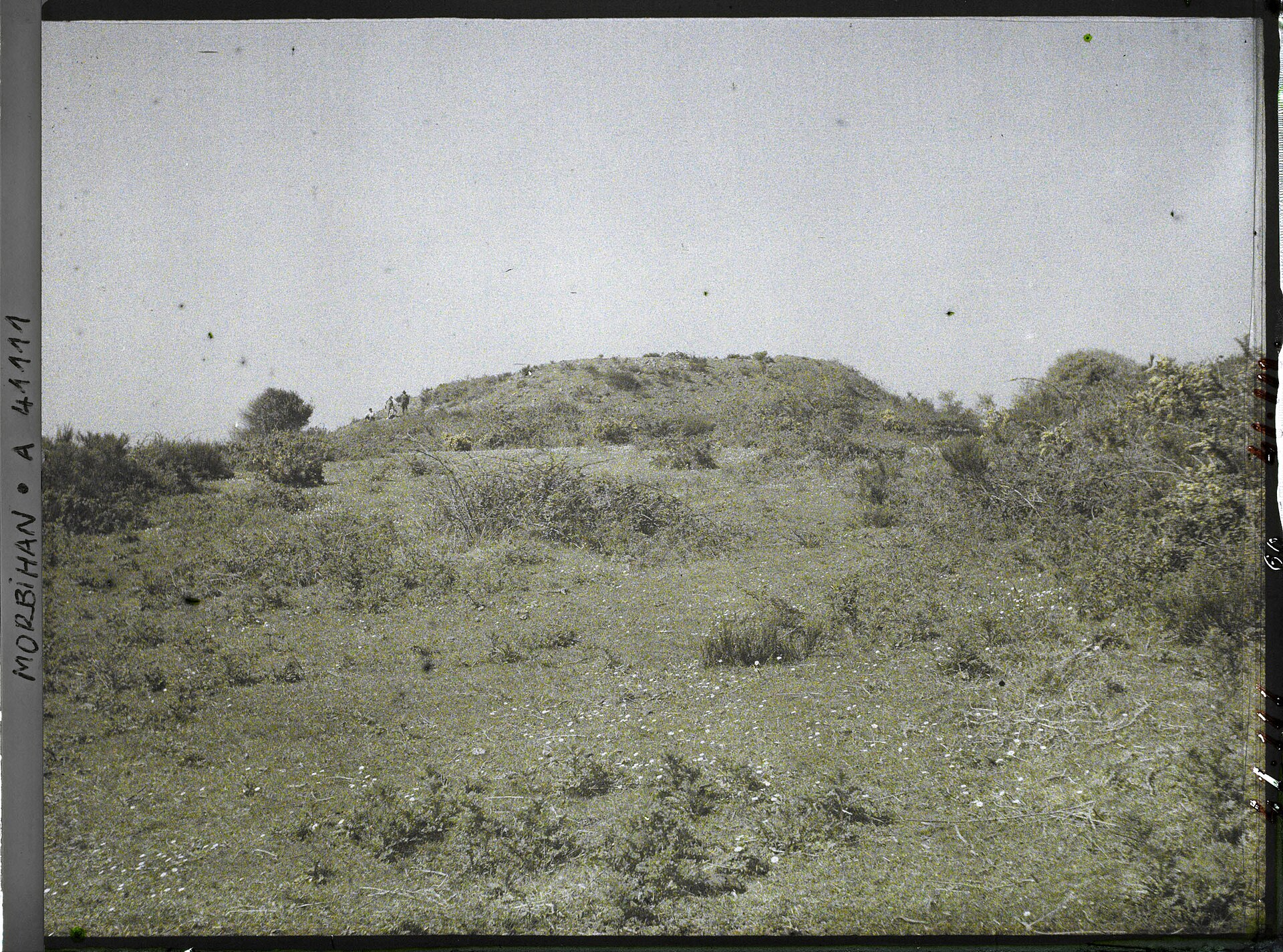
And then, after all that labour, the monument was deliberately sealed. At some point the passage was blocked and the entrance closed off, shutting the carved interior away in total darkness. The very artwork that had cost so much to create was hidden from human eyes, sealed inside the mound, perhaps meant only for the dead or the divine rather than for the living.
There is something profound in that act of sealing. The builders poured extraordinary effort into a masterpiece and then closed it away, as if the making mattered more than the seeing, or as if the intended audience was never us at all. It is a humbling thought: that the most beautiful passage in prehistoric Europe was created to be shut in the dark, and stayed that way for thousands of years.
Lost, robbed, and found again
Because it was sealed and then buried under its own collapsing mound, Gavrinis was effectively lost for millennia. The monument survived precisely because it was hidden, protected by the very cairn that entombed it. It was not until the eighteenth century that the site began to draw serious attention, and proper exploration of the passage followed later.
When people finally re-entered the passage and saw the carved slabs by lamplight, the effect must have been electrifying. Here was an interior unlike anything else known, its walls alive with engraving, preserved almost perfectly by its long burial. The rediscovery of Gavrinis transformed our understanding of what megalithic people were capable of artistically.
Since then the monument has been studied, restored, and protected, its cairn partly reconstructed so that visitors can experience the passage much as it would have been. The carvings that were meant to stay hidden forever are now, thanks to careful conservation, among the most admired images from the whole of European prehistory. History has reversed the builders’ decision to seal them away.
Why go to all this trouble?
The question that haunts Gavrinis is simply: why? Why would a Neolithic community invest so much, quarrying and raising and carving and building, to create a masterpiece and then bury it? There is no certain answer, but a few threads feel convincing when woven together.
Part of it is surely about the dead and the sacred. A tomb this elaborate was clearly meant to honour and contain something of great importance, whether the remains of revered ancestors or a focus for ritual. The carvings may have been an offering, a protection, or a way of charging the space with meaning and power. The effort itself was part of the point; extravagant labour is a way of declaring that something matters supremely.
Part of it may also be about the community of the living. Building Gavrinis together, over years, would have bound people into a shared project and a shared belief, forging identity and cohesion through collective effort and ritual. The monument was a statement to themselves and to the wider megalithic world around them: here is who we are, and here is what we can do. In creating it, they created themselves as a people.
Why Gavrinis matters
Gavrinis matters, first, because it rewrites our sense of prehistoric art. This is not crude or tentative work; it is a sustained, sophisticated, overwhelming artistic achievement, produced six thousand years ago by people with stone tools. It proves that the Neolithic imagination could be as ambitious and as visually intense as anything in later ages.
It matters, too, for what it reveals about connection and continuity. The broken reused stone linking Gavrinis to other monuments shows a world of shared beliefs and interlinked sites, in which sacred objects had histories and could be dismantled and redistributed. This was not a scatter of isolated tombs but a coherent ritual landscape, dense with meaning and relationship.
And it matters as a human story of devotion and mystery. People gave their labour, their skill, and perhaps their faith to cover a hidden passage in beautiful, unreadable signs, and then sealed it in the dark. We can stand in that passage today and feel the force of their commitment while understanding almost nothing of its content. That gap, between the clarity of the effort and the silence of its meaning, is exactly what makes Gavrinis unforgettable.
Crossing to the island today
To see Gavrinis now, you take a small boat across the water from the Breton coast, weather permitting, and land on the quiet island. Visits to the passage are limited and guided, which is right for so fragile and precious a place. Inside, in the cool dark, you walk between the carved slabs with the swirling motifs pressing in on either side, and the outside world falls away.
It is an intense experience, far more so than a photograph can convey. The density of the carving, the closeness of the passage, the knowledge of its age and of the sea that drowned the land around it, all combine into something genuinely awe-inducing. You are standing inside the mind of a vanished people, surrounded by their most concentrated act of making, unable to read a word of it and yet moved beyond words.
That, in the end, is the gift of Gavrinis. It offers no easy answers, only an overwhelming encounter with the depth, skill, and mystery of the human past. Of all the places I could send someone who doubts what “Stone Age” people were capable of, this small carved passage on its drowned hill would be near the top of the list. Go into the dark, look at the swirling stone, and try to tell me these were simple people.
A crowded ritual landscape
Gavrinis did not stand alone. This corner of southern Brittany, around the Gulf of Morbihan and the town of Carnac, is one of the densest concentrations of megalithic monuments anywhere on Earth. Within a short distance are great alignments of standing stones, other cairns and dolmens, and enormous individual menhirs, together forming a landscape saturated with Neolithic meaning.
Seen in that context, Gavrinis is one node in an extraordinary sacred geography. The people who built it lived surrounded by monuments raised by their ancestors and their neighbours, in a land where the boundary between the everyday and the sacred must have felt very thin. The broken reused capstone, shared between three tombs, is a direct clue to how interconnected this world was.
Understanding that helps explain the ambition of Gavrinis. It was created in a culture that had been building in stone for many generations and that clearly placed immense value on monuments to the dead and the divine. Gavrinis is not a bolt from the blue but the dazzling high point of a long, rich local tradition of megalithic building and art.
How old is it, and how do we know?
The construction of Gavrinis is generally placed around 4000 BCE, in the Neolithic, which makes it older than Stonehenge and far older than the Egyptian pyramids. As always, it is fair to ask how such a date is established for a monument with no inscriptions and no written records.
The answer combines several strands. Radiocarbon dating of organic material associated with the monument gives a scientific anchor, measuring the decay of a radioactive form of carbon in ancient remains. This is cross-checked against the style of the architecture and carvings, which can be compared with other, dated megalithic monuments in the region, and against the reused history of the great broken stone, which implies an even older monument that came before.
Put together, these lines of evidence place Gavrinis firmly in the fifth millennium BCE, with the reused orthostat pointing to still earlier monumental activity nearby. The great age of the site is not romantic guesswork; it rests on careful science and patient comparison, which is exactly what makes it trustworthy.
The power of the passage
It is worth dwelling on what it would have been like to actually use Gavrinis, because the design seems built for experience, not just for burial. Picture approaching the low entrance, leaving daylight behind, and moving into the narrow passage by the flicker of a torch or lamp. On either side, the carved slabs would leap and shift in the moving light, their swirling lines seeming to writhe and flow.
The passage funnels you inward, deeper and darker, toward the chamber at the heart of the mound. Everything about that journey, the constriction, the darkness, the overwhelming carved surfaces, the sense of moving from the world of the living toward the world of the dead, feels deliberately staged. This was an architecture of experience, designed to move the body and the mind through a powerful, controlled sequence.
Whoever passed through here, whether priests, mourners, or initiates, was surely meant to be transformed by it, to feel awe, fear, reverence, or transcendence. Gavrinis is not just a container for the dead; it is a machine for producing a profound human experience, and that intention still works on visitors today, six thousand years later.
The people who carved the stone
Behind every one of those thousands of pecked lines was a human being, and I keep coming back to them. Carving hard stone with stone tools is slow, demanding, physical work. To decorate almost an entire passage this densely represents an immense investment of time and expertise, which means there were people in this community devoted, at least in part, to this kind of skilled making.
Were they specialists, artists in something like our sense, whose skill was recognized and valued? Were the carvings made by many hands over a long period, or by a few masters? Did the act of carving itself have ritual meaning, each line a kind of prayer or offering? We cannot know for sure, but the consistency and confidence of the work suggest real expertise and a shared visual language passed down and practised.
What moves me is that their skill reaches us directly, even though everything else about them is lost. We do not know their names, their language, their beliefs, or their faces. But we can see exactly what their hands did, line by patient line, and feel the intelligence and dedication behind it. Across six thousand years, the carvers of Gavrinis still speak to us in the only language that survived: the stone itself.
Standing at the edge of understanding
Gavrinis leaves me, every time, poised between knowing and not knowing, and I have come to think that is the truest response to it. We know so much: how old it is, how it was built, how the sea drowned its landscape, how a broken stone links it to other tombs. And yet the one thing we most want to know, what the carvings meant, stays just out of reach.
That combination is rare and precious. Some ancient sites give up their secrets readily; others are so ruined that little can be said at all. Gavrinis offers a perfectly preserved masterpiece whose content is perfectly opaque. We can read every line and understand none of them, which forces a particular kind of humility. It reminds us that the past is genuinely foreign, not just an earlier version of ourselves.
And perhaps that is fitting for a monument built to be sealed in the dark. Gavrinis was never meant to explain itself to us. It keeps its meaning the way it kept its carvings, hidden inside, offered to something other than the casual gaze. To stand in that passage is to be admitted to a mystery without being given the key, and there is a strange, lasting power in that.
Older than almost everything
To really appreciate Gavrinis, it helps to set it against the timeline we usually carry in our heads. When its carvers were at work around 4000 BCE, there were as yet no pyramids in Egypt, no cities in Mesopotamia at their later height, and no stone circle at Stonehenge. Much of what we think of as the ancient world lay far in the future.
That reframing is important, because it places Gavrinis not at the tail end of prehistory but near a creative frontier, among the earliest great artistic and architectural achievements of humanity. These Breton communities were not copying grander civilizations elsewhere; they were, in their own right, doing something genuinely pioneering, producing monumental art of a quality that would not be surpassed for a very long time.
So the next time the pyramids or the classical world are held up as the beginning of human artistic greatness, I think of a dark carved passage on a drowned Breton hill, older by millennia, and I smile. The story of human creativity starts far earlier than the famous chapters suggest, and Gavrinis is one of its most breathtaking opening pages.
Few monuments reward slow, patient attention the way Gavrinis does. Every visit, every fresh look at the swirling slabs, seems to reveal another rhythm, another echo, another question. That inexhaustible quality is the mark of truly great art, and it is astonishing to find it here, at the very dawn of monumental building.
If you ever get the chance to make the crossing, take it. Some places are worth a boat, a walk, and a long silence in the dark, and this small carved island is surely one of them.
In an age when we are surrounded by images we barely notice, there is something clarifying about standing before an image made with such effort and conviction that its makers thought it worth burying forever. Gavrinis asks us to slow down and truly look, and it repays that attention many times over.
Gavrinis is one jewel in a vast necklace of ancient wonders, and every other site in this series adds to its meaning. Its closest kin is the great Breton cairn of Barnenez, and the two belong to the same astonishing megalithic tradition as the tomb of Newgrange, the circle at Stonehenge, the temples of Malta, and the stone village of Skara Brae. For prehistoric art and symbol on stone, see the painted caves of Lascaux and Chauvet, the carved pillars of Göbekli Tepe and Karahan Tepe, the signs of Vinča, and the carved warriors of Cerro Sechín. To meet the farming villages of the same broad age, visit Çatalhöyük, Aşıklı Höyük, Mehrgarh, Jiahu, and the mega-settlements of Cucuteni-Trypillia. For the first cities and river civilizations that followed, explore Jericho, Uruk and Sumer, Mohenjo-daro, Dholavira, Kalibangan, Liangzhu, Sarazm and Tell Brak. And further afield await the palace of Knossos, the reef city of Nan Madol, the pyramids of Caral, the temple of Chavín de Huántar, the earthworks of Poverty Point, and the solar towers of Chankillo. Each is another chamber in the same great passage of human history. The deep past continues at Los Millares, a fortified Copper Age town at the edge of Europe. The same reaching-for-permanence runs through Bougon, a cluster of ancient French burial mounds well worth meeting. It sits well beside the story of Almendres, a Portuguese stone circle built eight thousand years ago. It pairs beautifully with the story of Ġgantija, a temple older than the pyramids themselves. It pairs beautifully with the story of Knowth, a five-thousand-year-old tomb in the heart of Ireland. It pairs beautifully with the story of Tarxien, Malta’s most elaborate temple, carved over five thousand years ago. It pairs beautifully with the story of Mnajdra, a coastal temple older than the pyramids and aligned with the sun. The clifftop sanctuary of Ħaġar Qim offers yet another window onto the world of the first builders. The brooding tomb of Dowth offers yet another window onto the world of the first builders. The great stone rows of Carnac offer yet another window onto the world of the first builders. The remote ring of Callanish offers yet another window onto the world of the first builders. The stone warriors of Filitosa offer yet another window onto the world of the first builders. The clifftop stone ship of Ale’s Stones offers yet another window onto the monuments of the deep past.
You May Like
The Bardo, a Palace of the Beys Filled With Roman Mosaics


2 thoughts on “Gavrinis: The 6,000-Year-Old Carved Passage They Sealed in the Dark”