Everyone has heard of Çatalhöyük, the famous 9,000-year-old town in Turkey where people walked across their rooftops and entered their homes through the ceiling. It is one of the superstars of prehistory. But Çatalhöyük did not appear out of nowhere. A few hundred years before it rose, and just a couple of hundred kilometers away, there was an earlier settlement already doing many of the same remarkable things. Its name is Aşıklı Höyük, and it is one of the oldest villages in central Anatolia, a place where you can watch the very earliest experiments in settled life unfold. If Çatalhöyük is the famous novel, Aşıklı Höyük is the rough first draft, and in some ways that makes it even more fascinating.

I have a real fondness for Aşıklı Höyük because it sits at such a pivotal moment. This is a community caught in the very act of becoming settled, of figuring out how to live together permanently in one place, how to farm, how to build homes that last, how to bury their dead and organize their lives. It is prehistory in the making, and the mound preserves that transition with a clarity you rarely find anywhere else.
Where is Aşıklı Höyük?
Aşıklı Höyük lies in central Turkey, in the province of Aksaray, on the banks of the Melendiz river in the broader region of Cappadocia. This is a dramatic volcanic landscape, and that volcanic geology turns out to be central to the whole story. The nearby mountains produced obsidian, the glassy black volcanic stone that ancient people prized above almost anything else for making razor-sharp tools, and Aşıklı Höyük sat close to some of the best sources of it in the world.
The river provided water and fertile land, the plains offered space for early crops and grazing, and the surrounding highlands supplied stone and other resources. It was, in short, a well-chosen spot, the kind of place where a community could put down roots and stay for centuries. And stay they did, building and rebuilding on the same site until the accumulated debris of their lives formed the mound we see today.
How old is it?
Aşıklı Höyük is genuinely ancient. Its main occupation dates to roughly 8000 BCE and continued for well over a thousand years, placing it firmly in the aceramic Neolithic, the period before pottery had been invented in this region. That makes the settlement around ten thousand years old, older than Çatalhöyük, older than the great cities of Mesopotamia, older than almost anything most people can name.

Because people lived here continuously for so long, the mound preserves a beautiful sequence of layers, each one representing a phase in the community’s development. Archaeologists digging through these layers can trace how the village grew and changed over the centuries, watching in slow motion as a group of people committed ever more fully to the settled, farming way of life. It is one of the clearest records anywhere of the early Neolithic in Anatolia.
Houses you entered through the roof
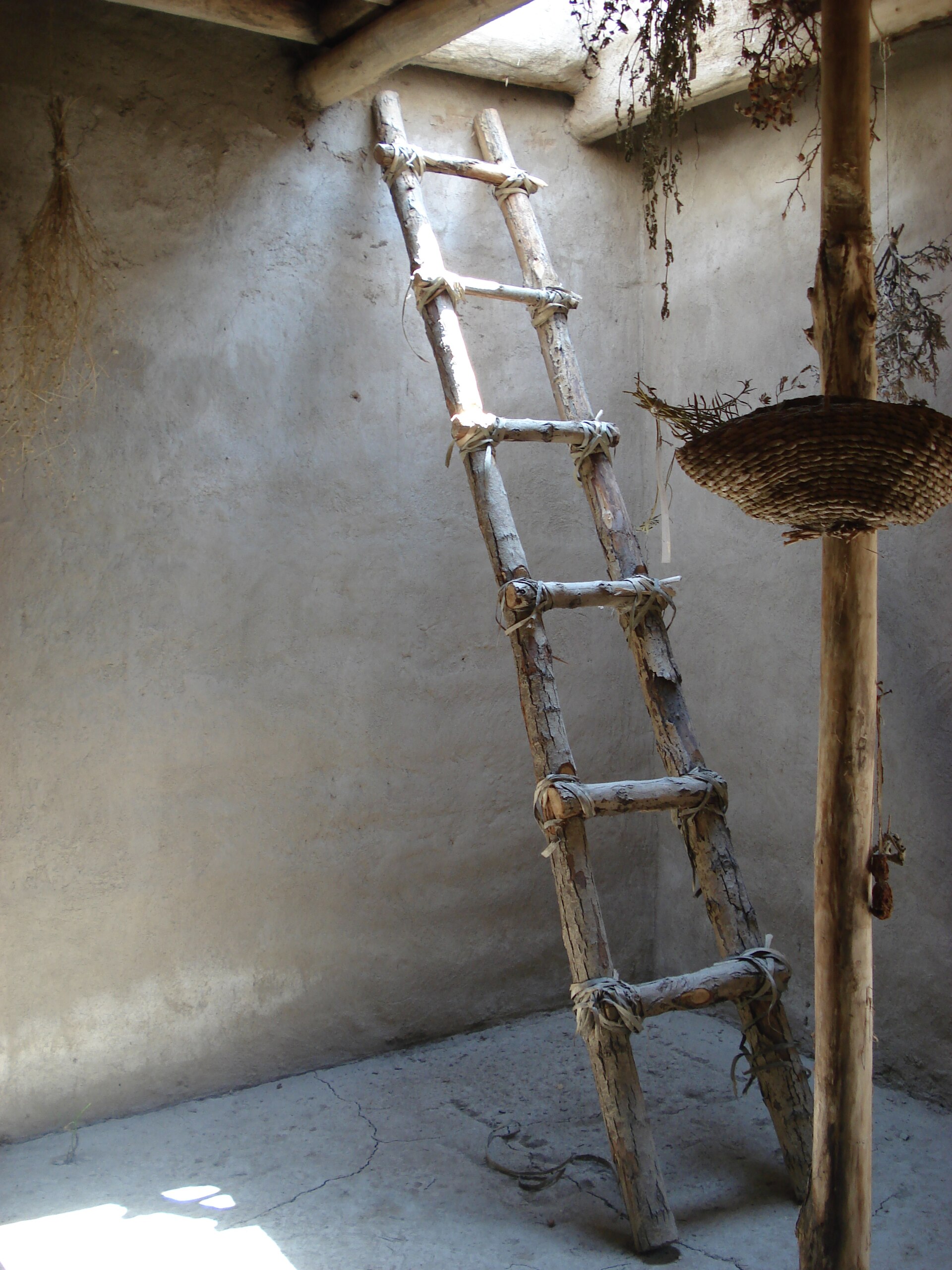
Here is the detail that connects Aşıklı Höyük so strikingly to its more famous successor. The houses here were built of mudbrick and packed so tightly together that there were essentially no streets between them. The buildings shared walls and clustered into dense blocks, and to get into your home you did not walk through a door at ground level. Instead, you climbed onto the roofs and entered your house through an opening in the ceiling, descending by a ladder into the room below.

If that sounds familiar, it is because it is exactly the arrangement that would later make Çatalhöyük so famous. The rooftops of Aşıklı Höyük effectively served as the community’s streets and open spaces, a whole layer of social life playing out above the packed houses. People would have walked across the roofs to visit neighbors, to work, and to gather, while the homes themselves stayed snug and defensible below. It is a completely different way of organizing a settlement from anything we are used to, and seeing it appear this early is genuinely thrilling.
The tight packing was not just quirky; it made sense. Sharing walls saved materials and labor, kept homes warm, and created a compact, cohesive community. But it also meant that daily life was intensely communal, with everyone living quite literally on top of one another. Learning to get along in such close quarters was one of the great social challenges of the early Neolithic, and Aşıklı Höyük shows people working it out.
Life around the hearth
Step down the ladder into one of these homes and you would find a single room, often with a hearth set into the floor. That hearth was the heart of the household, used for cooking, for warmth, and for the light it cast in the windowless interior. Around it, the business of daily life unfolded: preparing food, making and mending tools, sleeping, and simply being together as a family.

The floors were often plastered and kept clean, and the interiors were modest but functional. There were no grand public buildings dominating the early village in the way we might expect; life centered on the household and the immediate community. Yet within that simplicity lay a profound achievement. These people had solved the basic problem of how to live permanently in one place, generation after generation, something their hunting and gathering ancestors had never done.
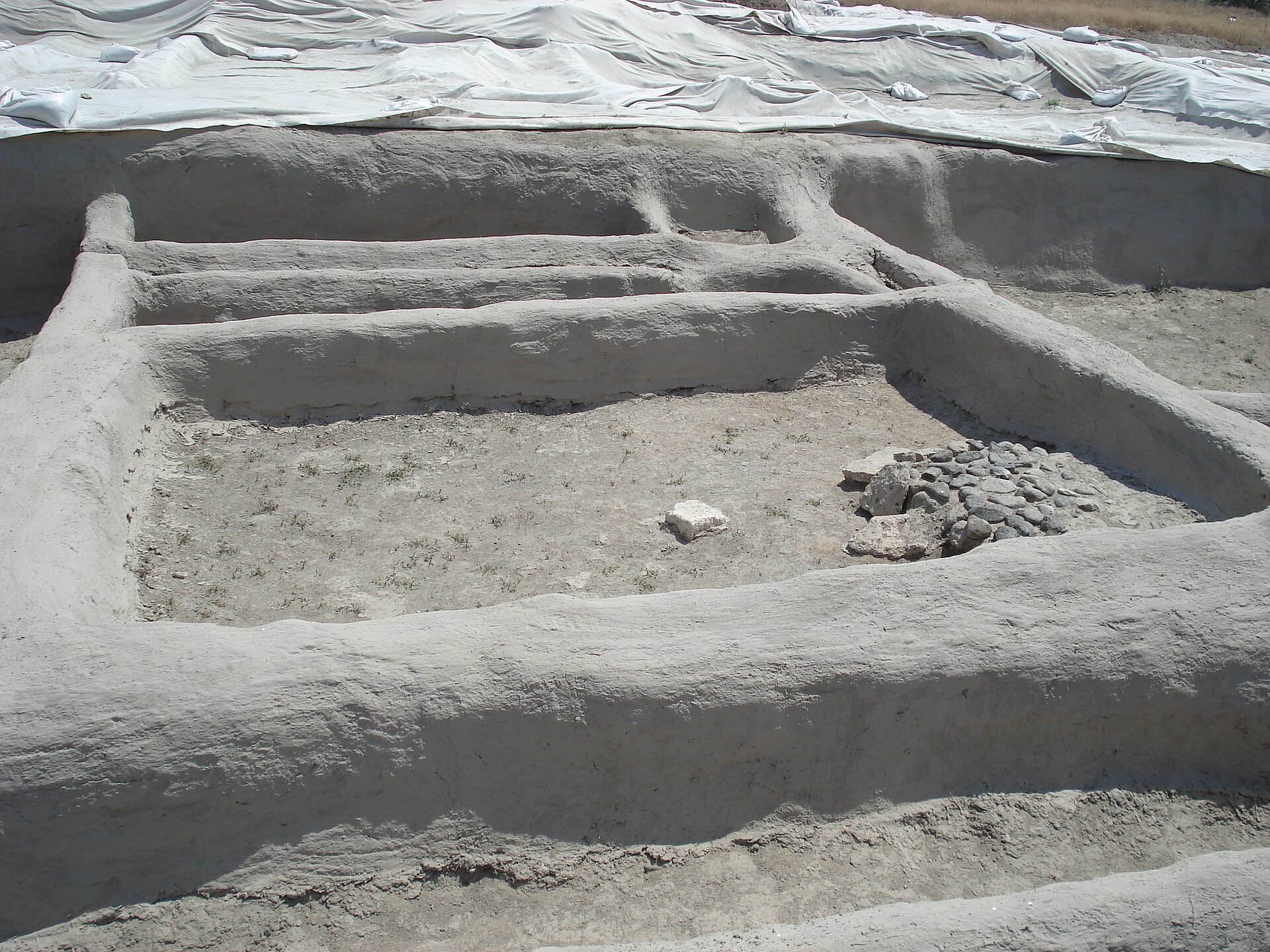
I find these hearths deeply moving. A fireplace is such a human thing, a gathering point, a source of comfort and food and light. Standing over one of these ancient hearths, it is easy to imagine a family huddled around it on a cold Anatolian night ten thousand years ago, talking, eating, and keeping warm, just as families have done ever since. The technology has changed beyond recognition, but the impulse to gather around the fire is exactly the same.
Becoming farmers
Aşıklı Höyük captures one of the most important transitions in all of human history: the shift from hunting and gathering to farming. In the earlier layers, the people relied heavily on wild resources, hunting animals and gathering plants from the landscape around them. But over time the evidence shifts, showing the growing importance of cultivated cereals and, crucially, the early stages of animal management.
One of the most exciting findings here concerns sheep. The inhabitants of Aşıklı Höyük appear to have been among the pioneers of keeping and managing sheep, taking early steps toward the full domestication that would transform human life. You can see, in the changing patterns of animal bones through the layers, a community gradually moving from hunting wild animals to controlling and herding them, one of the foundational shifts of the Neolithic revolution.
This did not happen overnight. It was a slow, experimental process, with people trying things out, learning, and adapting over many generations. That is precisely what makes Aşıklı Höyük so valuable. It does not show us farming as a finished, polished system but as a work in progress, a community in the very act of inventing the agricultural way of life that would eventually feed the world.
The dead beneath the floor
One of the most striking customs at Aşıklı Höyük, and again one it shares with Çatalhöyük, is how the people treated their dead. Rather than burying the deceased in a separate cemetery outside the village, they interred them right inside their homes, beneath the floors of the houses. The dead, in other words, remained part of the household, resting quite literally underfoot as life continued above them.
This practice tells us something profound about how these people saw the relationship between the living and the dead. There was no sharp separation, no banishing of the deceased to a distant graveyard. Ancestors stayed close, woven into the fabric of daily life, present in the very homes where families cooked, slept, and gathered. It speaks of a deep sense of continuity between the generations, and of homes that were as much about memory and ancestry as about shelter.
The burials also give archaeologists precious information about the people themselves, their health, their diet, their ages, and sometimes the injuries and illnesses they suffered. Each skeleton is a small biography, and together they let us reconstruct the lives of a community that left no written records. Through their bones, the people of Aşıklı Höyük can still, in a sense, tell us their stories.
The oldest brain surgery?
Among those burials came one of Aşıklı Höyük’s most astonishing discoveries. The skeleton of a woman was found with clear evidence of a hole having been deliberately made in her skull, a procedure known as trepanation. This is one of the earliest known examples of such surgery anywhere in the world, performed some ten thousand years ago.

Trepanation, cutting or drilling a hole in the skull, may have been done to relieve pressure, treat injury, or address illness we can only guess at. What is remarkable is the skill and daring it implies. Someone at Aşıklı Höyük understood enough about the human body, and had enough command of their tools, to open a living person’s skull, an intervention that would terrify most of us even today. It is a stunning reminder that these were not primitive people fumbling in the dark. They were intelligent, capable, and willing to attempt sophisticated medical procedures in the service of the sick.
Discoveries like this dismantle the condescending idea that ancient people were somehow simpler or less clever than we are. The inhabitants of Aşıklı Höyük practiced surgery, managed animals, planned and built a dense settlement, and traded across long distances, all without writing, without metal, and without any of the accumulated knowledge we take for granted. Their achievements, made from scratch, are in many ways more impressive than our own.
Obsidian and trade
Remember that volcanic landscape? It gave Aşıklı Höyük one of its greatest assets: access to obsidian. This naturally occurring volcanic glass can be worked into blades sharper than surgical steel, and in a world before metal it was an incredibly valuable material. The people here were perfectly positioned to obtain it from nearby sources, and they used it to make a whole array of tools.
Obsidian was not just for local use, though. It was traded across considerable distances, moving through networks that connected communities all across the ancient Near East. Aşıklı Höyük’s proximity to good obsidian sources would have made it a significant node in these networks, a place that could supply a prized material to others. This early trade is important because it shows that even these very early farming villages were not isolated. They were connected to a wider world, exchanging goods and, with them, ideas and techniques.
That connectivity helps explain how innovations spread so effectively across the Neolithic world. When communities trade, they also share knowledge, and the great transitions of the period, farming, herding, settled life, rippled outward along these very networks. Aşıklı Höyük was both a beneficiary and a contributor, tapped into the currents of exchange that were slowly transforming humanity.
The road to Çatalhöyük
It is impossible to talk about Aşıklı Höyük without returning to Çatalhöyük, because the two are so clearly connected. Aşıklı Höyük predates Çatalhöyük by several centuries, and it shows, in a simpler and earlier form, so many of the features that would later make Çatalhöyük famous: the dense, streetless packing of mudbrick houses, the roof-level entrances, the burial of the dead beneath the floors, the whole distinctive way of organizing communal life.

In this sense Aşıklı Höyük can be seen as a forerunner, an earlier expression of a way of life that would reach its fullest and most spectacular development at Çatalhöyük a few centuries later. The traditions pioneered here did not vanish; they evolved and flowered. Watching the connection between the two sites is like watching an idea grow up, from its first tentative expression to its mature, elaborate form.
This continuity is one of the great gifts of central Anatolian archaeology. It is rare to be able to trace such a clear line of development across sites and centuries, but here we can, following the settled way of life from its early beginnings at Aşıklı Höyük through to its famous fruition at Çatalhöyük. Together they tell one of the most important stories in the human past: how our ancestors first learned to live in permanent communities.
Why Aşıklı Höyük matters
So why should we care about this quiet mound by a Turkish river? Because Aşıklı Höyük gives us one of the clearest and earliest windows onto the birth of settled, farming life, the single most consequential change in the whole human story. Here we can watch people take the momentous steps of staying put, building permanent homes, managing animals, and forging a dense communal life, all captured in the layers of a single mound.
It also shows us just how capable these early people were. Brain surgery, animal domestication, sophisticated architecture, long-distance trade in obsidian, and a rich set of customs around death and the household, all achieved ten thousand years ago by a community inventing this way of life from scratch. And it deepens our understanding of the famous Çatalhöyük by revealing its roots, reminding us that even the most celebrated ancient sites stand on the shoulders of earlier, humbler pioneers.
When I picture Aşıklı Höyük now, I see smoke rising from rooftop openings, people crossing the roofs to visit their neighbors, families gathered around their hearths, sheep being tended on the plains, obsidian blades glinting as they are worked, and the ancestors resting quietly beneath the floors. For a place most people have never heard of, it holds one of the most important secrets of all: the story of how we first became villagers, and set out on the long road that led to everything that came after.
A name from a nearby village
Like most prehistoric sites, Aşıklı Höyük carries a name given by modern people rather than its ancient inhabitants, who left us no writing and no clue as to what they called their home. The name comes from the nearby village and simply means, in effect, the mound near Aşıklı. It is a humble label for a place of such importance, and it reminds us how much of our knowledge of these early communities has had to be reconstructed entirely from the physical traces they left behind.
That reconstruction is a painstaking business. With no texts to guide them, archaeologists have to read the settlement through its architecture, its tools, its bones, and its layers, piecing together the story of the people who lived here from the silent evidence of the ground. It is a bit like solving an enormous puzzle with most of the pieces missing, and yet the picture that emerges is remarkably detailed and vivid, a testament to the ingenuity of modern archaeological science.
The excavations at Aşıklı Höyük have been carried out with great care over many years, and the site has become an important center for understanding the Anatolian Neolithic. Part of what makes it so valuable is precisely the quality of its preservation and the length of its continuous occupation, which together allow researchers to track change over time with unusual precision. Few sites offer such a clear, unbroken record of the early farming way of life.
Living in a volcanic land
It is worth dwelling a little more on the extraordinary landscape that shaped Aşıklı Höyük, because Cappadocia is like nowhere else on earth. This is a region born of ancient volcanic eruptions, its terrain sculpted from soft volcanic rock into the surreal valleys, cones, and pinnacles that draw visitors today. In much later times people would carve entire underground cities and cave churches into this soft stone, but ten thousand years ago its gift to the inhabitants of Aşıklı Höyük was different: raw materials and, above all, obsidian.
The volcanic soils were also fertile, and the Melendiz river cutting through the landscape provided the reliable water any farming community needs. So the very forces that made Cappadocia so dramatic, its volcanoes and rivers, also made it a good place to pioneer the settled way of life. There is a nice irony in the fact that a landscape shaped by fiery destruction became a cradle for one of humanity’s great creative achievements.
Understanding that environment helps us appreciate the choices the people of Aşıklı Höyük made. They built with the mudbrick their surroundings provided, they exploited the obsidian their volcanoes had created, they farmed the fertile riverside land, and they managed the animals suited to the plains. Their whole way of life was a careful, intelligent response to the particular landscape they found themselves in, a reminder that early human communities were always in deep dialogue with their environment.
A community learning to live together
One of the things I keep coming back to with Aşıklı Höyük is the sheer social experiment it represents. For almost the entire history of our species, humans had lived in small, mobile bands, rarely staying anywhere for long and rarely encountering the same faces day after day for years on end. Settling down changed all of that. Suddenly people were living permanently, cheek by jowl, with the same neighbors, sharing walls, rooftops, and resources. That was an enormous adjustment, and Aşıklı Höyük shows a community working through it.
Living so closely together brought real benefits: shared labor, mutual support, safety in numbers, and the ability to pool knowledge and resources. But it also brought new challenges. How do you resolve disputes when you cannot simply walk away? How do you share out food, work, and space fairly? How do you maintain harmony among dozens or hundreds of people packed into a dense cluster of homes? These are questions that mobile hunter-gatherers rarely had to face, and the villagers of Aşıklı Höyük were among the first to grapple with them.
The very layout of the settlement, with its shared walls and rooftop pathways, would have required constant cooperation and negotiation. Your roof was your neighbor’s road; your wall was also theirs. Living here meant being bound together in a web of mutual dependence, and the community’s survival for over a thousand years suggests they found ways to make it work. In learning to live together at this scale, the people of Aşıklı Höyük were laying the social foundations for everything that would follow, the villages, towns, and cities still to come.
Visiting Aşıklı Höyük today
Today Aşıklı Höyük is an accessible and rewarding place to visit, especially for anyone already drawn to the wonders of Cappadocia. Alongside the excavated areas of the mound, researchers have built experimental reconstructions of the houses, recreating the mudbrick homes with their roof entrances so that visitors can actually see and, in a sense, step into the world of the ancient villagers. It is one thing to look at low wall foundations and quite another to stand beside a full reconstruction and grasp how these homes really worked.
These reconstructions are a wonderful bridge across time. Climbing toward a roof entrance, ducking into a snug, windowless room, standing beside a hearth, you get a visceral sense of daily life ten thousand years ago that no diagram could ever convey. It transforms an abstract archaeological site into a living, breathing place where you can almost hear the footsteps on the roofs and smell the smoke of the cooking fires.
Set against the extraordinary backdrop of Cappadocia, with its later cave dwellings and underground cities telling their own chapters of the human story, Aşıklı Höyük takes its rightful place as the earliest of them all. It is where the long human adventure in this remarkable landscape began, and it deserves to be far better known. If you find yourself among the fairy chimneys and rock churches of the region, seek it out. You will be standing at one of the true beginnings of settled human life.
What a humble mound can teach us
There is a lesson in Aşıklı Höyük that goes beyond the specifics of Neolithic Anatolia. It is that the biggest turning points in history often look, at first glance, entirely unremarkable. There are no palaces here, no gold, no towering monuments to stop a visitor in their tracks. Just a mound of old mudbrick beside a river. And yet within that mound lies one of the most important transformations our species ever underwent: the moment we stopped wandering and started to stay, stopped merely finding our food and started to grow it.
Everything that came after, every village, town, city, and civilization in this entire series, ultimately rests on that quiet revolution. The first farmers did not know they were changing the world; they were simply trying to feed their families and build decent lives. But their small, patient choices, repeated over countless generations, carried humanity across a threshold from which there was no going back. Aşıklı Höyük lets us stand at that threshold and look back at the world we left behind, and forward to the one we were about to create.
That, in the end, is why places like this matter so much. They are not just old ruins; they are the roots of our own way of life. When we understand how the people of Aşıklı Höyük lived, farmed, healed, traded, and buried their dead, we understand something essential about ourselves and how we came to be who we are. The mound may be humble, but the story it holds is nothing less than the story of how the modern human world began.
It is humbling to realize that the comfortable, settled lives so many of us take for granted trace back, in an unbroken line, to pioneering communities exactly like this one on the banks of the Melendiz.
Aşıklı Höyük is really one chapter in a much longer story, so if it has caught your imagination there is plenty more to explore. The obvious companion piece is Çatalhöyük, its famous successor, and the great temples nearby at Göbekli Tepe and Karahan Tepe round out the Anatolian picture beautifully. To follow the farming revolution elsewhere, visit Mehrgarh and the ancient wall of Jericho. For the first cities that this way of life eventually produced, explore Uruk, Tell Brak, Mohenjo-daro and Dholavira, or their distant cousins at Liangzhu, Sarazm and Caral. If monuments are more your thing, there is Stonehenge, Newgrange, the temples of Malta and the cosy village of Skara Brae. And for sheer variety, do not miss the palace of Knossos, the painted caves of Lascaux and Chauvet, the reef city of Nan Madol, the temple of Chavín de Huántar, the vast settlements of Cucuteni-Trypillia, the carved warriors of Cerro Sechín, and the earthworks of Poverty Point. Each one adds another thread to the astonishing tapestry of how humanity first learned to settle down and build a world. If early creativity fascinates you, take a detour to Jiahu, home of the world’s oldest playable instruments. If you love monuments to the heavens, take a detour to Chankillo, the oldest solar observatory in the Americas. The story continues at Kalibangan, an Indus town rebuilt after what may be history’s earliest recorded earthquake. The story continues at the Cairn of Barnenez, a 75-metre Neolithic cairn on the Breton coast. The story reaches the Danube at Vinča, home to thousands of enigmatic clay figurines. The story reaches Brittany again at Gavrinis, sometimes called the Sistine Chapel of megalithic art. See also Los Millares, whose walls, bastions, and vast necropolis rose over five thousand years ago. You might also wander over to Bougon, one of the oldest surviving pieces of architecture anywhere on Earth. If standing stones speak to you, wander over to Almendres, a hillside of ancient granite near Évora. If giant stones fascinate you, step into Ġgantija, Malta’s colossal Neolithic temple complex. If carved stones fascinate you, step into Knowth, home to Europe’s richest megalithic art. If prehistoric art fascinates you, step into Tarxien, the richest of Malta’s Neolithic temple complexes. If ancient astronomy fascinates you, step into Mnajdra, Malta’s solar temple by the Mediterranean. You might also wander to Ħaġar Qim, where Neolithic builders raised twenty-tonne stones above the sea. You might also wander to Dowth, where a five-thousand-year-old mound still guards its dark chambers. You might also explore Carnac, where Neolithic farmers raised more than three thousand menhirs across the fields. You might also wander to Callanish, where thirteen ancient stones ring a towering monolith. You might also wander to Filitosa, whose carved menhirs bear faces, swords, and daggers. You might also sail your imagination to Ale’s Stones, a 67-metre ship of stone above the Baltic.
You May Like
The Bardo, a Palace of the Beys Filled With Roman Mosaics