In the green heart of Ireland’s Boyne Valley, a short walk from its more famous neighbour Newgrange, sits a huge grassy mound that most people have never heard of. Yet Knowth may just be the most extraordinary of them all. Ringed by dozens of smaller tombs and carved with the largest collection of Neolithic art anywhere in Europe, it is a monument that quietly outshines almost everything around it.
I have always thought Knowth gets unfairly overshadowed. Newgrange has the dramatic solstice light, and it deserves its fame, but Knowth has something rarer: sheer abundance. Its great mound covers not one but two passages, and the stones around it are covered in swirling, mysterious carvings that have kept archaeologists puzzling for decades. Let me take you through this remarkable place.

- What Knowth actually is
- How old the great mound is
- The two passages
- The astonishing carved stones
- The ring of smaller tombs
- The people who built it
- What it was all for
- Why Knowth still matters
- A closer look at the satellite tombs
- Knowth and the Boyne Valley
- Trying to read the carvings
- The engineering of a giant mound
- How Knowth gave up its secrets
- A monument reused across the ages
- Knowth among the great passage tombs
- A people who watched the heavens
- What it feels like to stand there
- Knowth and the Neolithic achievement
- The enduring legacy of the mound
- Visiting Knowth today
- Protecting a fragile treasure
What Knowth actually is
Knowth is a passage tomb, a type of monument where a stone-lined corridor leads into a chamber built deep inside a covering mound of earth and stone. But Knowth is not a modest example. Its main mound is enormous, and around it clusters a whole ring of smaller satellite tombs, making the site a kind of prehistoric complex rather than a single grave.
Along with Newgrange and Dowth, Knowth forms part of Brú na Bóinne, one of the most important concentrations of prehistoric monuments anywhere in the world. Together these great mounds represent an astonishing investment of effort by the people who lived in this fertile river valley thousands of years ago.

How old the great mound is
Knowth was built around 3200 BC, more than five thousand years ago. That places it in the same remarkable window as Newgrange, and it means the great mound predates the Egyptian pyramids and Stonehenge’s famous stone circle. When it was raised, this was cutting-edge architecture, the work of a confident and capable society.
What I find striking is how the site was used and reused over an immense span of time. Long after the tomb builders were gone, later peoples returned to Knowth, reoccupying and reshaping it across the centuries. The mound you see today carries layers of history stacked one on another, a place that stayed meaningful for thousands of years.

The two passages
Here is where Knowth pulls ahead of its neighbours. Its great mound contains two separate passages, one entering from the east and one from the west, running toward the centre from opposite sides. Each leads to its own chamber, and together they make Knowth uniquely rich among the tombs of the Boyne Valley.
The two passages may have been aligned with the movements of the sun, possibly toward sunrise and sunset around the equinoxes, though the details are debated. If so, it would echo the famous solstice alignment at Newgrange, suggesting these builders shared a deep interest in tracking the sky and weaving it into their sacred architecture.

The astonishing carved stones
If Knowth is famous for one thing, it is the art. The kerbstones ringing the base of the great mound, and many stones within the passages, are covered in carved designs: spirals, lozenges, zigzags, crescents, and radiating patterns. Taken together, they form the greatest concentration of megalithic art in all of Europe.

What do these symbols mean? Honestly, we do not know, and that is part of their spell. Some may represent the sun and moon, some may be maps of the sky, some may be purely symbolic or spiritual. They are messages carved in a language we have lost, and yet the care and skill behind them speaks clearly across the millennia.

The ring of smaller tombs
The great mound does not stand alone. It is surrounded by around eighteen smaller satellite tombs, each a passage tomb in its own right, clustered around the central giant. This arrangement turns Knowth into something more like a cemetery or ceremonial precinct than a single monument.
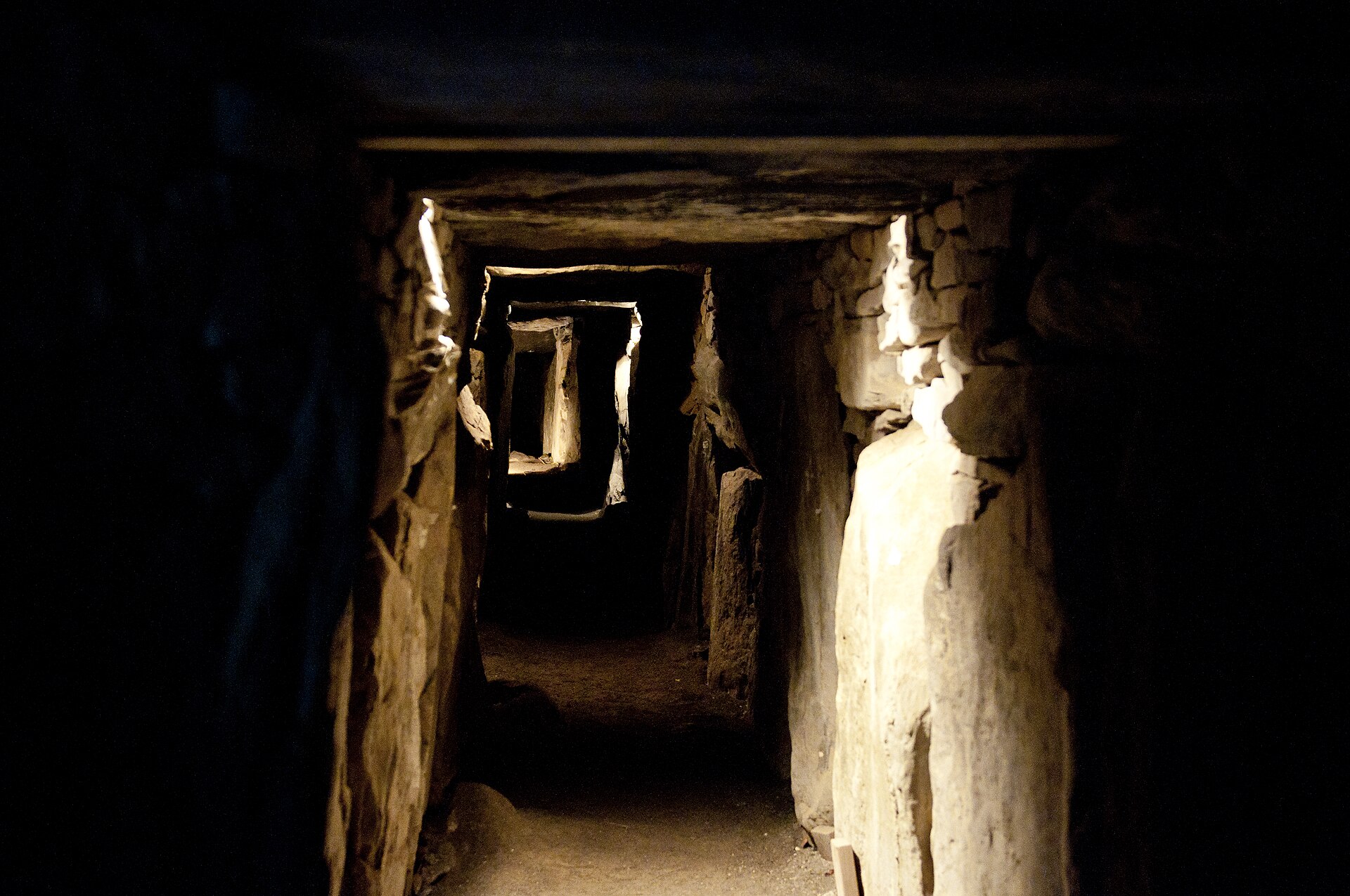
Why build so many tombs in one place? The clustering suggests Knowth was a focal point, a place of special significance that drew burials and monuments to it over a long period. Perhaps the great mound was seen as the heart of a sacred landscape, and to be buried nearby was to share in its power.
The people who built it
The builders of Knowth were Neolithic farmers, growing crops and raising animals in the rich soils of the Boyne Valley. They were not a distant empire; they were a settled farming society with the surplus, organisation, and shared belief needed to raise monuments on this staggering scale.
Think about the effort involved. Enormous stones had to be gathered, moved, shaped, carved, and raised, and a vast mound of earth and stone piled over the passages. This was the work of many people across a long time, coordinated toward a shared vision. Knowth is, in a sense, a portrait of that community’s ambition and faith.
What it was all for
Knowth was clearly a place of the dead, but it was almost certainly much more than a graveyard. The cremated remains found in the tombs, the careful alignments, the abundant art, and the sheer scale all point to a site of deep ritual and ceremonial importance, tied to beliefs about death, the cosmos, and the ancestors.
These monuments likely also marked territory and identity, a visible statement that this land belonged to the community whose ancestors lay within. And they gave the living a fixed, sacred place to gather, remember, and reaffirm who they were. Knowth wove together death, sky, land, and belonging in a single monumental gesture.
Why Knowth still matters
Knowth matters because it shows the astonishing sophistication of Neolithic Ireland. This was a society capable of monumental engineering, precise astronomical interest, and an artistic tradition of breathtaking richness, all more than five thousand years ago. It shatters any lazy assumption that early farmers were simple people.
It also matters because it survived, carvings and all, so that we can still stand before those swirling stones and feel the presence of the people who made them. Few places let you touch the deep past so directly. At Knowth, the distance of millennia narrows to the width of a single carved spiral.
A closer look at the satellite tombs

Standing among the smaller tombs that ring the great mound, you begin to grasp just how planned this whole landscape was. Each satellite is a passage tomb in miniature, with its own kerb of stones and, in many cases, its own carved decoration. They were not random additions but part of a deliberate, evolving sacred precinct.
Some of these smaller tombs are older than the great mound itself, which tells us the site grew over time, gathering monuments around a place that was already special. Others came later. Together they form a dense cluster that turns Knowth into one of the richest single concentrations of passage tombs anywhere.
Knowth and the Boyne Valley
Knowth cannot really be understood in isolation. It belongs to Brú na Bóinne, the bend in the River Boyne where Newgrange, Knowth, and Dowth stand within sight of one another, surrounded by dozens of other monuments. This was a whole ceremonial landscape, one of the greatest of the ancient world.
Imagine the effort represented by that landscape as a whole: three enormous mounds and countless smaller ones, all raised by farming communities in the same fertile valley. The Boyne must have been a place of immense significance, a spiritual centre that drew people and labour across generations.
Seeing Knowth as part of this wider whole changes how you experience it. You are not looking at a lone curiosity but at one jewel in a crown of monuments, a single node in a sacred geography that the builders wove across the entire valley.
Trying to read the carvings
The megalithic art of Knowth is so abundant and so varied that it invites endless interpretation. Spirals, circles, crescents, zigzags, and radiating rays appear again and again. Some researchers see representations of the sun and moon; others suspect maps of the heavens or records of astronomical events; still others read them as purely symbolic or spiritual designs.
One of the most intriguing suggestions is that certain stones may encode observations of the moon or sun, turning the tomb into a kind of record of the sky. Whether or not that is true, the very presence of so much careful, deliberate carving tells us these were not idle decorations. They mattered deeply to the people who made them.
What moves me is the patience and skill involved. Carving hard stone with stone tools is painstaking work. To cover so many surfaces with such intricate designs represents an enormous investment of time and meaning, a message the builders clearly wanted to endure. And endure it has, even if we can no longer fully read it.
The engineering of a giant mound
Building Knowth was a monumental feat. The great mound covers a large area and rises high above the surrounding land, built from countless tonnes of stone and earth, with two long stone passages threading toward its centre. None of this could be done quickly or easily with the tools available.
The builders had to quarry and gather suitable stones, transport them, often over considerable distances, shape them, decorate many of them, and set them precisely in place, all before heaping up the vast covering mound. Every stage demanded planning, coordination, and sustained effort across a long span of time.
That is why I never see these mounds as merely piles of earth. They are the product of sophisticated engineering and social organisation, evidence of a society capable of conceiving and completing projects far larger than any single lifetime. Knowth is applied knowledge, made monumental.
How Knowth gave up its secrets
For most of history, Knowth was a grassy mound whose true nature was hidden. Its passages, its art, and its ring of satellite tombs only came fully to light through decades of careful excavation in the twentieth century, one of the longest and most detailed archaeological investigations ever carried out in Ireland.
That patient work transformed our understanding. It revealed not one passage but two, uncovered the astonishing wealth of carved stones, and traced how the site had been used and reused across thousands of years. Knowth went from an obscure hill to one of the most important prehistoric monuments in Europe.
It is a wonderful reminder of how much the deep past can hide in plain sight. For countless generations, people walked past this mound with no idea of the treasures within. It took curiosity, patience, and painstaking effort to let Knowth finally tell its story.
A monument reused across the ages
One of the most fascinating things about Knowth is that its life did not end when the tomb builders were gone. Later peoples returned again and again, reoccupying the site, reshaping the great mound, and leaving their own marks across the centuries. The monument remained meaningful far beyond its original purpose.
This long afterlife tells us something about the power places can hold. Once a spot becomes sacred or significant, it can draw people back for millennia, each generation reinterpreting it in their own way. Knowth was not a static relic but a living place, continually reused and reimagined.
That layering of history makes the archaeology beautifully complex, and it deepens the site’s meaning. When you stand at Knowth, you are standing at a place that mattered to people across an almost unimaginable stretch of time, from the first tomb builders to those who came thousands of years later.
Knowth among the great passage tombs
It helps to see Knowth alongside its famous relatives. Newgrange is celebrated for the beam of sunlight that pierces its chamber at the winter solstice, a genuinely magical alignment. Dowth, the third great Boyne mound, is quieter and less excavated. Knowth’s distinction is its double passage and its unrivalled wealth of carved art.
Comparing them is not about ranking, but about appreciating how a single valley produced three monumental tombs, each with its own character. Together they show a society experimenting with, and mastering, the art of building for the dead on a colossal scale, tuned to the movements of the sky.
Placed in this company, Knowth holds its own and then some. If Newgrange is the valley’s showpiece of light, Knowth is its showpiece of art and abundance, a mound so rich in carving and so complex in structure that it stands among the most remarkable Neolithic monuments anywhere on Earth.
A people who watched the heavens
Everything about the Boyne monuments suggests their builders were close watchers of the sky. Newgrange famously catches the winter solstice sunrise; Knowth’s two passages may have marked other key moments in the solar year. For farming communities, this sky-watching was not idle. The calendar governed planting, harvest, and survival.
A monument that helped mark the turning of the year would have been both practical and profoundly spiritual. It tied the community to the rhythm of the cosmos and gave the passage of time a sacred shape. The alignment of these tombs suggests a worldview in which the movements of the sun and the fate of the dead were deeply intertwined.
I find it genuinely moving that people five thousand years ago, without writing or instruments as we know them, could pin the rhythm of the heavens to great mounds of stone. They turned astronomy into architecture, and that architecture still stands, still aligned, still keeping its ancient appointment with the sky.
What it feels like to stand there
Visiting Knowth is a quietly powerful experience. You walk around the great mound, taking in its scale and the ring of smaller tombs, and everywhere your eye falls on carved stones, spirals and lozenges worked into the rock by hands that vanished five thousand years ago. It is impossible not to feel the weight of that time.
Running your eye along a kerbstone’s carvings, you find yourself wondering about the person who made them. What did the spirals mean to them? What did they believe waited beyond death? We cannot know, but the very act of asking bridges the gulf between us and them, if only for a moment.
That is the real gift of Knowth. It is not just a set of facts to learn but a place to feel the depth of human time, to stand where a whole society expressed its deepest beliefs in stone and earth, and to sense across the millennia that their wonder, their artistry, and their care for the dead are, in the end, our own.
Knowth and the Neolithic achievement
To appreciate Knowth fully, remember the broader revolution it belongs to. Across the Neolithic world, people were settling into farming, tying themselves to particular lands, and developing new ways of thinking about time, the sacred, and the ancestors. Out of that settled life came the surplus and the motivation to build on a grand scale.
The Boyne monuments are among the most spectacular expressions of that revolution anywhere. They show that Neolithic Ireland was not a remote backwater but a vibrant, sophisticated society, fully capable of monumental engineering, astronomical observation, and a rich artistic tradition. Knowth is the proof, carved in stone.
Placed in that context, Knowth becomes more than an Irish wonder. It is a vivid chapter in the global story of how settled farming communities, all around the world, began to raise structures meant to outlast them, binding together the living, the dead, the land, and the sky.
The enduring legacy of the mound
What does Knowth leave us, beyond its stones and carvings? For me, its greatest legacy is a kind of proof: evidence that people five thousand years ago were every bit as capable, thoughtful, and artistically ambitious as we imagine ourselves to be. They planned, engineered, observed the heavens, and created art of astonishing richness.
They also left us a direct, physical link to a world that would otherwise be almost unimaginable. Without written records, the tomb builders would be little more than a shadow. Because they built and carved in stone, we can still stand in their sacred landscape and feel, however faintly, the presence of the people who shaped it.
That is the quiet power of Knowth. It carries meaning across an almost unthinkable gulf of time, one careful generation of preservation at a time. We have become the latest custodians of a monument older than history itself, and how long it endures depends, in part, on whether we keep believing it matters.
Visiting Knowth today
A visit to Knowth today is a genuinely rewarding experience. Because the site is fragile and precious, access is managed carefully, usually through guided visits that begin at the nearby visitor centre for Brú na Bóinne. That structure helps, because by the time you reach the mound you understand something of the people who raised it.
Walking around the great mound, you get to appreciate both its enormous scale and the astonishing detail of its carved kerbstones. Guides point out designs you might otherwise miss and explain the long, layered history of the site, from the first tomb builders to the peoples who reused it thousands of years later.
What stays with most visitors is not a single fact but a feeling, a deep sense of connection to a society that lived, worshipped, and buried its dead here five thousand years ago. Knowth turns abstract prehistory into something you can walk around and almost touch, and that transformation is exactly what makes it unforgettable.
Protecting a fragile treasure
Monuments like Knowth are irreplaceable, and that carries real responsibility. Carved stones that have survived five thousand years can still be worn by weather and by the pressure of many visitors over time. Careful management, conservation, and controlled access are what allow the mound and its art to keep telling their story.
Every effort to protect the site, and every respectful visitor who treats it gently, plays a part in ensuring that Knowth endures. These stones belong not just to us but to everyone who comes after, and preserving them is a way of keeping faith with both the builders and the future.
In a very real sense, we have become the current guardians of one of humanity’s most remarkable Neolithic monuments. Whether Knowth still stands, carvings intact, in another thousand years depends on choices made now. That thought turns a simple visit into something meaningful, a small act of care passed forward through time.
There is one final image I carry from Knowth: the great mound at dusk, its carved kerbstones catching the last light, the smaller tombs gathered around it like family, and the Boyne Valley stretching quiet and green all around. Whoever these builders were, they wanted to make something that would speak to the future. Standing there, more than five thousand years later, you realise they succeeded, and that we are the future they were speaking to.
If Knowth has drawn you into the world of the Boyne Valley and beyond, its closest companion is of course Newgrange: The 5,000-Year-Old Tomb Built to Catch the Solstice Sun, the neighbouring tomb whose solstice light is world-famous. From there, follow the megalith trail to Stonehenge: How and Why This Ancient Stone Circle Was Really Built, The Megalithic Temples of Malta: Older Than the Pyramids, Gavrinis: The 6,000-Year-Old Carved Passage They Sealed in the Dark, Bougon: The 7,000-Year-Old Burial Mounds Older Than the Pyramids, Almendres Cromlech: Europe’s Oldest Stone Circle, 2,000 Years Before Stonehenge, and the giant temples of Ġgantija: The Giant Temples of Gozo, Older Than the Pyramids. Reach back to the very beginning with Göbekli Tepe: The World’s Oldest Temple and How It Rewrote History and Karahan Tepe: The Astonishing Sister of Göbekli Tepe, and trace the first towns through Çatalhöyük: The 9,000-Year-Old Town With No Streets, Jericho: The World’s Oldest City and Its 10,000-Year-Old Wall, Skara Brae: The 5,000-Year-Old Village Known as the Scottish Pompeii, and Aşıklı Höyük: The 10,000-Year-Old Village That Came Before Çatalhöyük. The great river and valley civilisations unfold at Uruk and Sumer: The First Cities and the Birth of Writing, Mohenjo-daro: The 4,500-Year-Old City That Was Centuries Ahead of Its Time, Liangzhu: The 5,000-Year-Old Water City That Rewrote China’s History, Dholavira: The 4,500-Year-Old City That Beat the Desert With Water Engineering, Tell Brak: The Syrian Mound That May Rewrite Where Cities Began, and The Cairn of Barnenez: Europe’s Colossal Stone Monument Older Than the Pyramids, while across the seas you’ll meet Caral: The 5,000-Year-Old City That Rose As the Pyramids Were Built, Chavin de Huantar: The 3,000-Year-Old Andean Temple Built to Overwhelm the Senses, Cerro Sechin: The 3,600-Year-Old Peruvian Temple Carved With Warriors and Their Victims, Poverty Point: The 3,700-Year-Old Earthworks Built by Hunter-Gatherers, Not Farmers, Chankillo: The 2,300-Year-Old Peruvian Towers That Are the Americas’ Oldest Solar Observatory, and the astonishing Nan Madol: The Ancient City Built on a Coral Reef in the Middle of the Pacific. For still more deep history, wander through The World’s Oldest Art: Inside the Painted Caves of Lascaux and Chauvet, Knossos: The 4,000-Year-Old Palace Behind the Myth of the Minotaur, Cucuteni-Trypillia: Europe’s 6,000-Year-Old Mega-Settlements That Might Be the First Cities, Sarazm: The 5,500-Year-Old Town in Tajikistan That Rewrites Central Asia’s Past, Mehrgarh: The 9,000-Year-Old Village Where South Asia Learned to Farm, Jiahu: The 9,000-Year-Old Chinese Village Whose Flutes Still Play, Kalibangan: The Indus Town With the World’s Oldest Ploughed Field, Vinča: The Danube Culture That May Have Written Before Anyone Else, and Los Millares: The 5,000-Year-Old Fortified Town at the Edge of Europe. Each one is another thread in the same long human story. It pairs beautifully with the story of Tarxien, Malta’s most elaborate temple, carved over five thousand years ago. It pairs beautifully with the story of Mnajdra, a coastal temple older than the pyramids and aligned with the sun. The clifftop sanctuary of Ħaġar Qim offers yet another window onto the world of the first builders. The brooding tomb of Dowth offers yet another window onto the world of the first builders. The great stone rows of Carnac offer yet another window onto the world of the first builders. The remote ring of Callanish offers yet another window onto the world of the first builders. The stone warriors of Filitosa offer yet another window onto the world of the first builders. The clifftop stone ship of Ale’s Stones offers yet another window onto the monuments of the deep past.
You May Like
The Bardo, a Palace of the Beys Filled With Roman Mosaics


3 thoughts on “Knowth: Europe’s Greatest Collection of Neolithic Art, Hidden Beside Newgrange”