There is a moment, standing on the southern cliffs of Malta with the wind coming off the sea, when you realize the pile of golden stone in front of you is older than almost anything you have ever laid eyes on. Ħaġar Qim — the name means “standing stones” in Maltese — has been sitting here for something like five and a half thousand years, longer than the pyramids of Giza, longer than Stonehenge in its finished form. And yet it does not feel like a museum piece. It feels alive, weathered, a little stubborn, as if it has simply decided to outlast us all.
I have wanted to write about this place for a long time. Partly because it is beautiful, and partly because it complicates every neat story we like to tell about early humans. The people who raised these blocks had no metal tools, no wheel, no writing. What they had was an extraordinary sense of purpose, and stones that some archaeologists estimate weigh in the region of twenty tonnes. Somehow that was enough.
- A temple on the edge of the island
- The stones and how they were raised
- Inside the chambers
- Light, the solstice, and a carved calendar of sorts
- The people who worshipped here
- Silence, then rediscovery
- The islet on the horizon
- A stone that both gives and betrays
- Spirals, pits, and the temple’s decoration
- Part of a wider Maltese network
- How we know its age
- The fat ladies of Malta
- Rethinking the “primitive” label
- What the name tells us
- The long fight to protect it
- Standing there today
- Why Ħaġar Qim still matters
A temple on the edge of the island
Ħaġar Qim sits near the village of Qrendi, on a low ridge overlooking the tiny islet of Filfla and the wide blue nothing of the Mediterranean beyond. The setting is not accidental. Whoever chose this spot wanted a horizon, wanted sky, wanted the sea. When you approach on foot the temple seems to grow out of the hill itself, its outer wall bulging with rounded blocks that have softened over the millennia into something almost organic.
The building we call a single temple is really a cluster of connected chambers, added to and rebuilt over centuries. Its main entrance faces roughly southeast, framed by a trilithon — two uprights and a lintel — that has become one of the most photographed doorways in prehistory. Step through it and you leave the modern world behind.

What strikes most visitors first is the sheer scale. One of the outer slabs is among the largest stones used anywhere in Maltese temple building, a monster of soft globigerina limestone that must have taken a small community weeks to move even a short distance. Standing beside it, you feel very small and very temporary.
The stones and how they were raised
Here is the question everyone asks, and it is a fair one: how? No metal, no draft animals we can be certain of, no cranes. The honest answer is that we do not know for sure, but the evidence points toward patience rather than magic. Stone balls found at several Maltese sites may have been used as rollers, letting teams of people drag blocks over a moving bed of rounded stones.
The builders chose their material carefully. The softer globigerina limestone, easy to carve but quick to erode, was used for the interior and decoration. The harder coralline limestone, tougher and more durable, went into the outer walls where it had to bear weight and weather. That distinction alone tells you these were not people fumbling in the dark. They understood their stone.

Raising the tall uprights, the orthostats, would have meant digging a socket, tipping the stone in, and packing it tight. Every step carried risk. A slipped block could crush a worker or shatter after months of effort. That they succeeded so many times, across so many temples, speaks to accumulated skill passed down through generations.
Inside the chambers
Move deeper into Ħaġar Qim and the space folds inward into a series of oval rooms, or apses, arranged off a central corridor. The plan is often described as curvilinear — all soft curves, no sharp corners — which gives the interior a strangely intimate, almost bodily feel. Some scholars have long noted that the temple outlines echo the rounded forms of the “fat lady” figurines found across Malta.

Inside, the finds were remarkable. Altars, offering tables, decorated slabs pitted with drilled holes in tidy patterns, and several of those famous rotund statuettes. One niche seems designed to catch light at a particular time of year. Another chamber may have been reserved for a select few, its entrance small enough to control who passed.

It is tempting to imagine the smell of it — smoke, animal fat, crushed herbs — and the sound of voices echoing off stone. We will never recover those sensations, but the architecture gives us hints. This was a place built for gathering, for ceremony, for something people felt was worth an enormous collective effort.
Light, the solstice, and a carved calendar of sorts
One of the quiet marvels of Ħaġar Qim is how its builders worked with the sun. At the summer solstice, sunrise light passes through a small oval opening — sometimes called the “oracle hole” — and falls onto a slab inside, marking the longest day. Whether this was a precise instrument or a symbolic gesture is still debated, but the alignment is real and repeats every year.

This interest in the sky ties Ħaġar Qim to its close neighbour just down the slope, and to a wider pattern across the Neolithic world. Communities separated by whole seas seem to have shared an instinct to fix their most important buildings to the turning of the year. It is one of those threads that makes the deep past feel less foreign.
The people who worshipped here
Who were they? Farmers, mostly. They grew barley and wheat, kept sheep, goats, pigs and cattle, and lived in villages we have barely begun to locate because their homes, built of mud and perishable material, have largely dissolved. The temples endured precisely because they were built to last, while the everyday world around them faded.

Their religion, as far as we can reconstruct it, centred on fertility, the dead, and perhaps a great mother figure represented by those heavy-limbed statues. Animal bones suggest feasting and sacrifice. There is no sign of kings or armies. What held this society together seems to have been shared belief and shared labour, which is its own kind of power.
Silence, then rediscovery
Around 2500 BC, the temple culture of Malta ended. Not with an invasion we can point to, or a catastrophe written in the ground, but with a fading. Building stopped. The great sites fell quiet. Theories range from soil exhaustion and climate stress to social collapse, and the truth is probably a tangled combination we may never fully untie.

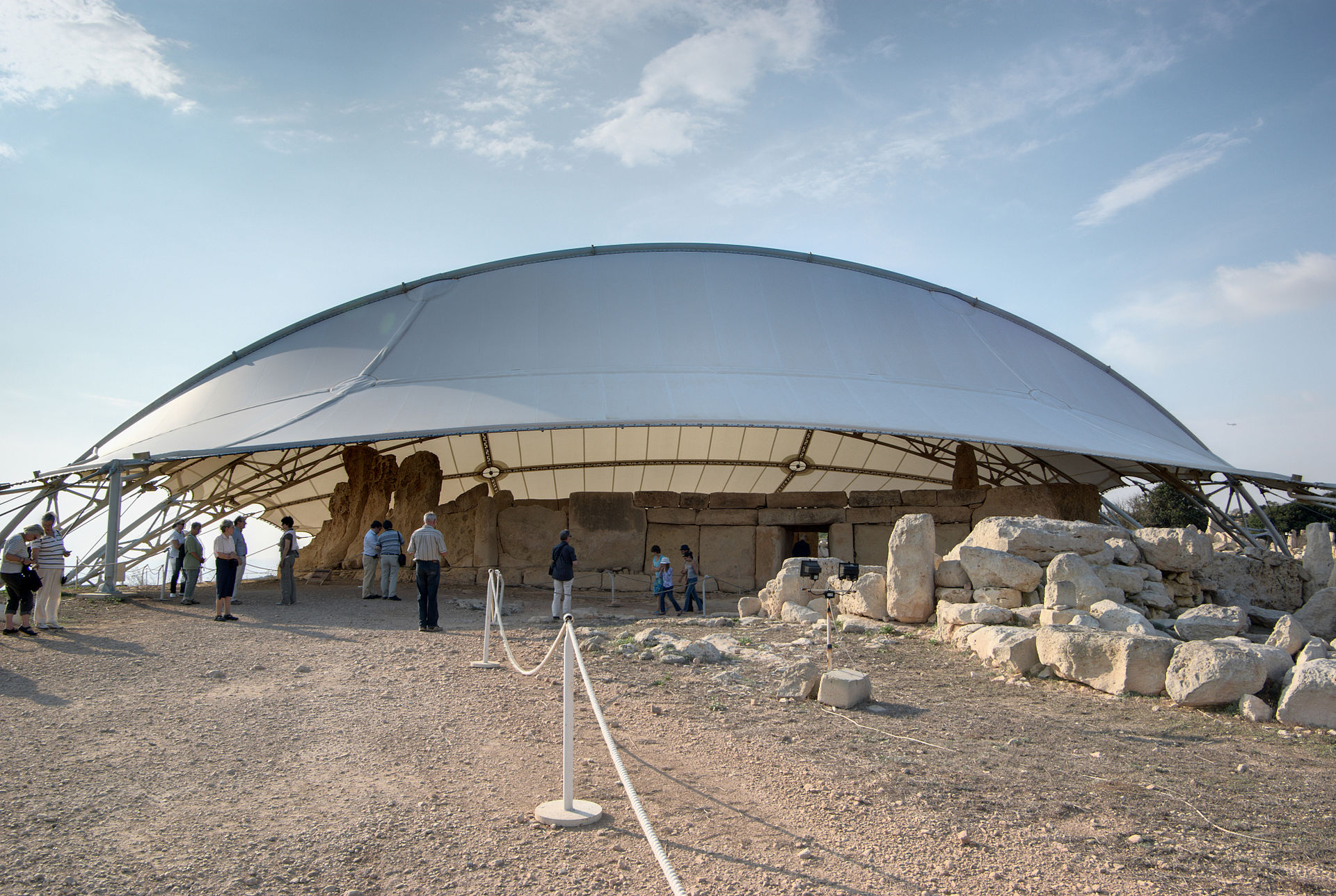
For thousands of years Ħaġar Qim slept under drifting soil and scrub, half forgotten. Serious excavation began in the nineteenth century, and the site has been studied, protected, and — in recent decades — sheltered under a great protective canopy to slow the erosion eating at its soft stone. Standing there now, you are looking at survival against very long odds.
Why Ħaġar Qim still matters
It is easy to file a place like this under “ruins” and move on. I think that would be a mistake. Ħaġar Qim is proof that complexity, ambition, and a hunger for meaning are not modern inventions. Long before cities and empires, people on a small island decided to build something enormous, something that pointed at the sky and the sea and the seasons, and they made it happen with their hands.
That is worth sitting with. When we talk about human achievement we tend to reach for the pyramids or the cathedrals, the things with famous names attached. But the anonymous farmers of Neolithic Malta got there first, in their own way, and left us stones that still stop people in their tracks. If you ever get the chance to stand in that doorway with the sea behind you, take it.
The islet on the horizon
You cannot really talk about Ħaġar Qim without mentioning Filfla, the small uninhabited islet that sits directly on the temple’s southern sightline. From the temple terrace it appears to float, a low grey shape on the water, and it is hard not to wonder whether it meant something to the builders. Prehistoric people rarely wasted a dramatic horizon, and this one is as dramatic as they come.
Some researchers have suggested that Filfla played a role in the temple’s alignments, or at least in the mental map of the people who gathered here. We cannot prove it. But when you sit where they sat and follow the same line of sight out to that lonely rock, the coincidence feels less like coincidence and more like design.
Whatever the truth, Filfla is a reminder that these temples were never sealed boxes. They were open to the landscape, tied to the sea and the sky, part of a world their builders read as carefully as we read a page.
A stone that both gives and betrays
The globigerina limestone that makes Ħaġar Qim so workable is also its great weakness. Soft enough to carve with stone and antler tools, it is equally soft enough for wind, rain, and salt spray to nibble away century after century. Some of the decorated surfaces that early excavators recorded have since blurred almost to nothing.
This is the quiet tragedy of the site. Every rainy winter takes a little more. It is why the modern shelter was built, an enormous tent-like canopy that keeps the worst of the weather off the most vulnerable stones. Purists grumble about how it looks, and I understand them, but without it we would be watching the temple dissolve in real time.
There is a lesson in that limestone. The very quality that let Neolithic people build something so ambitious is the quality now working to erase it. Preservation here is not a one-time act but a constant, patient argument with time.
Spirals, pits, and the temple’s decoration
Ħaġar Qim was not bare. Its builders decorated key surfaces with rows of drilled pits, with panels, and elsewhere in Maltese temple art with flowing spirals and running relief patterns. The pitted decoration in particular — tidy fields of small round holes — gives a texture that catches raking light beautifully in the early morning or late afternoon.
We do not know what these patterns meant. They may have been purely decorative, or they may have carried symbolism now lost to us entirely. The spiral, which appears across so many prehistoric cultures, hints at something shared and deep, though I am wary of reading too much into it.
What the decoration does prove is intent. Nobody spends days drilling neat rows of holes into stone unless it matters to them. Beauty, or at least meaning, was part of the plan from the beginning.
Part of a wider Maltese network
Ħaġar Qim did not stand alone. Malta and its sister island Gozo are dotted with these temples, dozens of them, built over a span of more than a thousand years. Together they represent one of the densest concentrations of monumental prehistoric architecture anywhere on Earth, packed onto islands you can drive across in under an hour.
That density raises fascinating questions. Was there rivalry between communities, each raising its own temple? Cooperation? A shared priesthood moving between sites? We can only guess, but the sheer number of monuments suggests a society for whom this kind of building was central, not occasional.
Seen this way, Ħaġar Qim is one voice in a chorus. To understand it fully you have to hear the others too — the temples down the hill, across the island, and over the water on Gozo, all singing variations of the same architectural song.
Standing there today
Visiting now is a curious mix of the ancient and the carefully managed. You buy a ticket, walk a boardwalk, and pass beneath that protective canopy into the temple’s embrace. It is quieter than you expect. Even with other visitors around, the stones seem to absorb sound, and there are moments when you feel almost alone with five thousand years of accumulated silence.
I always tell people to slow down here. It is easy to snap a few photos and move on to the next thing, but Ħaġar Qim rewards patience. Sit for a while. Watch how the light moves across the blocks. Notice the way the curves pull your eye inward. The temple was built to be experienced slowly, and it still is.
And when you leave, walk the short path to its neighbour before you go. The two belong together, and seeing them in one afternoon is one of the great experiences the ancient world has to offer.
How we know its age
It is one thing to say Ħaġar Qim is more than five thousand years old, and another to explain how we can possibly know. The answer lies in a combination of methods. Radiocarbon dating of organic material found in and around the temples gives us a framework, placing the main phases of Maltese temple building between roughly 3600 and 2500 BC.
Pottery styles help too. Archaeologists have built a detailed sequence of Maltese ceramic phases, each with its own name and characteristic decoration, and by matching the pottery found at a site to that sequence they can place it in time. Ħaġar Qim belongs mainly to what is called the Tarxien phase, near the tail end of the temple era.
None of this is guesswork dressed up as certainty. It is careful, cross-checked reasoning, and it converges on a consistent picture: a temple raised in the fourth millennium BC, expanded and reworked over generations, then abandoned as the whole culture wound down.
The fat ladies of Malta
Among the most memorable finds from Ħaġar Qim and its sister sites are the corpulent statuettes affectionately nicknamed the “fat ladies,” though their sex is often ambiguous. Carved from limestone, with heavy thighs, folded arms and small heads, they have become emblems of Maltese prehistory, and copies of them fill the island’s gift shops today.
What they meant is a puzzle. Many people read them as fertility figures, symbols of abundance and the life-giving power the temple communities depended on. Others caution that we are projecting modern assumptions onto forms we barely understand. The figures may represent deities, ancestors, priests, or something we have no word for.
Whatever they were, they were clearly important. To carve them from stone, to place them in the innermost chambers, to make them again and again across centuries — that is not idle craft. It is belief, given weight and shape.
Rethinking the “primitive” label
We have a bad habit of using the word “primitive” for anything before writing, as if these were simpler people living simpler lives. Ħaġar Qim demolishes that idea. Planning a temple with aligned sightlines, sorting two kinds of limestone by their properties, organising the labour of an entire community, feeding the workers, coordinating over years — none of that is simple.
What these people lacked was our technology, not our intelligence. Give a modern engineer the same tools and the same isolation and see how quickly they could raise a twenty-tonne slab. The achievement here is not despite the builders’ supposed backwardness; it is a testament to how much human ingenuity can accomplish with almost nothing.
I think that is why places like this matter so much. They dissolve the comfortable distance we like to keep between ourselves and the deep past. Stand in that doorway and the gap between you and the builder narrows to almost nothing. You are both just people, looking at the sea, wanting to make something that lasts.
What the name tells us
The name Ħaġar Qim is Maltese for “standing stones” or “worshipping stones,” depending on how you read it, and that plainness is oddly moving. Long after the builders and their beliefs had vanished, later inhabitants of the island looked at these blocks jutting from the earth and named them simply for what they were: stones that stand.
Place names often preserve a fossil memory of how people once understood a landscape. Here, the memory is of something set apart, something that demanded a word of its own. Even when its purpose was forgotten, the site kept a shadow of its old significance in its name.
There is something fitting in that. The temple outlasted the language of its makers, outlasted the Romans and the Arabs and the Knights, and still it is known by a phrase that means, more or less, “the stones that would not lie down.”
The long fight to protect it
Preserving Ħaġar Qim has been a running battle. Beyond the erosion of the soft limestone, the site has faced pollution, vibration, the pressure of visitors, and simply the passage of centuries of Maltese weather. Conservators have tried consolidants, coverings, and careful monitoring, learning as they go what helps and what quietly makes things worse.
The great protective shelter, raised in the twenty-first century, was the boldest intervention. It changed the look of the site dramatically, and not everyone loves it, but the logic is hard to argue with: better a sheltered temple than a beautiful ruin crumbling into sand within a few generations.
Recognition as a UNESCO World Heritage Site, as part of the Megalithic Temples of Malta, brought both prestige and obligation. It means the island is committed to keeping these stones standing for people not yet born. That is a long promise to make about something already so old.
Every time I read about a site like this, I come away a little humbled. We flatter ourselves that ambition and artistry are recent achievements, the fruit of civilisation and leisure. Then a place like Ħaġar Qim reminds us that ordinary farming communities, working with almost nothing, built things we still cannot fully explain.
Maybe that is the real gift of the deep past: not answers, but a kind of respectful uncertainty. These people were as clever, as devout, as stubborn and as capable as we are. The stones are the proof, and they are still standing.
If Ħaġar Qim has pulled you into the strange, patient world of the first builders, there is a whole trail to follow. Its neighbour on the same hillside, Mnajdra: The 5,000-Year-Old Maltese Temple That Tracks the Sun, tracks the sun in much the same way, and the broader story of the island runs through The Megalithic Temples of Malta: Older Than the Pyramids, Ġgantija: The Giant Temples of Gozo, Older Than the Pyramids, and Tarxien: Malta’s Most Elaborate Prehistoric Temple, Carved 5,000 Years Ago. For the roots of it all, few places rival Göbekli Tepe: The World’s Oldest Temple and How It Rewrote History and Karahan Tepe: The Astonishing Sister of Göbekli Tepe in Anatolia, or the walled beginnings of Jericho: The World’s Oldest City and Its 10,000-Year-Old Wall. Britain and Ireland answer with Stonehenge: How and Why This Ancient Stone Circle Was Really Built, Newgrange: The 5,000-Year-Old Tomb Built to Catch the Solstice Sun, Skara Brae: The 5,000-Year-Old Village Known as the Scottish Pompeii, Vinča: The Danube Culture That May Have Written Before Anyone Else, Gavrinis: The 6,000-Year-Old Carved Passage They Sealed in the Dark and Knowth: Europe’s Greatest Collection of Neolithic Art, Hidden Beside Newgrange, while France offers The Cairn of Barnenez: Europe’s Colossal Stone Monument Older Than the Pyramids, Los Millares: The 5,000-Year-Old Fortified Town at the Edge of Europe and Bougon: The 7,000-Year-Old Burial Mounds Older Than the Pyramids. Across the wider Neolithic and Bronze Age world you can wander through Çatalhöyük: The 9,000-Year-Old Town With No Streets, Uruk and Sumer: The First Cities and the Birth of Writing, Mohenjo-daro: The 4,500-Year-Old City That Was Centuries Ahead of Its Time, Liangzhu: The 5,000-Year-Old Water City That Rewrote China’s History, Caral: The 5,000-Year-Old City That Rose As the Pyramids Were Built, Knossos: The 4,000-Year-Old Palace Behind the Myth of the Minotaur, Dholavira: The 4,500-Year-Old City That Beat the Desert With Water Engineering, Nan Madol: The Ancient City Built on a Coral Reef in the Middle of the Pacific, Chavin de Huantar: The 3,000-Year-Old Andean Temple Built to Overwhelm the Senses, Cucuteni-Trypillia: Europe’s 6,000-Year-Old Mega-Settlements That Might Be the First Cities, Cerro Sechin: The 3,600-Year-Old Peruvian Temple Carved With Warriors and Their Victims, Poverty Point: The 3,700-Year-Old Earthworks Built by Hunter-Gatherers, Not Farmers, Sarazm: The 5,500-Year-Old Town in Tajikistan That Rewrites Central Asia’s Past, Mehrgarh: The 9,000-Year-Old Village Where South Asia Learned to Farm, Tell Brak: The Syrian Mound That May Rewrite Where Cities Began, Aşıklı Höyük: The 10,000-Year-Old Village That Came Before Çatalhöyük, Jiahu: The 9,000-Year-Old Chinese Village Whose Flutes Still Play, Chankillo: The 2,300-Year-Old Peruvian Towers That Are the Americas’ Oldest Solar Observatory, Kalibangan: The Indus Town With the World’s Oldest Ploughed Field, The World’s Oldest Art: Inside the Painted Caves of Lascaux and Chauvet and Almendres Cromlech: Europe’s Oldest Stone Circle, 2,000 Years Before Stonehenge. Every one of them adds another line to the same long, human story. For another chapter in the same ancient story, visit Dowth, the overlooked third mound of the Boyne. For another chapter in the same deep past, wander the endless rows of Carnac in western France. For another chapter in the same deep past, visit Callanish, Scotland’s great circle at the edge of the sea. For another face of prehistory, visit Filitosa, where ancient stone figures still watch over the hills. For another face of the ancient world, visit Ale’s Stones, Scandinavia’s great ship traced in standing boulders.
You May Like
Norse Explorers Reached Canada 500 Years Before Columbus