There are ancient sites that impress you with a single great object — one temple, one tomb, one towering stone. And then there is Carnac, which does something stranger. It overwhelms you with repetition. Thousands upon thousands of standing stones, marching in long parallel rows across the fields of southern Brittany, going on and on until they blur into the distance. The first time you see them, the mind simply refuses to accept the scale.
I have wanted to write about Carnac for a while, because it is one of those places that quietly dismantles our assumptions about the ancient world. This is not one monument. It is a landscape-sized project, older than Stonehenge, older than the pyramids, raised by people we tend to picture as primitive farmers. And nobody, after all these centuries, can tell you for certain why they did it.
- A monument measured in kilometres
- The great alignments
- The stones themselves
- The question no one can answer
- The farmers who moved mountains
- Saints, soldiers, and folklore
- How old are the stones?
- Tombs among the rows
- The astronomy debate
- Loss, protection, and access
- The great broken menhir
- Part of a megalithic Europe
- Moving stones without machines
- The meaning behind the stones
- Rediscovery and early study
- Walking the alignments today
- Why Carnac still stops us in our tracks
A monument measured in kilometres
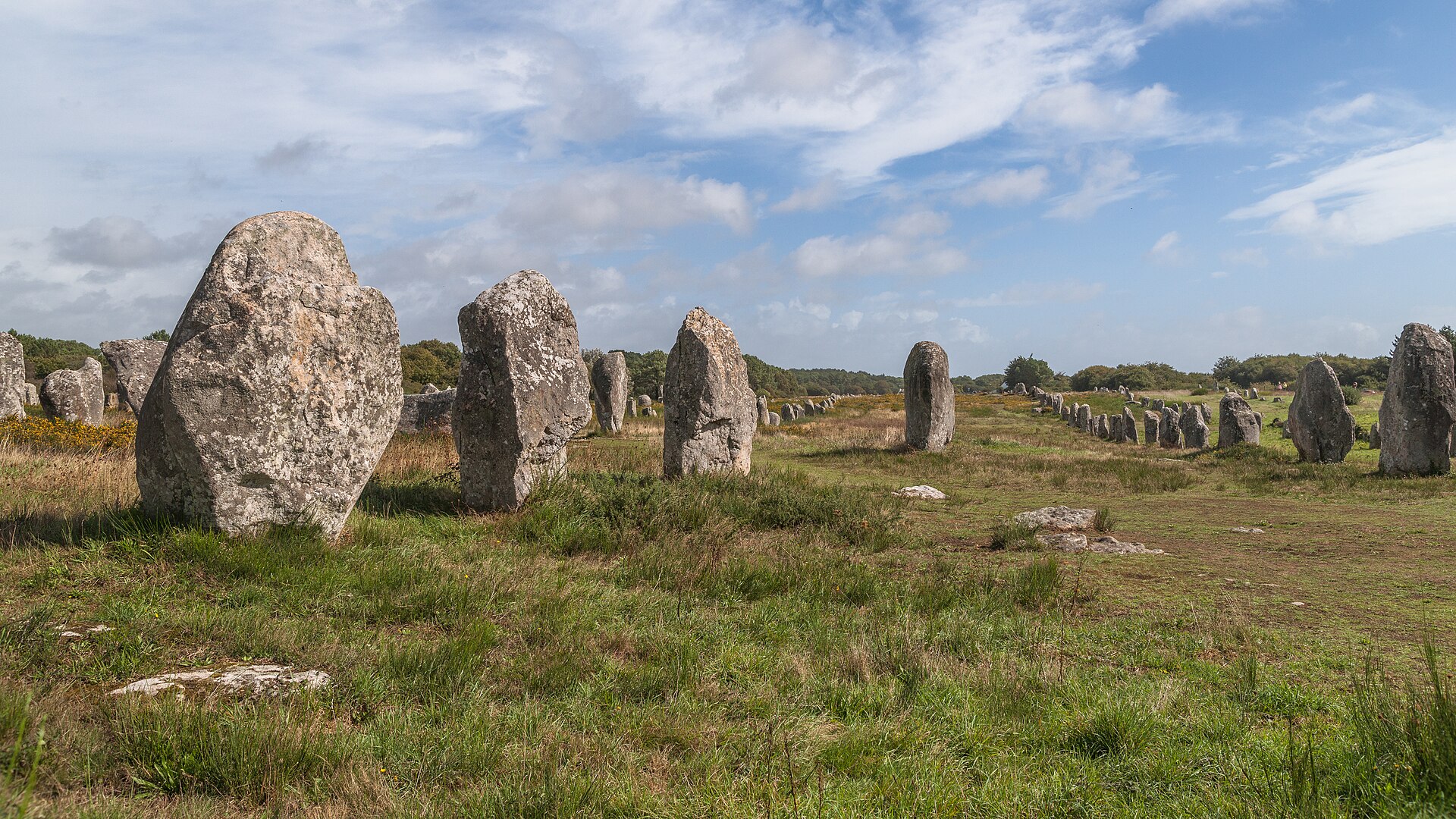
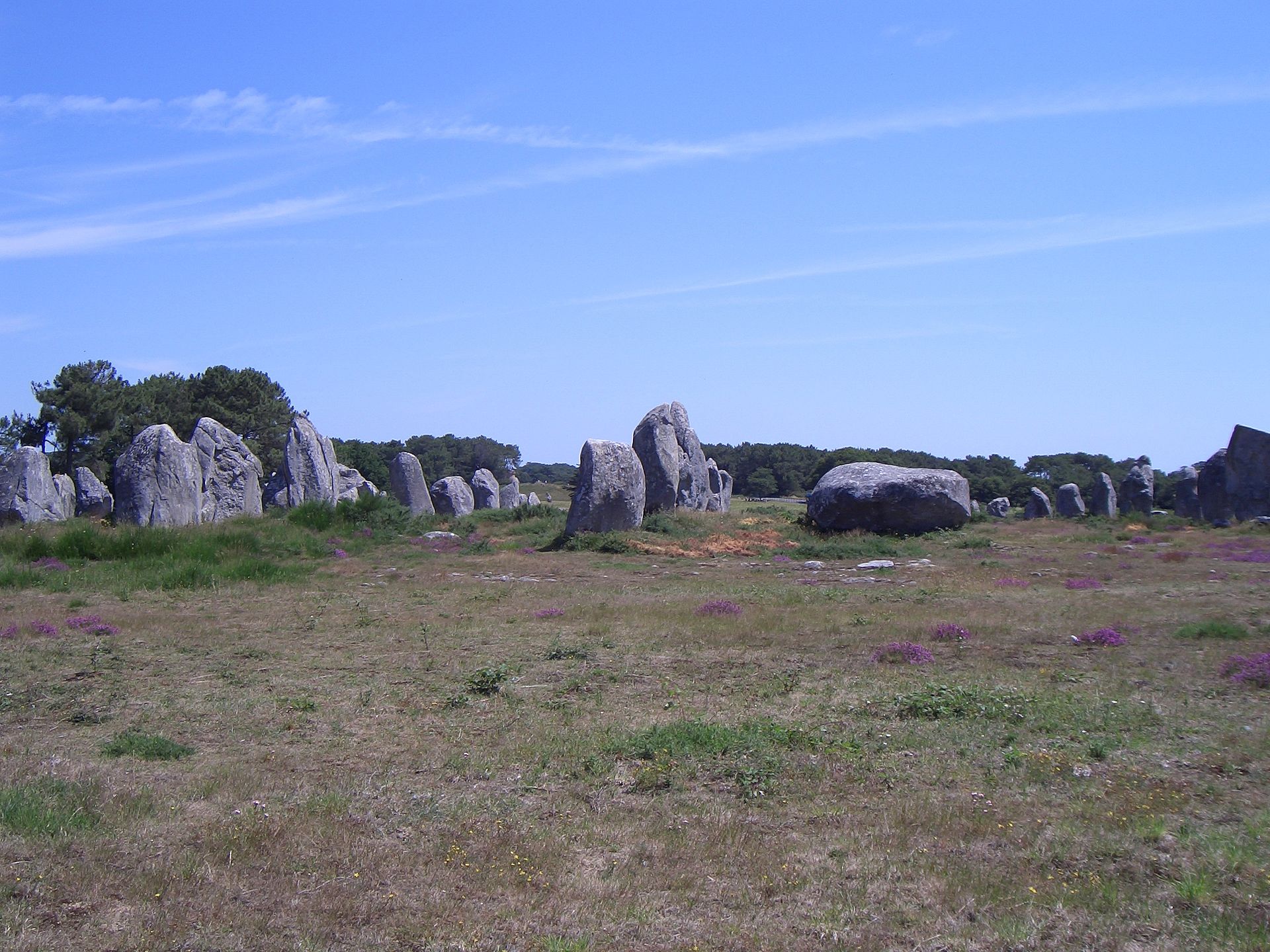
Most ancient sites you can take in with a single glance. Carnac you have to walk. The alignments stretch for kilometres across the countryside near the town of Carnac, on the Gulf of Morbihan, comprising well over three thousand standing stones arranged in long, deliberate rows. It is the largest concentration of menhirs anywhere in the world.
The stones are grouped into several major fields — Ménec, Kermario, Kerlescan and others — each a system of parallel lines running roughly east to west. Some of these lines are more than a kilometre long. Together they form one of the most ambitious feats of engineering the Neolithic world ever attempted.
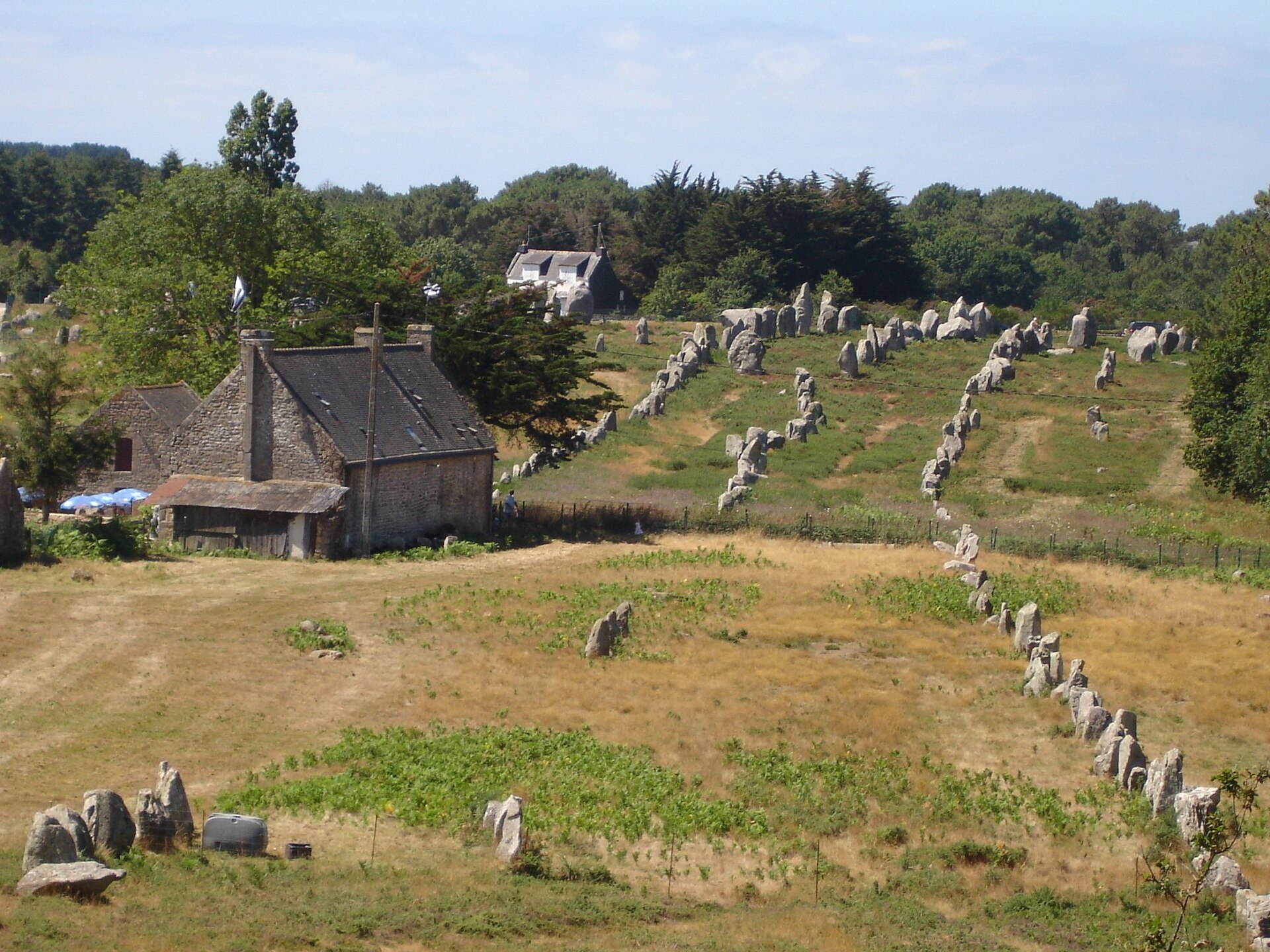
What gets me is the sheer commitment involved. This was not a weekend’s work or a single generation’s whim. The construction of Carnac unfolded over centuries, beginning around 4500 BC and continuing for a very long time, as one community after another added to the design their ancestors had begun.
The great alignments
Walk the Ménec alignment and you find eleven or so converging rows of stones, running for over a kilometre and bracketed at each end by the remains of stone enclosures, or cromlechs. The stones are graded, generally taller at one end and shrinking as the rows proceed, which cannot be an accident. Someone planned that gradient.
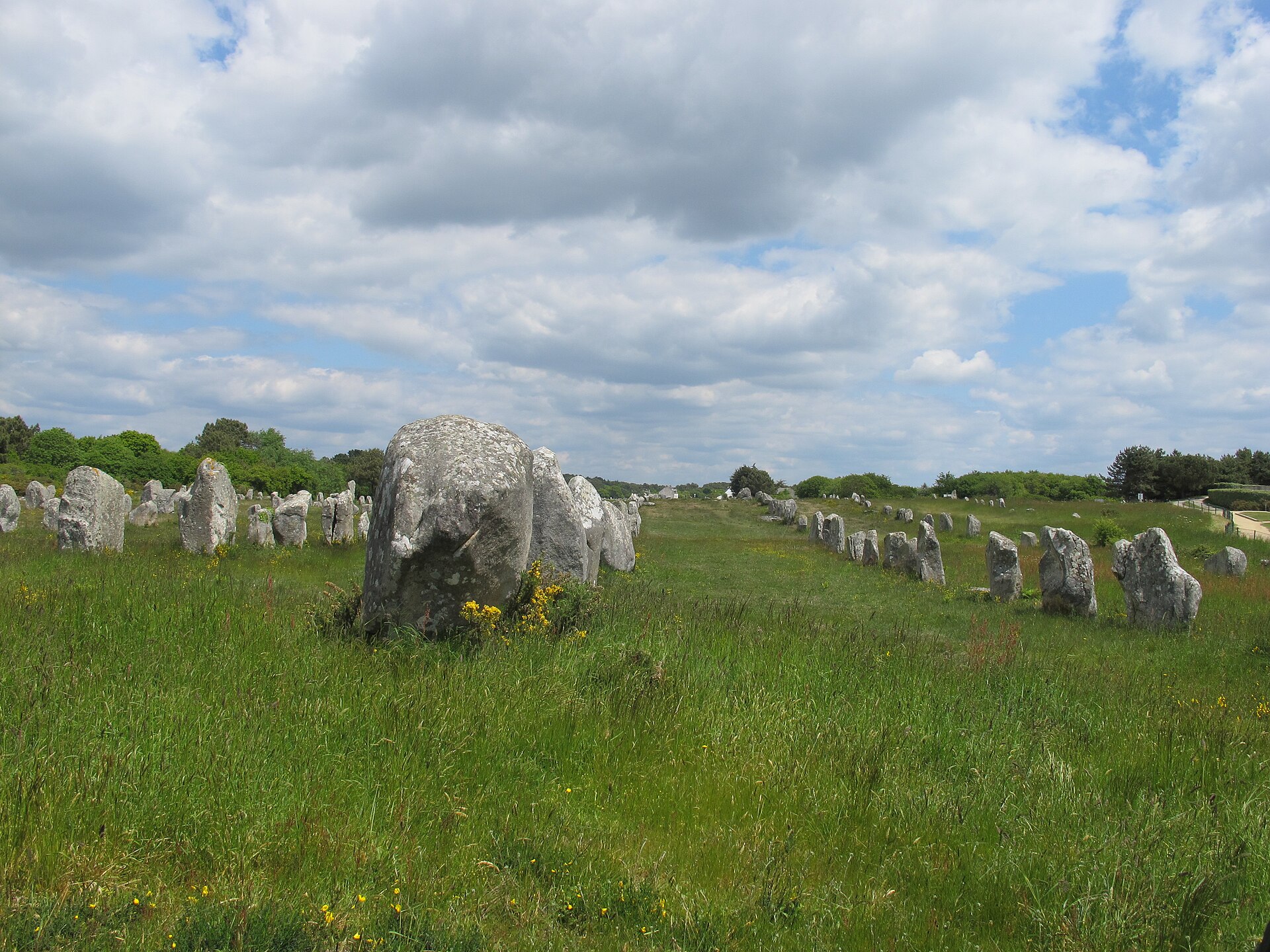
Kermario, the next great field, is if anything even more imposing, with over a thousand stones in its rows and a stone enclosure and burial mound woven into the scheme. Kerlescan adds still more. The impression, walking between them, is of a design so vast that no single vantage point can contain it.
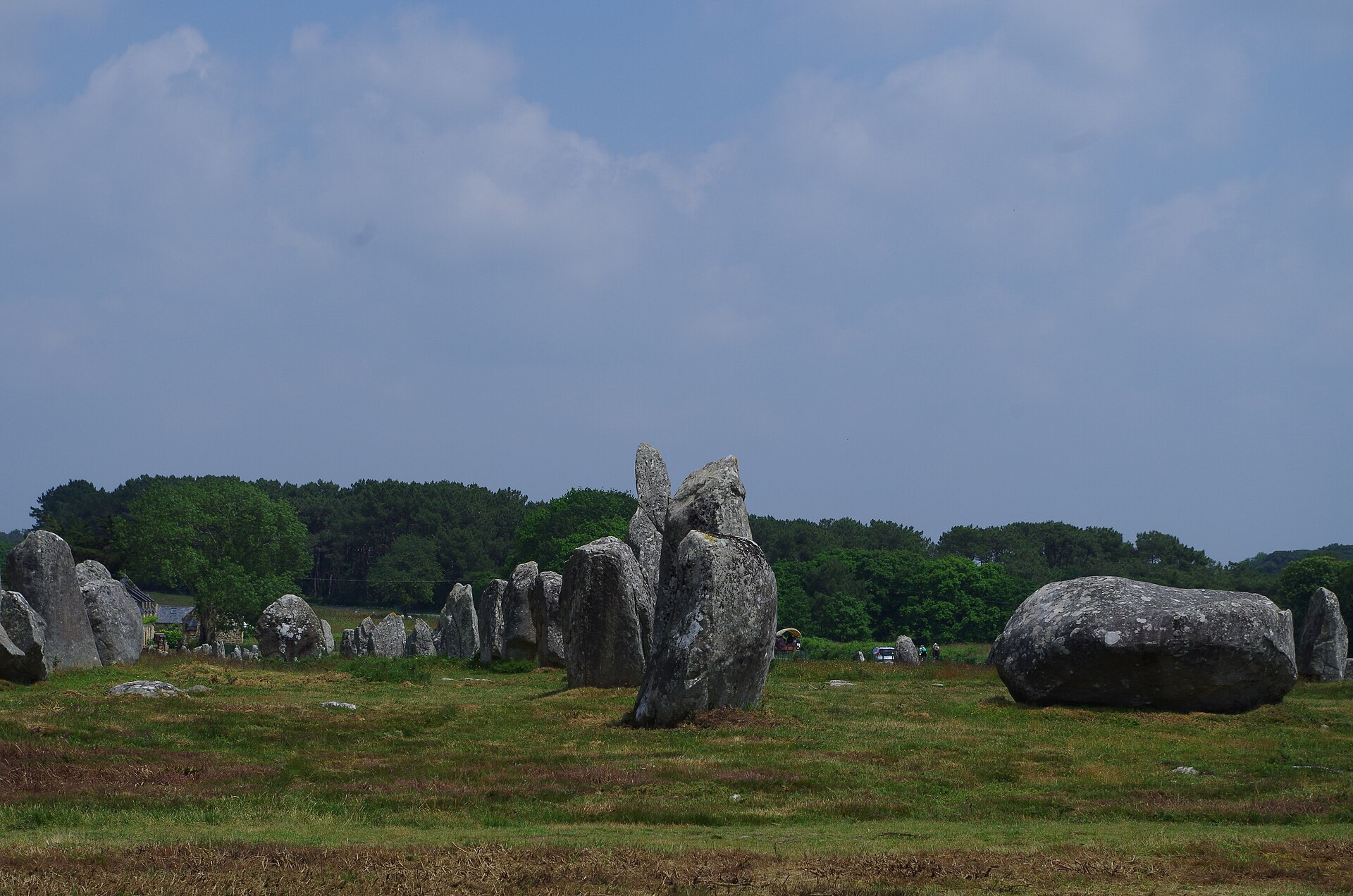
Whether the separate fields were once a single continuous system, broken up over the millennia by farming and stone-robbing, is still debated. Standing among them, though, you feel the underlying intent — this was one great idea, expressed across a whole landscape.
The stones themselves
The menhirs of Carnac are of local granite, dragged from the surrounding land and set upright in the earth. They vary enormously in size. Many stand around a metre or two high, roughly human-scale, but others are giants, and the largest broken menhir in the region once stood more than twenty metres tall before it fell and shattered.
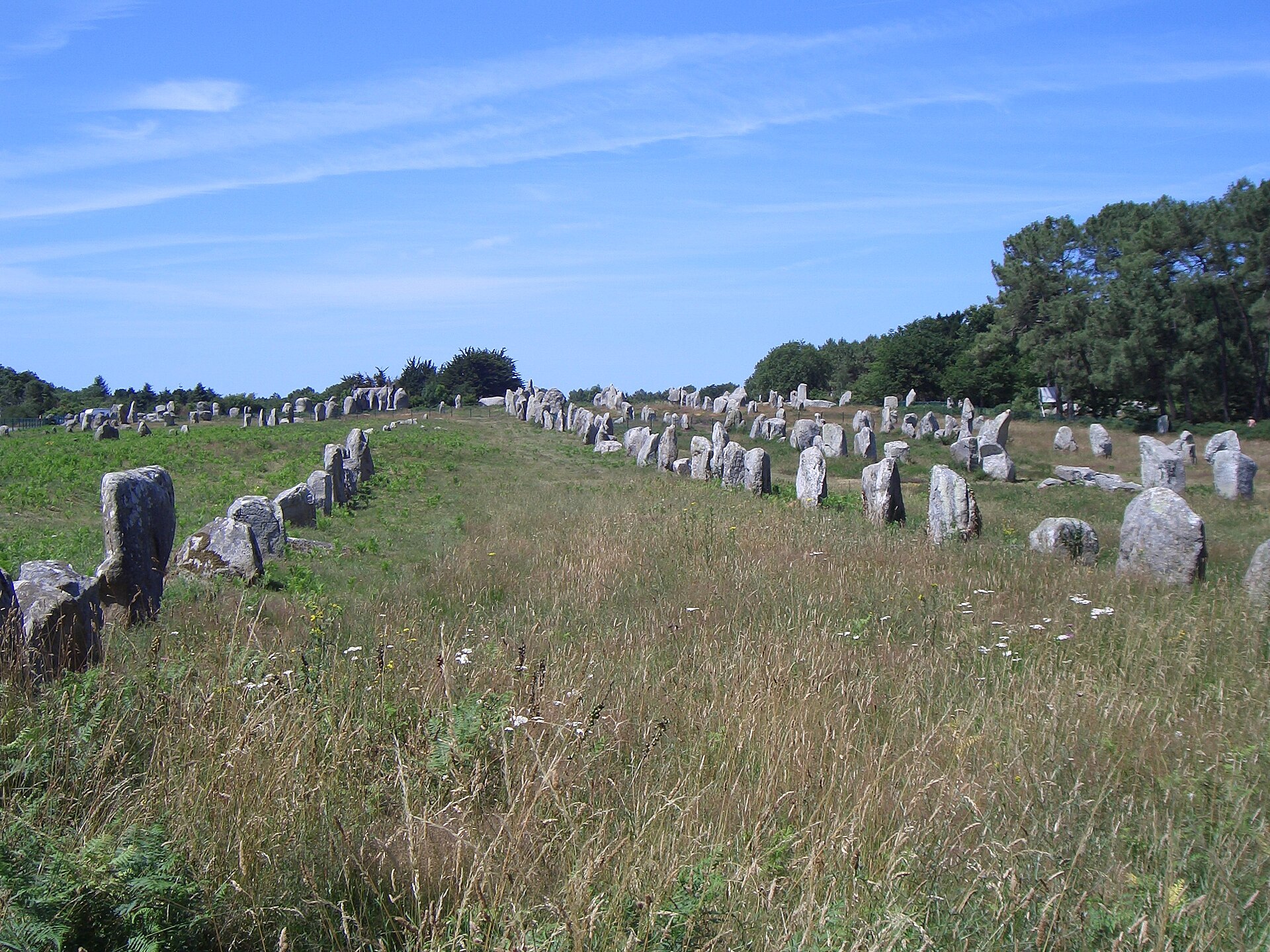
Moving and raising these stones with Neolithic technology was a monumental task. The methods were almost certainly the familiar ones — levers, ropes, timber sledges, wooden rollers, ramps of packed earth, and above all the muscle of large numbers of people working together. Every stone represents a small collective triumph.
Time and weather have rounded and lichened them, and many now lean at odd angles or have toppled entirely. But enough remain standing, in enough of their original order, that the grand pattern is still unmistakable after six and a half thousand years.
The question no one can answer
Here is the heart of the mystery: why? Why would people invest centuries of labour in row after row of standing stones? The honest answer is that we do not know, and the theories are many. Some see astronomical intent, the rows aligned to the movements of the sun or moon, a vast calendar written in granite.
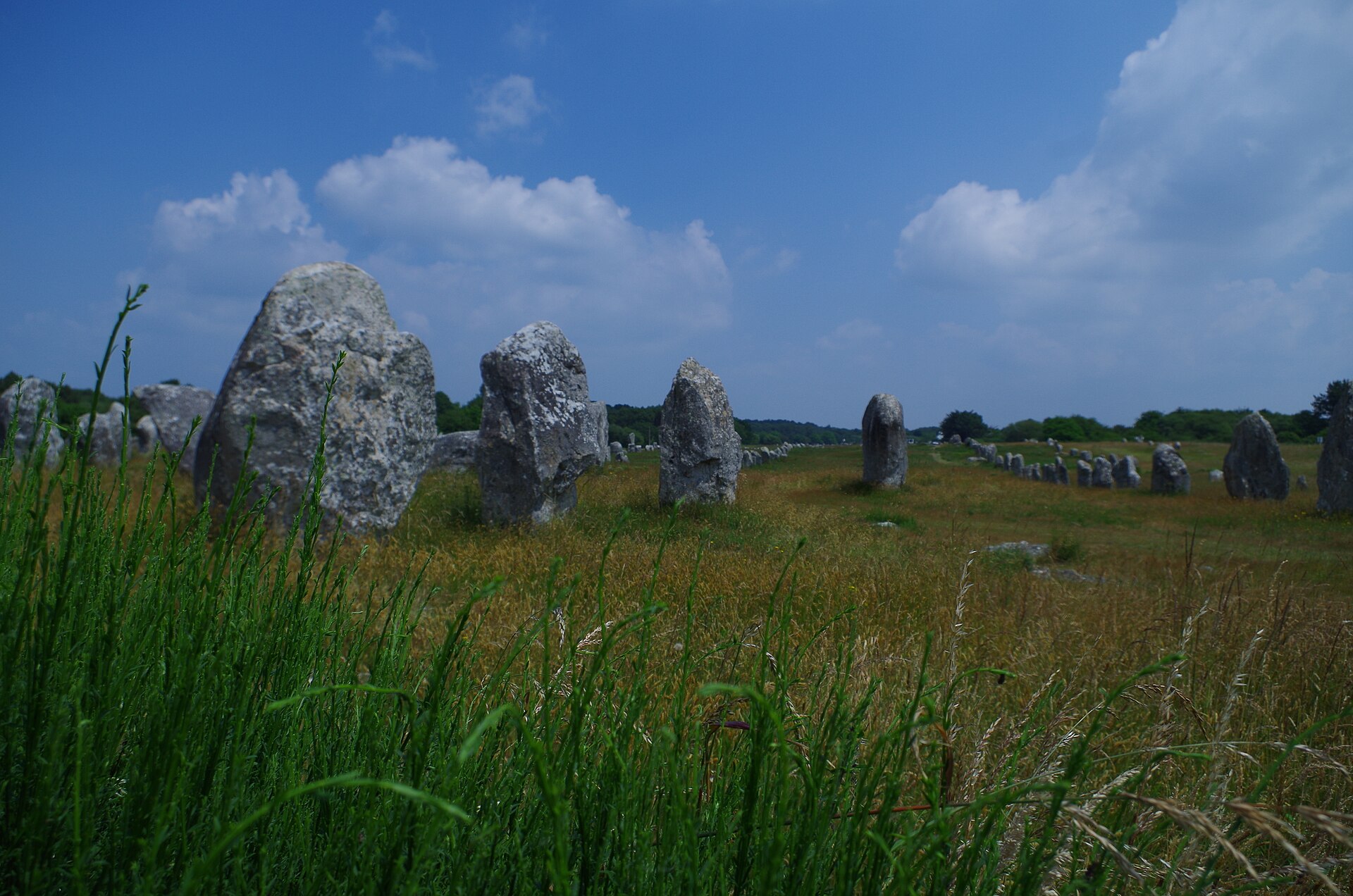
Others read them as processional ways, routes for rituals we can no longer reconstruct, perhaps connecting the living world to the realm of the dead. The presence of burial mounds among the rows lends weight to the idea that death and the ancestors were somewhere near the centre of it all. Still others suspect territorial markers, or displays of a community’s strength and unity.
I have come to think the uncertainty is part of the point. Carnac resists a single tidy explanation because it was probably never about a single thing. Meaning, like the stones, accumulated over centuries.
The farmers who moved mountains
The people who built Carnac were among the first farmers of Atlantic Europe, growing crops and keeping animals along this mild, fertile coast. They had no metal in the earliest phases, no writing, no wheeled vehicles we can confirm. What they had was organisation, tradition, and an evidently deep conviction that this work mattered.
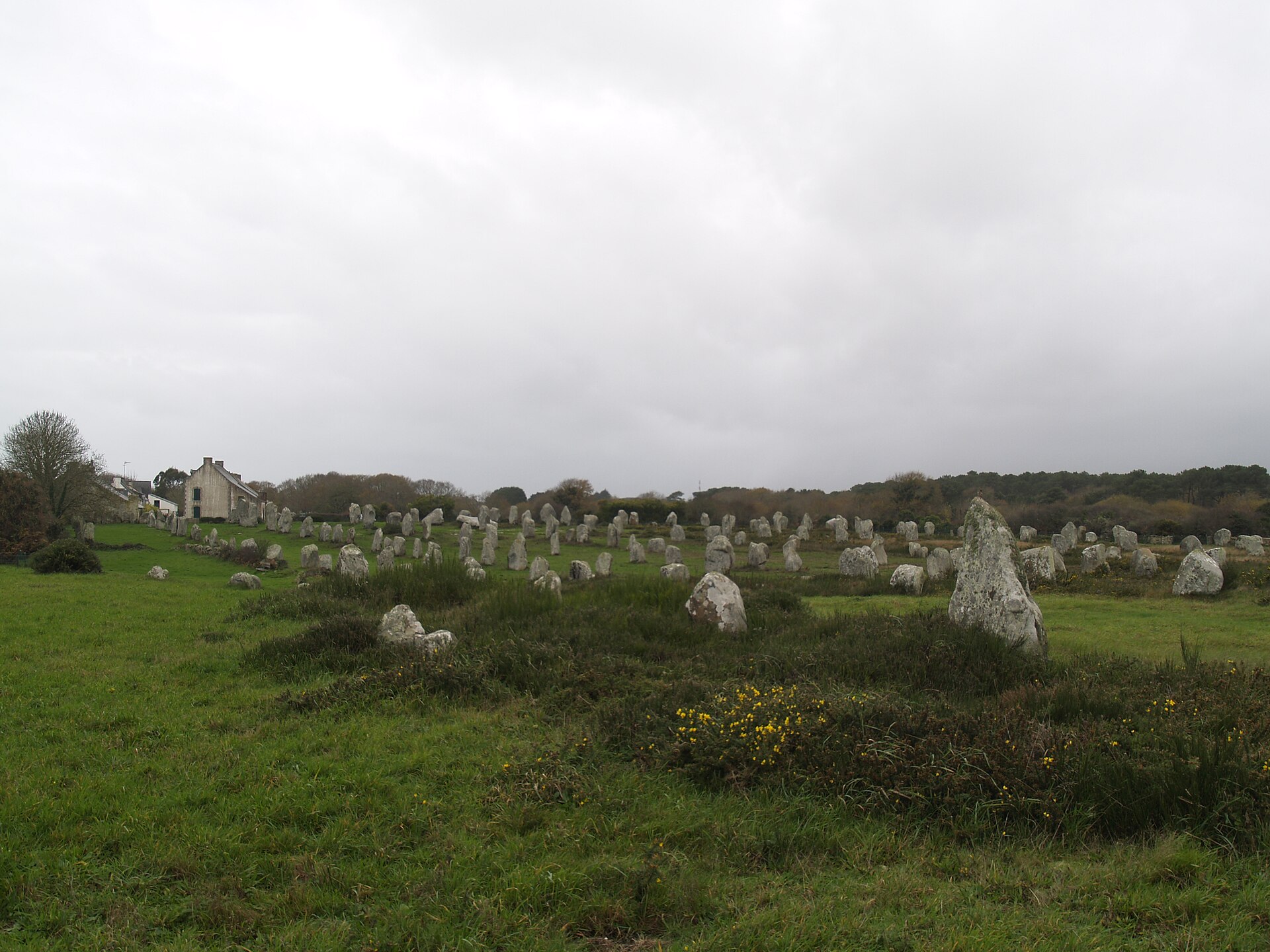
That conviction is the thing I keep circling back to. You do not commit generation after generation to hauling and raising thousands of stones unless the project sits at the very core of who you are. Carnac was not decoration. It was, in some sense we can feel but not fully grasp, the expression of an entire worldview.
Saints, soldiers, and folklore
Long after the builders were forgotten, local tradition reached for stories to explain the stones. The most famous claims that the rows are a Roman army turned to stone by a fleeing saint, frozen mid-march across the fields. It is nonsense as history, but it captures something true about how the alignments look: like a vast host, halted forever.
Folklore like this is a reminder that Carnac has been astonishing people for a very long time, not just modern tourists. Every era that encountered these stones felt the need to account for them, and when the real explanation was lost, imagination filled the gap.
There is a lesson in that too. We are not the first to stand here baffled and impressed, and we will not be the last. The stones outlast every story we tell about them.
Why Carnac still stops us in our tracks
Carnac matters because it explodes the idea that monumental ambition needs cities, kings, or writing. Here were farming communities on the edge of Europe who, with almost nothing we would recognise as technology, reshaped an entire landscape and left a mark still legible six and a half thousand years later.
Stand at the end of one of those long rows, with the stones dwindling into the distance and the Breton wind in your face, and you feel the reach of human intention across time. Whatever they meant to say, they said it loudly enough that we are still listening. That, to me, is reason enough to make the journey.
How old are the stones?
Dating standing stones is trickier than dating a settlement, because a bare menhir leaves little organic material to test. At Carnac, archaeologists have relied on the surrounding evidence — associated burials, buried soils, artefacts, and comparisons with better-dated monuments — to build a chronology.
The consensus places the beginning of the alignments in the earlier Neolithic, around 4500 BC, with activity continuing over a long span. That makes Carnac older than the great phase of Stonehenge and older than the Egyptian pyramids by a wide margin. These are among the oldest monumental structures humanity ever raised.
It is worth pausing on that. When we picture the deep past, we tend to start with Egypt or Mesopotamia. Yet here, on the Atlantic edge of Europe, farmers were already reshaping the land on a colossal scale a thousand years and more before the first pharaoh.
Tombs among the rows
Carnac is not only rows of stones. Scattered through and around the alignments are burial monuments — dolmens, passage graves, and great earthen mounds such as the famous Tumulus Saint-Michel, which rises above the town and once covered rich burials. Death was clearly woven into the fabric of the whole complex.
This mingling of the alignments with tombs is one of the strongest hints about their purpose. It suggests that whatever the rows were for, they belonged to the same world of ritual and ancestry as the graves. The living and the dead shared this landscape, and the stones may have helped mediate between them.
Exactly how remains beyond us. But the pattern — monuments to the dead set within a vast field of standing stones — recurs across megalithic Europe, from Brittany to Ireland, and it ties Carnac firmly into that shared tradition.
The astronomy debate
Ever since researchers began measuring the alignments closely, the possibility that they encode astronomical knowledge has fascinated and divided scholars. Some have argued that the rows, and certain outlying great stones, mark the risings and settings of the sun and moon at key points of the year.
Others are far more cautious, pointing out that with thousands of stones over kilometres of ground, you can find an alignment to almost anything if you look hard enough. The truth probably lies in between: the builders were surely aware of the sky and the seasons, but reading Carnac as a precise observatory may claim more certainty than the stones can bear.
What is not in doubt is that these people watched the heavens. Every farming society does; their survival depended on it. Whether that awareness was literally built into the geometry of the rows is a question the granite has so far refused to settle.
Loss, protection, and access
Carnac has not come down to us untouched. Over the centuries countless stones were toppled, broken up for building material, or cleared to make way for farming. What survives, remarkable as it is, is only a fraction of what once stood. Some rows were even re-erected in the nineteenth century, not always in their original positions.
Today the alignments are protected as a national heritage site, and there is an ongoing effort toward wider recognition of Brittany’s megaliths. To preserve the stones and the fragile ground around them, access to the main fields is now managed, with visitors kept to paths or guided onto the stones only at certain times.
It is a familiar tension: the desire to walk freely among the stones set against the need to keep them standing for the future. On balance, a slightly more distant Carnac that survives intact is better than an intimate one loved to ruin.
Walking the alignments today
Visiting Carnac is unlike visiting almost any other ancient site, precisely because there is so much of it. You cannot do it justice in ten minutes. The rewarding approach is to walk, to follow a line of stones and feel the rhythm of them, the way the pattern reveals itself slowly as you move.
Go early or late, when the low sun rakes across the granite and each stone throws a long shadow, and the fields fill with a strange, striped light. That is when Carnac is at its most haunting, and when it is easiest to imagine the processions and gatherings that may once have filled these avenues.
Give it time. Sit at the end of a row. Let the scale settle over you. Carnac is not a monument you tick off a list; it is one you absorb, slowly, the way its builders must have experienced it across the seasons of their lives.
The great broken menhir
Not far from Carnac lies one of the most astonishing objects in all of prehistory: the Grand Menhir Brisé, the Great Broken Menhir. Now lying shattered in several pieces, it once stood over twenty metres tall and weighed in the region of three hundred tonnes, making it the largest single standing stone ever raised in Neolithic Europe.
Think about that for a moment. Three hundred tonnes of granite, quarried, transported some distance, and set upright by people with no metal and no machines. Whether it fell in an earthquake or was toppled deliberately, its very existence rewrites what we think Neolithic communities were capable of.
The Grand Menhir belongs to the same broad culture as the Carnac alignments and reminds us that these were not modest efforts. The builders were reaching for the limits of what was physically possible, and sometimes, as with this colossal stone, pushing right past them.
Part of a megalithic Europe
Carnac did not arise in isolation. It belongs to a great arc of megalithic building that swept along the Atlantic seaboard, from Iberia through Brittany to Britain and Ireland, over thousands of years. Standing stones, stone circles, dolmens and passage tombs appear again and again across this whole region, sharing ideas and forms.
How these ideas travelled — by trade, by migration, by the movement of beliefs along the coasts — is one of the great questions of European prehistory. But the family resemblance is unmistakable. The people of Carnac were part of a wider conversation in stone that stretched across the western edge of a continent.
Seeing Carnac in that context makes it feel less like an oddity and more like a magnificent local chapter of a shared human impulse: to mark the land permanently, to gather the community around great works, to reach for something lasting.
Moving stones without machines
The question everyone asks about any megalith is the practical one: how on earth did they move these things? At Carnac, with thousands of stones of every size, the answer was almost certainly a well-honed communal technology built from simple parts — timber, rope, muscle, and accumulated know-how.
A stone could be levered onto a wooden sledge, hauled over rollers or a greased timber track by teams pulling on ropes, then eased into a prepared pit and tipped upright, the pit packed tight to hold it. None of it required metal or the wheel. It required people, coordination, and patience — all of which these communities clearly had in abundance.
Experiments in modern times have shown that surprisingly modest numbers of people, working cleverly, can move very large stones. The magic at Carnac is not in some lost secret technique but in the will to do it thousands of times over, across the generations.
The meaning behind the stones
The word menhir itself comes from Breton, from terms meaning “long stone,” and it is telling that the local language kept a plain, practical name for these monuments long after their purpose was forgotten. Even stripped of meaning, the stones demanded a word of their own.
That impulse to name and categorise the inexplicable runs through Carnac’s whole history. Generation after generation looked at the rows, felt their strangeness, and reached for language to contain them — sometimes practical, sometimes mythological, never quite adequate to the reality.
Perhaps that is fitting. A monument built over centuries, for reasons that shifted and layered over time, was never going to be captured by a single tidy label. The stones remain, in the end, gloriously resistant to definition.
Rediscovery and early study
Serious antiquarian interest in Carnac gathered pace in the nineteenth century, when scholars began surveying, sketching, and cataloguing the alignments in earnest. Their work, for all its limitations by modern standards, saved a great deal of information and drew the wider world’s attention to the site.
Some of the re-erection of fallen stones dates from this era, well-meant but not always accurate, which is why archaeologists today treat the exact positions of some menhirs with caution. It is a reminder that even preservation leaves its fingerprints on a monument.
Since then, Carnac has been studied with ever more sophisticated methods, from careful excavation to geophysical survey. Each generation of researchers peels back a little more — and, reliably, uncovers fresh questions to replace the ones it answers.
I always come away from places like this a little rearranged inside. We carry a quiet assumption that real ambition and real achievement are modern things. Carnac says otherwise, in the plainest possible language: thousands of stones, raised by hand, still standing after six and a half thousand years.
Maybe that is the deepest gift these fields offer. Not a solved puzzle, but a humbling one — proof that the people of the deep past were every bit as capable, as devoted, and as determined to leave a mark as we are.
If Carnac has pulled you into the world of standing stones and the first builders, there is a whole trail to follow. Its fellow French megaliths, The Cairn of Barnenez: Europe’s Colossal Stone Monument Older Than the Pyramids, Gavrinis: The 6,000-Year-Old Carved Passage They Sealed in the Dark and Los Millares: The 5,000-Year-Old Fortified Town at the Edge of Europe, share its DNA, while Britain and Ireland answer with Stonehenge: How and Why This Ancient Stone Circle Was Really Built, Newgrange: The 5,000-Year-Old Tomb Built to Catch the Solstice Sun, Skara Brae: The 5,000-Year-Old Village Known as the Scottish Pompeii, Vinča: The Danube Culture That May Have Written Before Anyone Else, Knowth: Europe’s Greatest Collection of Neolithic Art, Hidden Beside Newgrange and Dowth: The Forgotten Third Mound of Ireland’s Boyne Valley. The great island temples of Malta — The Megalithic Temples of Malta: Older Than the Pyramids, Mnajdra: The 5,000-Year-Old Maltese Temple That Tracks the Sun, Ħaġar Qim: Malta’s Cliff-Top Temple Older Than the Pyramids and Tarxien: Malta’s Most Elaborate Prehistoric Temple, Carved 5,000 Years Ago — push the same instinct in another direction. For where it all began, few places rival Göbekli Tepe: The World’s Oldest Temple and How It Rewrote History and Karahan Tepe: The Astonishing Sister of Göbekli Tepe in Anatolia, or the walled town of Jericho: The World’s Oldest City and Its 10,000-Year-Old Wall. And the wider human story unfolds through Çatalhöyük: The 9,000-Year-Old Town With No Streets, The World’s Oldest Art: Inside the Painted Caves of Lascaux and Chauvet, Uruk and Sumer: The First Cities and the Birth of Writing, Mohenjo-daro: The 4,500-Year-Old City That Was Centuries Ahead of Its Time, Liangzhu: The 5,000-Year-Old Water City That Rewrote China’s History, Caral: The 5,000-Year-Old City That Rose As the Pyramids Were Built, Knossos: The 4,000-Year-Old Palace Behind the Myth of the Minotaur, Dholavira: The 4,500-Year-Old City That Beat the Desert With Water Engineering, Nan Madol: The Ancient City Built on a Coral Reef in the Middle of the Pacific, Chavin de Huantar: The 3,000-Year-Old Andean Temple Built to Overwhelm the Senses, Cucuteni-Trypillia: Europe’s 6,000-Year-Old Mega-Settlements That Might Be the First Cities, Cerro Sechin: The 3,600-Year-Old Peruvian Temple Carved With Warriors and Their Victims, Poverty Point: The 3,700-Year-Old Earthworks Built by Hunter-Gatherers, Not Farmers, Sarazm: The 5,500-Year-Old Town in Tajikistan That Rewrites Central Asia’s Past, Mehrgarh: The 9,000-Year-Old Village Where South Asia Learned to Farm, Tell Brak: The Syrian Mound That May Rewrite Where Cities Began, Aşıklı Höyük: The 10,000-Year-Old Village That Came Before Çatalhöyük, Jiahu: The 9,000-Year-Old Chinese Village Whose Flutes Still Play, Chankillo: The 2,300-Year-Old Peruvian Towers That Are the Americas’ Oldest Solar Observatory, Kalibangan: The Indus Town With the World’s Oldest Ploughed Field, Bougon: The 7,000-Year-Old Burial Mounds Older Than the Pyramids, Almendres Cromlech: Europe’s Oldest Stone Circle, 2,000 Years Before Stonehenge and Ġgantija: The Giant Temples of Gozo, Older Than the Pyramids. Each adds another line to the same long, human story. The remote ring of Callanish offers yet another window onto the world of the first builders. The stone warriors of Filitosa offer yet another window onto the world of the first builders. The clifftop stone ship of Ale’s Stones offers yet another window onto the monuments of the deep past.
You May Like
The Bardo, a Palace of the Beys Filled With Roman Mosaics