There is a story you probably know, even if you have forgotten where you first heard it. A monstrous creature, half man and half bull, prowling the heart of a maze so cunningly built that no one who entered it could ever find the way out. A hero named Theseus, a ball of thread from a lovestruck princess, a slow walk into the dark to kill the beast. The Minotaur in the Labyrinth. It is one of the oldest and most haunting myths the Western world has ever told.
Now here is the part that gives me chills every time. Buried on the island of Crete, in the eastern Mediterranean, there really is a place that seems to have inspired that legend: a palace so vast and so bewilderingly complex, with so many hundreds of interconnecting rooms, corridors, staircases, and storerooms, that walking through it must have felt like being lost in a maze. Its walls were decorated with images of bulls and bull-leaping athletes. And at its heart sat the throne of a king whose name may echo down to us as Minos. The palace is called Knossos, and it is the beating heart of Europe’s first great civilization.
The people who built it are called the Minoans, and around four thousand years ago they created something genuinely new on European soil — a sophisticated, artistic, sea-faring society centuries before the glory of classical Greece. So let me take you to Knossos. I want to walk you through its painted halls, sit you down before its throne, and untangle the real history from the myth, because the truth turns out to be every bit as astonishing as the legend.
Europe’s First Civilization
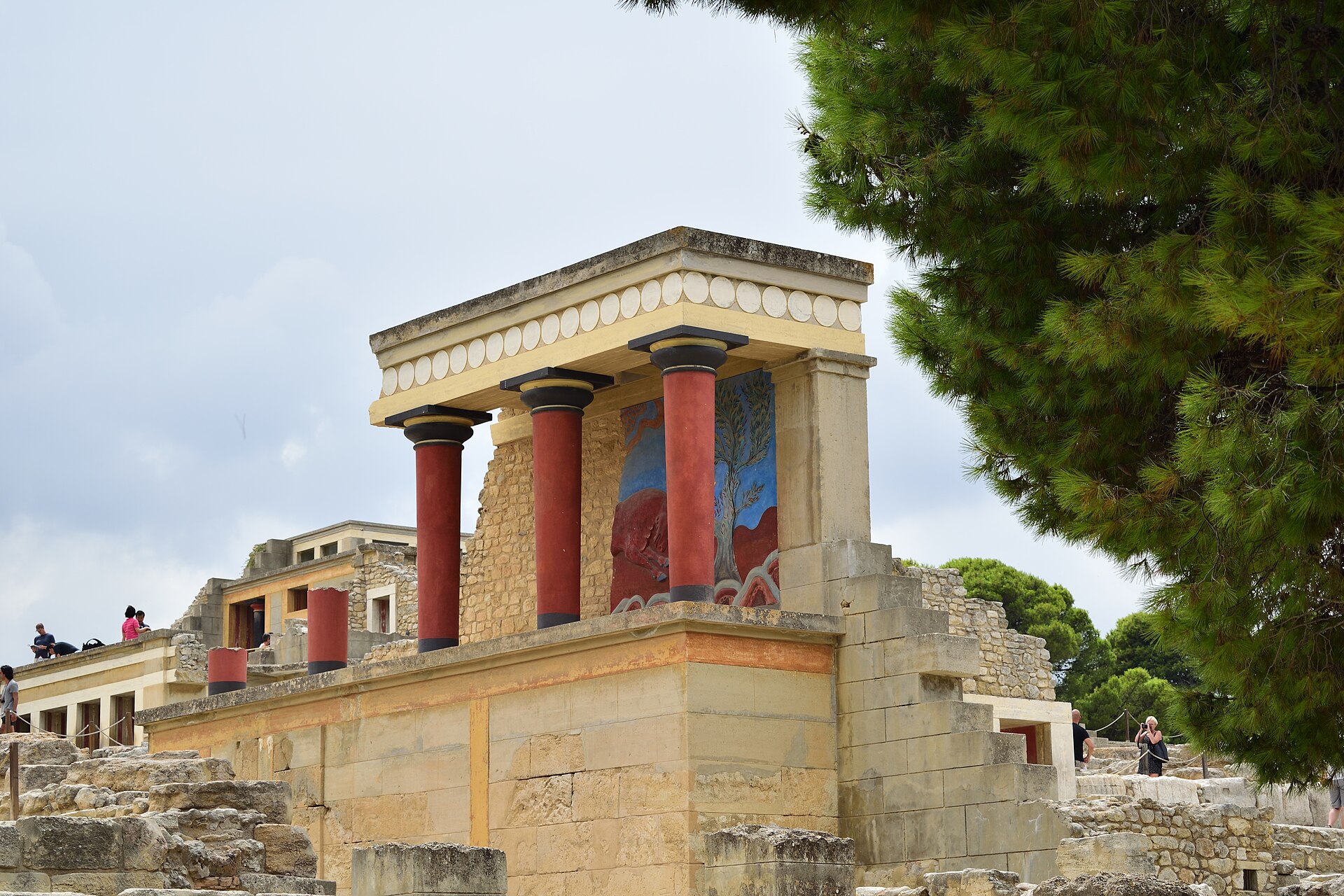
Let us get our bearings first, because the significance of the Minoans is easy to miss if you grew up, as most of us did, thinking that European civilization began with the Greeks and Romans. It did not. Long before the Parthenon, long before Athens and Sparta, there were the Minoans, flourishing on Crete from roughly 2000 BCE onward, in the middle of the Bronze Age. They are, by most reckonings, the first advanced civilization to arise on European soil. Everything that came later in the Western tradition has these islanders somewhere in its family tree.
We call them Minoans after the legendary King Minos, a name given to them by the archaeologist who uncovered Knossos. We do not actually know what they called themselves, because although they wrote, using scripts we call Linear A and Linear B, their earlier language remains largely a mystery to us. Linear A, the script of the Minoans proper, has never been fully deciphered. So once again, as with so many of the oldest civilizations, we find ourselves face to face with a people who left us their art, their architecture, and their writing, and yet whose own voices we cannot quite hear. We know them by their things, not their words.
What their things tell us, though, is remarkable. This was a culture of extraordinary artistic sophistication, of maritime power, of wealth and comfort and beauty. While much of Bronze Age Europe was still living in relatively simple villages, the Minoans were building multi-storey palaces with running water, painting their walls with vivid frescoes, trading across the whole eastern Mediterranean, and enjoying a standard of living that would not be matched in Europe again for a very long time. They were, in a real sense, ahead of their moment — a flash of brilliance in the deep Bronze Age.
A Palace Like a Labyrinth
The Palace of Knossos is the largest and most famous of the Minoan palaces, and to understand the Minotaur legend, you really have to grasp how strange and sprawling it was. This was not a single grand building with a clear front door and a tidy floor plan. It was an enormous, rambling complex of well over a thousand interlocking rooms, spread across several storeys, arranged around a large central courtyard, and expanded and rebuilt over centuries into a warren of astonishing complexity.
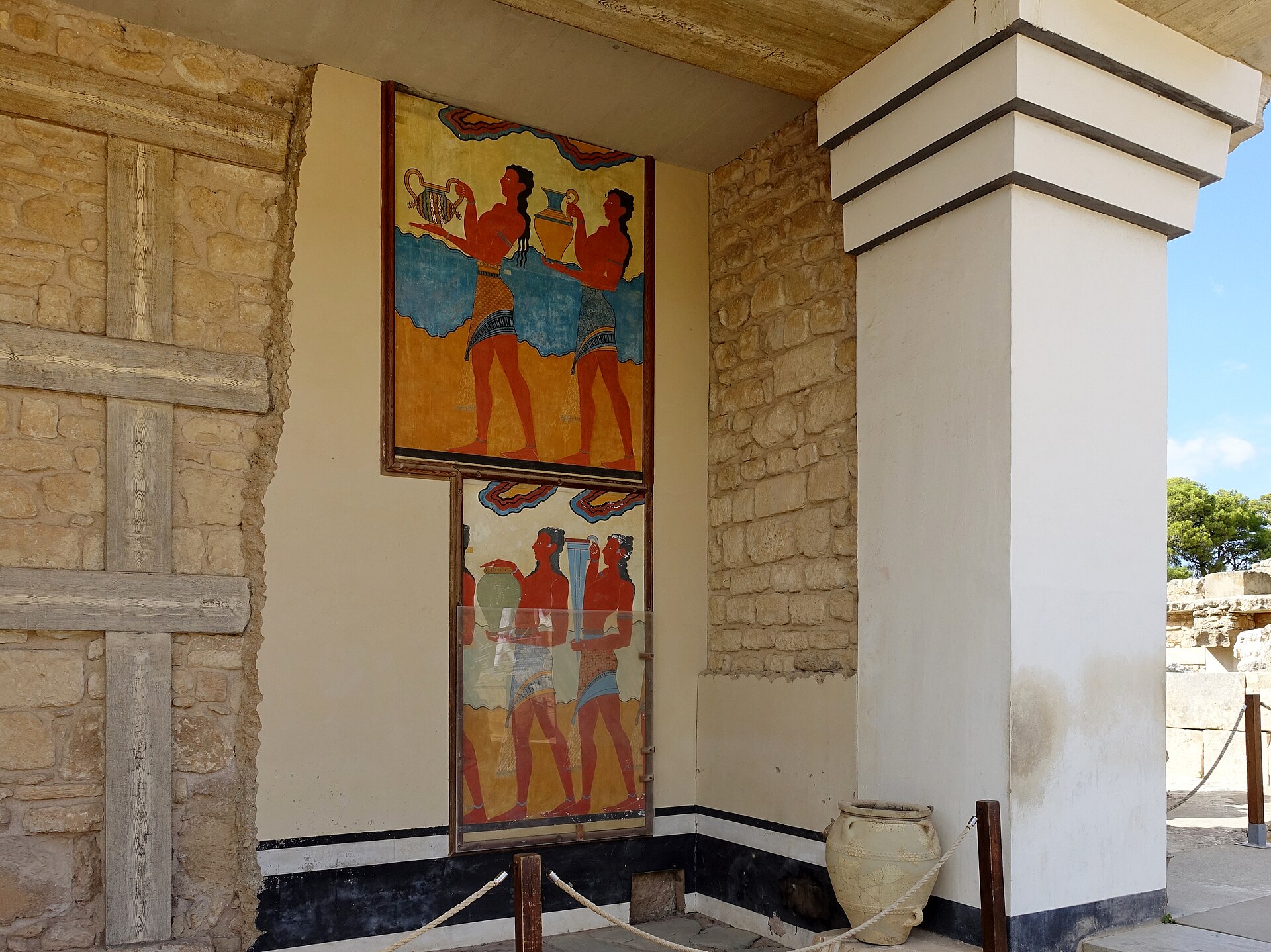
There were royal apartments and workshops, shrines and light-wells, grand staircases and humble service corridors, and above all storerooms — long magazines lined with enormous storage jars, holding the oil, grain, and wine that were the palace’s wealth. Corridors turned and branched. Stairs went up and down between levels. Rooms opened onto rooms. To a visitor arriving from a simpler world, the experience of moving through Knossos must have been genuinely disorienting, a place where you could easily lose your way. Is it any wonder that the Greeks, gazing back at the ruins of this incomprehensible maze of a building, imagined a labyrinth with a monster at its centre?
Some scholars even point out that the Minoan symbol of the double-headed axe, which appears all over Knossos, was called a labrys, and that the word labyrinth may derive from it — the labyrinth being, quite literally, the house of the double axe. Whether or not that etymology is exactly right, the connection feels powerful. The myth of the Labyrinth was not invented out of thin air. It was the Greeks’ way of remembering, and mythologizing, a real and awe-inspiring place that had crumbled into ruin long before their time.
The Oldest Throne in Europe
Deep within the palace, archaeologists uncovered a small, quiet room that has a very big claim to fame. Against one wall stands a carved stone chair, simple and dignified, flanked by benches and surrounded by frescoes of reclining griffins — mythical creatures, part lion and part eagle — that seem to stand guard over whoever sat there. It is known as the throne room, and that stone chair is often called the oldest throne in Europe.
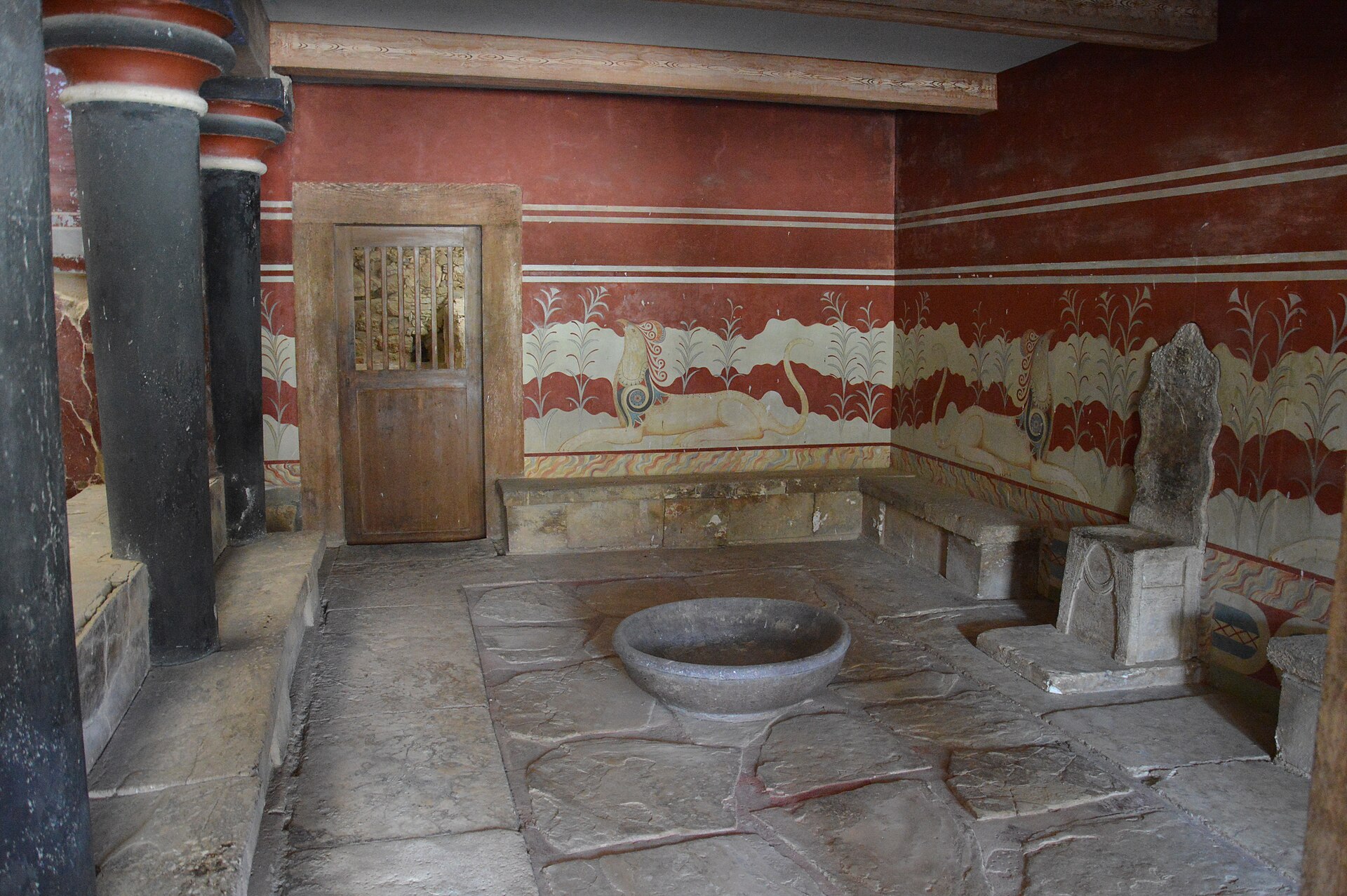
Sit with that for a moment. This is the oldest surviving purpose-built seat of power on the entire European continent, the place where, four thousand years ago, someone wielded authority over the Minoan world. But here is where it gets intriguing: we are not entirely sure who sat there, or even whether it was a throne in the way we usually mean. Was it the seat of a king, the Minos of legend? Or was it, as some archaeologists suspect, the seat of a priestess — a place of religious rather than purely political power? The griffins, the ritual basin nearby, the whole atmosphere of the room, hint that religion and rulership at Knossos may have been deeply intertwined, perhaps even led by women.
That possibility opens a fascinating window. Minoan art is full of powerful female figures — goddesses, priestesses, women taking part in and even leading ceremonies. Some scholars have argued that women held an unusually prominent place in Minoan society, in religion and perhaps in governance too. We should be careful not to project our hopes onto the silent past, but the evidence genuinely allows for a society in which female authority mattered far more than it would in the Greece that followed. That little stone chair, guarded by its griffins, may have been the seat of a queen or a high priestess presiding over the spiritual life of Europe’s first civilization.
A World Painted in Colour
If one thing makes the Minoans leap off the page for me, it is their painting. These people loved colour, movement, and life, and they covered the walls of Knossos with frescoes so fresh and lively that they can still make you smile across four thousand years. This was not stiff, formal, intimidating art. It was joyful. Dolphins leap through blue water. Birds perch among flowers. Elegant figures process in fine clothes. Athletes vault over the backs of charging bulls. Blue monkeys clamber through gardens of lilies and saffron.
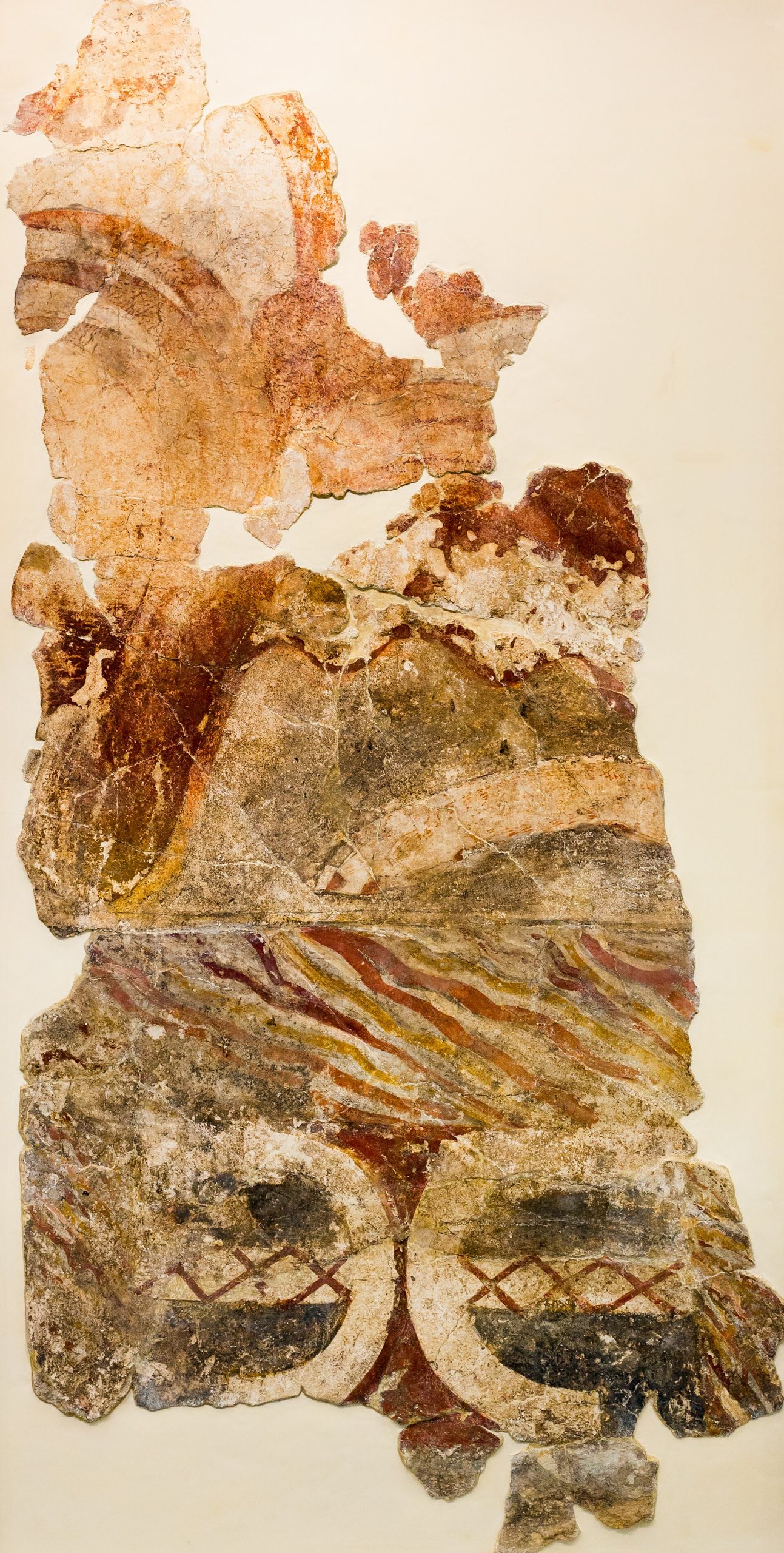
Compared to the grand, solemn art of Egypt or Mesopotamia, with its god-kings and marching armies, Minoan art feels almost startlingly modern and humane. It celebrates nature and beauty and the pleasures of life. The figures are graceful and fluid rather than rigid. There is an obvious delight in the natural world — in the sea, in flowers, in animals — that speaks of a people who found the world around them worth looking at closely and lovingly. When I look at a Minoan fresco of dolphins or lilies, I do not feel the weight of a distant, alien culture. I feel a shared human pleasure in a beautiful world.
One thing worth knowing, in the interest of honesty, is that much of what you see at Knossos today is heavily restored. The frescoes survived only in fragments, and early twentieth-century restorers filled in the gaps, sometimes generously, sometimes controversially, guided as much by imagination as by evidence. So the vivid, complete images we admire are part ancient Minoan and part modern reconstruction. It is worth keeping that in mind. But even the genuine fragments are enough to show us a civilization that painted its world with extraordinary vitality and love.
Bulls, Horns, and the Minotaur
You cannot spend long at Knossos without noticing the bulls. They are everywhere — in the frescoes, in the sculpture, in the very architecture. And the most famous Minoan image of all is the astonishing sport of bull-leaping: young athletes grasping the horns of a charging bull and vaulting, somersaulting, right over its back. Whether this was a real athletic feat, a religious ritual, or some combination of the two, it clearly sat at the very centre of Minoan culture. The bull was sacred, powerful, and everywhere.
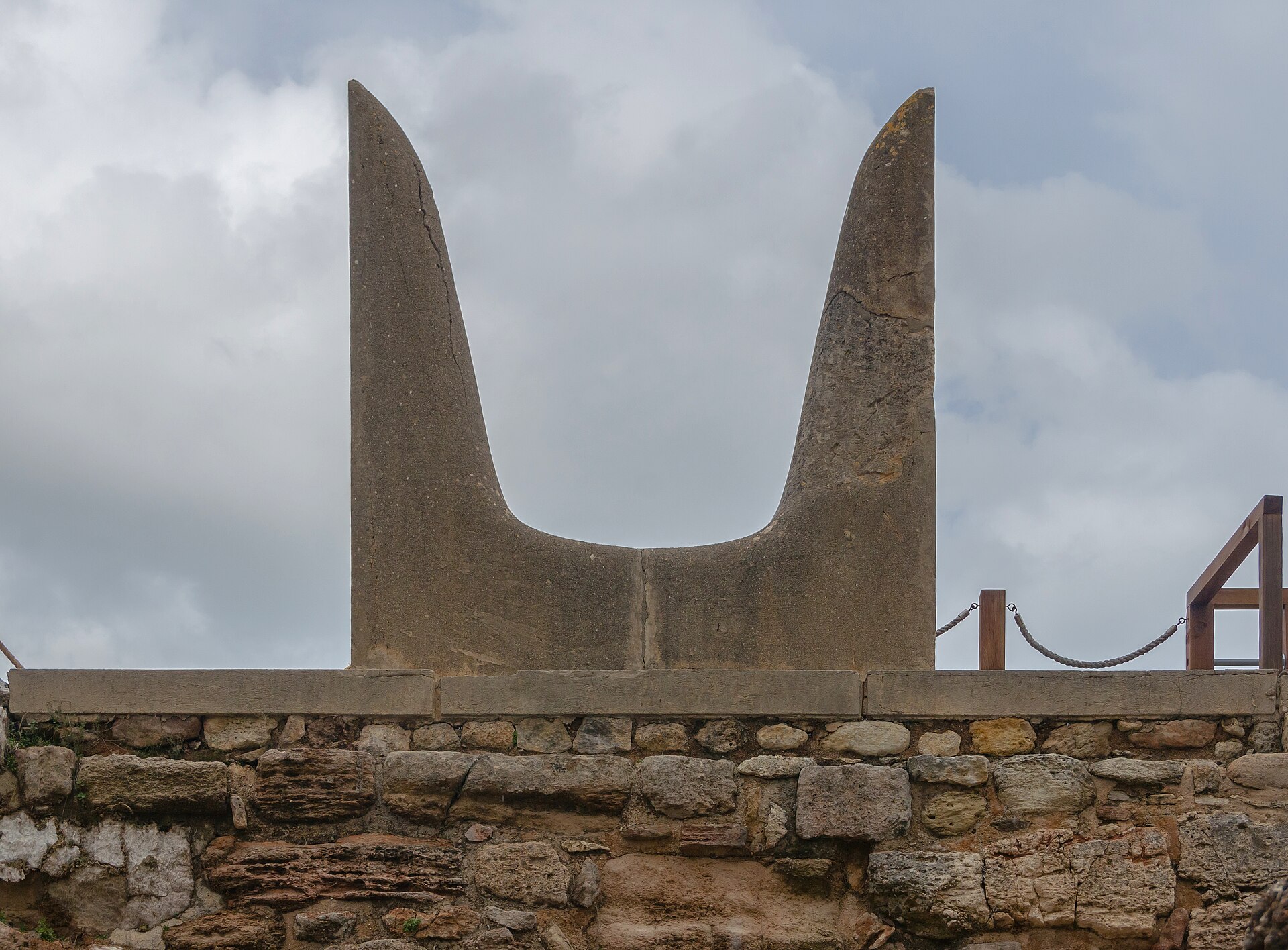
That reverence took solid form in what are called the Horns of Consecration — great stylized bull’s horns, carved in stone, that stood atop shrines and important parts of the palace. To the Minoans these horns were plainly sacred, a religious symbol charged with meaning we can only partly guess at. And when you put it all together — the maze-like palace, the omnipresent bulls, the sacred horns, the bull-leaping athletes — you can practically watch the Minotaur myth assembling itself in the imagination of later peoples. A labyrinthine palace, obsessed with bulls, ruled from a mysterious throne. Fold in the memory of some real practice or tragedy involving bulls, exaggerate it over centuries of retelling, and you get a bull-headed monster in a maze.
I find this one of the most satisfying things in all of archaeology: watching a wild myth resolve into a real place. The Minotaur never existed, of course. But a bull-worshipping civilization, ruling from a palace so complex it seemed a maze, absolutely did. The legend is a kind of distorted memory, a dream that the Greeks dreamed about a lost world they only half understood. And the dream turned out to have a real address: Knossos, on the island of Crete.
Masters of the Sea
Here is something the myth leaves out but the history makes clear: the Minoans were, above all, a people of the sea. Crete sits in the middle of the eastern Mediterranean, and the Minoans turned that position into power. They built ships, they sailed, they traded, and they spread their goods and their influence across the whole region — to the Greek mainland, to the islands of the Aegean, to Egypt, to the coasts of the Near East. Minoan pottery and craft have turned up all over the ancient Mediterranean, the fingerprints of a far-reaching trade network.
This maritime reach is probably the real root of another legend: the so-called thalassocracy, or sea-empire, of King Minos, which later Greek writers described as the first great naval power in their history. Whether the Minoans ruled a true empire or simply dominated trade and the sea lanes, their command of the water made them rich and secure. It may even explain a curious feature of their palaces: for a long time, Knossos and the other Minoan centres seem to have had little in the way of heavy defensive walls. Why fortify your cities when your navy is your wall, and the sea itself protects you? A civilization confident enough in its ships to leave its palaces open is a confident civilization indeed.
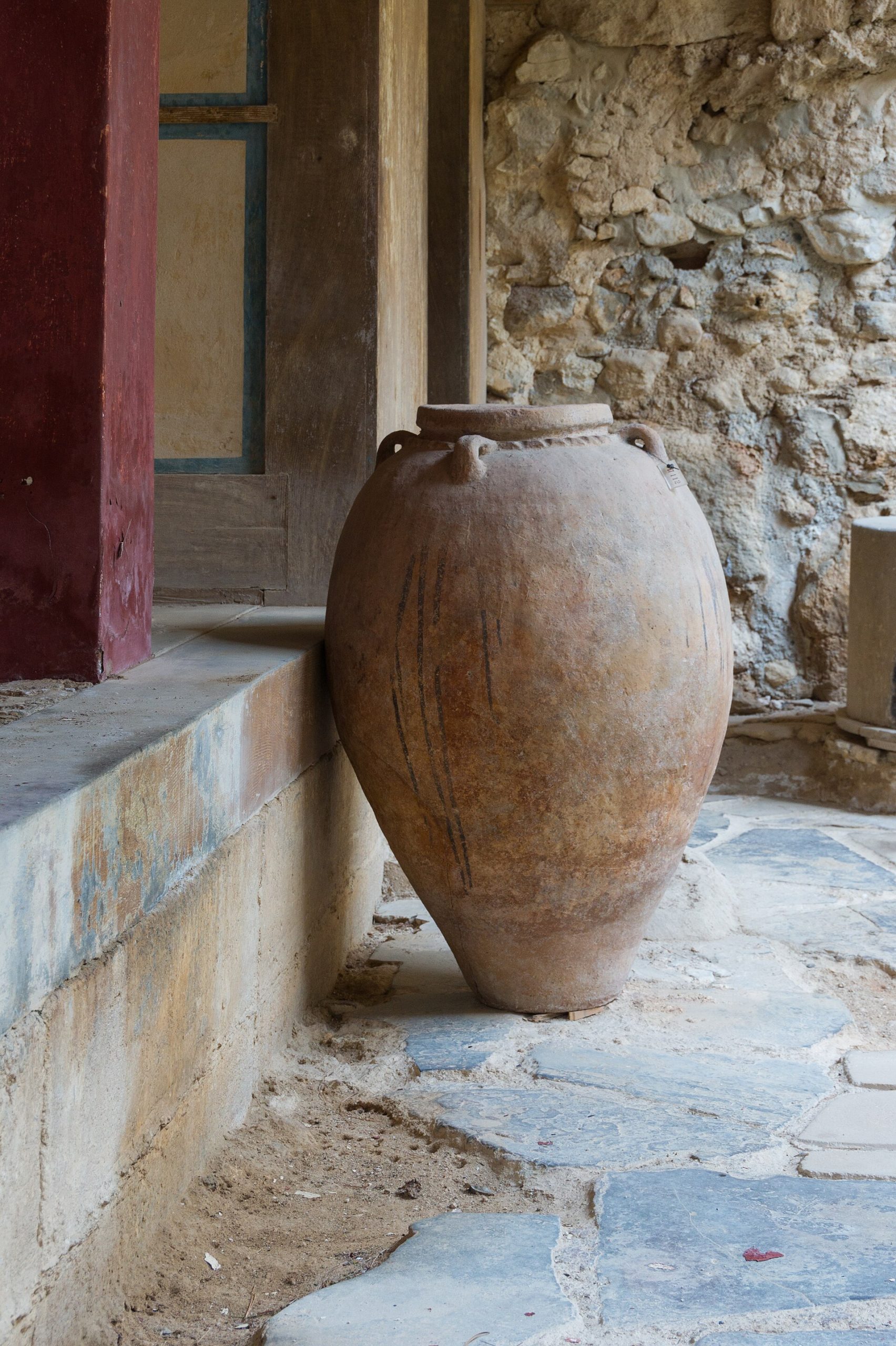
Those enormous storage jars I mentioned, the pithoi that lined the magazines of Knossos, are the quiet evidence of all this. Fill them with olive oil and wine and grain, load that surplus onto ships, and sail it out to trade for the gold, ivory, and luxuries of distant lands. The palace was not just a royal residence. It was a centre of production, storage, and trade — the engine of a maritime economy that made the Minoans the masters of their sea.
Surprisingly Modern Comforts
Of all the things that make me like the Minoans, their plumbing might top the list, and I say that only half in jest. Knossos had a genuinely sophisticated water and drainage system that would not disgrace a much later age. There were terracotta pipes carrying fresh water through the palace. There were channels and drains carrying wastewater away. There were bathrooms. And most famously, in the queen’s quarters, there appears to have been a flushing toilet — a seat set over a drain that could be sluiced clean with water. Four thousand years ago.
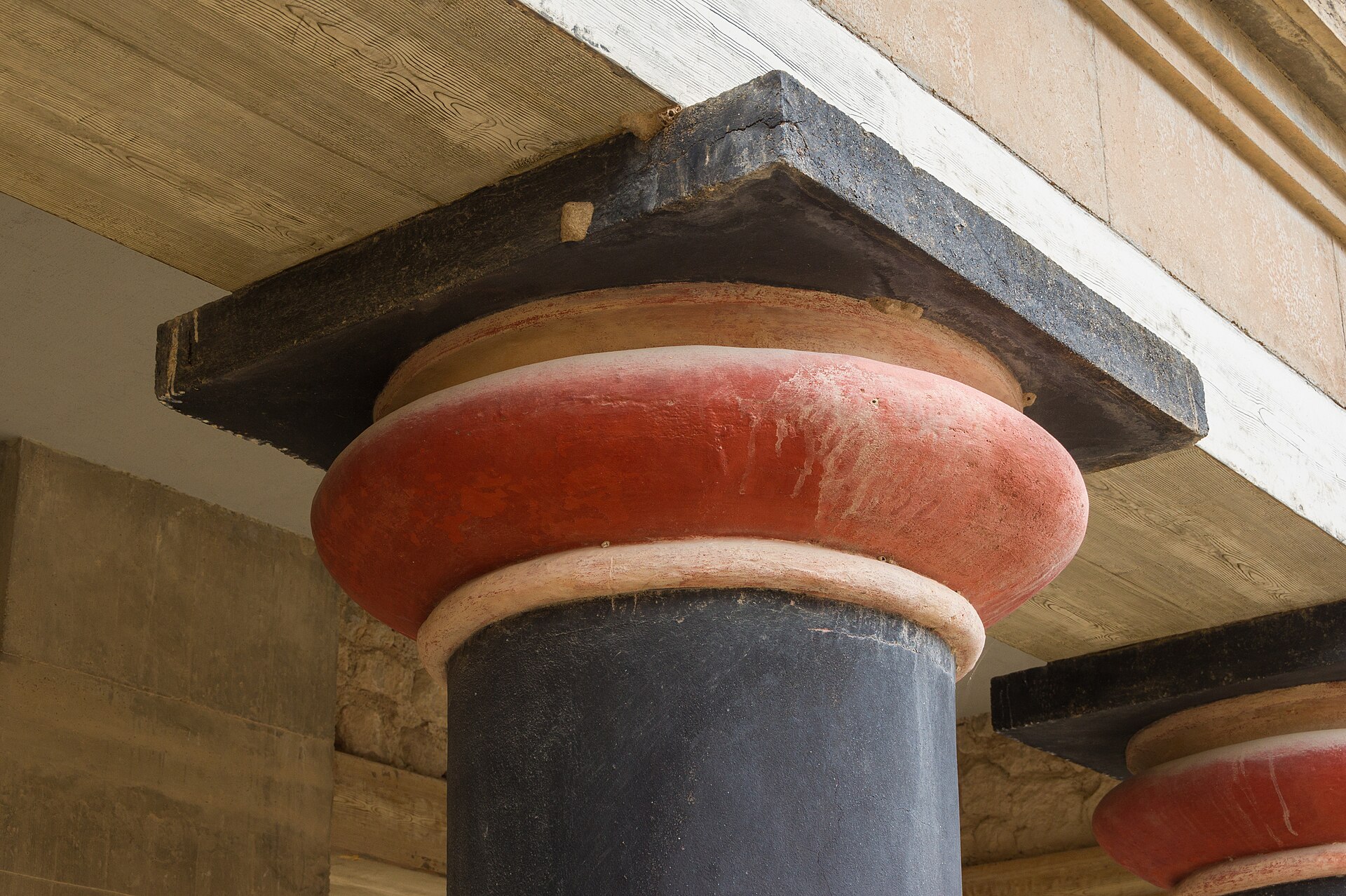
The palace was also cleverly built for comfort in other ways. The Minoans used light-wells — open shafts that brought sunlight and air down into the depths of the multi-storey building — so that even interior rooms were not gloomy and stale. Their distinctive columns, painted red and tapering downward from top to bottom (the opposite of later Greek columns), framed airy porticoes and staircases. The whole design shows a real concern for how it would feel to actually live and move inside the building: for light, for air, for water, for comfort. This was luxury, Bronze Age style.
It is these homely, human details that collapse the distance between us and them. We can admire a pyramid or a temple from afar and feel awe, but a flushing toilet and a well-lit hallway make me feel something warmer — kinship. The Minoans wanted the same things we want from a home: to be clean, to be comfortable, to have light and fresh air and running water. They were not remote god-haunted ancients. They were people who liked a nice bathroom. And somehow that makes their lost world feel closer than all the frescoes and thrones combined.
The Man Who Rebuilt a Myth
We owe our knowledge of Knossos, and much of what we see there today, to one determined and complicated Englishman: Sir Arthur Evans. At the very start of the twentieth century, Evans began excavating the mound at Knossos, and what he uncovered astonished the world — a vast, previously unknown Bronze Age civilization, older than the Greece everyone thought they knew. It was Evans who named the Minoans, after the legendary King Minos, and Evans who brought their painted, labyrinthine world back into the light.
But Evans did something controversial, too, and it is worth being honest about it. Rather than simply excavating and preserving the ruins, he reconstructed large parts of the palace — pouring concrete, raising columns, repainting frescoes — according to his own vision of what Minoan Knossos had looked like. Some of the most iconic sights at the site today, the bold red columns and vivid wall paintings, are as much Arthur Evans as they are ancient Minoan. Purists have criticized this ever since, arguing that he blurred the line between discovery and invention, between the real past and one man’s dream of it.
I have complicated feelings about this, and I suspect you might too. On one hand, Evans’ reconstructions help ordinary visitors actually picture and feel the ancient palace, rather than staring at a confusing field of foundations. On the other, they permanently mixed his guesswork into the fabric of the site, so that we can never again see Knossos with entirely clean eyes. It is a reminder that our picture of the ancient world is always partly a creation of the people who dug it up. When we walk through Knossos, we are walking through a collaboration between the Minoans and a twentieth-century Englishman with a vivid imagination — a myth rebuilt, in more ways than one.
Fire, Waves, and the Fall of the Minoans
So how did Europe’s first civilization come to an end? The story is dramatic, and it involves one of the largest natural catastrophes of the ancient world. Around the middle of the second millennium BCE, on the island of Thera — modern Santorini, not far north of Crete — a colossal volcanic eruption tore the island apart. It was one of the most violent eruptions in human history, and it would have sent ash raining down, darkened skies, and, crucially, hurled tsunamis across the sea toward Crete.
For a civilization built on the sea, on ships and ports and coastal trade, a tsunami would have been devastating. The Minoan fleet, the harbours, the coastal settlements — all terribly vulnerable. Many scholars think the Thera eruption dealt the Minoans a blow they never fully recovered from, wrecking their maritime power and shaking the foundations of their prosperity. It may not have destroyed them overnight, but it seems to have weakened them at exactly the wrong moment.
Into that weakness came others. In the aftermath, the Minoans appear to have fallen increasingly under the influence, and eventually the control, of the Mycenaeans — the warlike Greeks of the mainland, the people who would later be remembered in Homer’s tales of the Trojan War. The palaces suffered destruction by fire, whether from earthquakes, invasion, or unrest. Knossos itself limped on for a while under new masters before finally falling silent. Europe’s first great civilization did not vanish in a single instant, but through a grinding combination of natural catastrophe and the rise of tougher, more militarized neighbours.
And yet, as always, the ending is not the whole story. The Minoans did not simply disappear. Their art, their writing, their religion, and their ways flowed into Mycenaean Greek culture, and through it, into the Greek civilization that would one day light up the classical world. The Greeks who told the tale of the Minotaur were, in a sense, the cultural descendants of the very people whose palace inspired it. The Minoans live on, quietly, in the DNA of Western civilization itself.
Why Knossos Matters
When I stand back and ask why Knossos holds such a grip on us, I think it comes down to the way it sits at the exact meeting point of myth and history. Most ancient sites give us either dry facts or empty legends. Knossos gives us both at once, fused together. Here is the real palace behind the Labyrinth, the real bulls behind the Minotaur, the real throne behind the myth of King Minos. To walk through Knossos is to watch a fairy tale turn solid under your feet, and there is nothing else in archaeology quite like that feeling.
But beyond the myth, Knossos matters because it shows us that Europe’s story of civilization begins earlier, and more beautifully, than we usually imagine. Before the philosophers and the marble temples, before democracy and drama, there were the Minoans — painting dolphins on their walls, sailing their ships across a bright sea, enjoying their running water and their sunlit halls, leaping over bulls in some ritual we will never fully understand. They were sophisticated, artistic, comfortable, and outward-looking, and they were the first Europeans to build a world like that. Everything that came after owes them a quiet debt.
And they leave us, as the best ancient places always do, with a mystery we cannot quite solve. We cannot read their oldest writing. We do not know exactly who sat on their throne. We cannot be sure what happened in their bull rituals or their labyrinthine shrines. They dance just beyond our understanding, painted and vivid and forever slightly out of reach. Perhaps that is why the myth grew up around them in the first place. Some places are simply too beautiful and too strange to be remembered as mere history. They have to become legend. Knossos is one of those places.
The Riddle of Linear A
I want to return, before we finish, to one of the most tantalizing puzzles the Minoans left behind, because it is a mystery that professional codebreakers are still wrestling with today. The Minoans wrote. On clay tablets and seals, they left behind a script we call Linear A, a system of signs used to keep records across their palaces. And despite more than a century of effort by brilliant minds, Linear A has never been convincingly deciphered. We can see the writing. We cannot read it.
What makes this especially frustrating — and fascinating — is that its successor was cracked. A later script called Linear B, used by the Mycenaean Greeks who took over Crete, was famously deciphered in the 1950s by an architect named Michael Ventris, who showed that it recorded an early form of Greek. That triumph let us read the Mycenaean palace records, their lists of goods and workers and offerings. But Linear A, the older Minoan script, uses many of the same signs to write a different, unknown language, and applying the sounds of Linear B to it produces nothing anyone can understand. The Minoan tongue remains locked away.
This is why we still cannot say, with certainty, who the Minoans really were, what they called their gods, or what stories they told about themselves. Their business records sit in museum cases, legible as shapes but silent as speech. It is a strange kind of intimacy and distance combined: we have their handwriting, and we cannot read a word of it. Somewhere in those undeciphered tablets may lie the Minoans’ own account of their kings, their rituals, perhaps even the truth behind the bulls and the labyrinth. For now, they keep their secret. And in a way, that unread script is the perfect emblem of Knossos itself — a place forever poised between what we know and what we can only imagine.
The Palace at the Edge of Legend
The next time you hear the old story of Theseus walking into the Labyrinth to face the Minotaur, I hope a second image rises behind it: a sunlit palace on a Cretan hillside, its red columns glowing, its walls alive with leaping dolphins and charging bulls, the sea glittering beyond, and somewhere in its maze of painted halls, the oldest throne in Europe waiting quietly in the dark. That is Knossos. The monster was never real. But the wonder absolutely was.
If Knossos has kindled that particular hunger — the longing to stand in the places where our ancestors first built something to outlast themselves — there are plenty more waiting for you. You could journey to the very dawn of monumental building at Göbekli Tepe in Turkey and its sister site Karahan Tepe, or step into the oldest cities on Earth at Jericho, Uruk in ancient Sumer, and the doorway-less warren of Çatalhöyük. If great stone monuments are your thing, there is Stonehenge, the solstice tomb of Newgrange, and the temples of Malta that predate the pyramids. Or travel further afield to the drowned water-city of Liangzhu in China, the immaculate streets of Mohenjo-daro, the stone houses of Skara Brae in Orkney, the pyramids of Caral in Peru, and the painted caves of Lascaux and Chauvet, where human art itself begins. And out in the salt deserts of India, you can discover Dholavira, the Indus city that beat the desert with water engineering.
You can also keep wandering these ancient paths through our Ancient Greece and Archaeology tags. It pairs well with Nan Madol, the astonishing reef-built city of the western Pacific. For something stranger still, meet Chavin de Huantar and its fanged god carved in stone. For a very different kind of early town, meet Cucuteni-Trypillia and its wheel-shaped cities. For something starker still, meet Cerro Sechin and its wall of carved warriors. For a monument that rewrites the rules, meet Poverty Point and its concentric earthen ridges. If unexpected places intrigue you, do not miss Sarazm, the ancient proto-city on a river plain in Tajikistan. The roots of settled life reach right back to Mehrgarh, the ancient village that seeded the Indus civilization. The question of where urban life truly began leads straight to Tell Brak, ancient Nagar. If early farming fascinates you, take a detour to Aşıklı Höyük, one of Anatolia’s oldest villages. If early creativity fascinates you, take a detour to Jiahu, home of the world’s oldest playable instruments. If you love monuments to the heavens, take a detour to Chankillo, the oldest solar observatory in the Americas. The story continues at Kalibangan, an Indus town rebuilt after what may be history’s earliest recorded earthquake. The story continues at the Cairn of Barnenez, a 75-metre Neolithic cairn on the Breton coast. The story reaches the Danube at Vinča, home to thousands of enigmatic clay figurines. The story reaches Brittany again at Gavrinis, sometimes called the Sistine Chapel of megalithic art. See also Los Millares, whose walls, bastions, and vast necropolis rose over five thousand years ago. You might also wander over to Bougon, one of the oldest surviving pieces of architecture anywhere on Earth. If standing stones speak to you, wander over to Almendres, a hillside of ancient granite near Évora. If giant stones fascinate you, step into Ġgantija, Malta’s colossal Neolithic temple complex. If carved stones fascinate you, step into Knowth, home to Europe’s richest megalithic art. If prehistoric art fascinates you, step into Tarxien, the richest of Malta’s Neolithic temple complexes. If ancient astronomy fascinates you, step into Mnajdra, Malta’s solar temple by the Mediterranean. You might also wander to Ħaġar Qim, where Neolithic builders raised twenty-tonne stones above the sea. You might also wander to Dowth, where a five-thousand-year-old mound still guards its dark chambers. You might also explore Carnac, where Neolithic farmers raised more than three thousand menhirs across the fields. You might also wander to Callanish, where thirteen ancient stones ring a towering monolith. You might also wander to Filitosa, whose carved menhirs bear faces, swords, and daggers. You might also sail your imagination to Ale’s Stones, a 67-metre ship of stone above the Baltic.
You May Like
The Bardo, a Palace of the Beys Filled With Roman Mosaics


3 thoughts on “Knossos: The 4,000-Year-Old Palace Behind the Myth of the Minotaur”